
The Roman Temple of Évora is a temple of the 1st century AD on Largo Conde de Vila Flor, in the centre of Évora, on the site of the forum of the Roman town of Ebora Liberalitas Julia. It was long called the Temple of Diana, a name that goes back to a theory of the Jesuit Manuel Fialho in the 17th century, but it was probably dedicated to the cult of the emperor Augustus.
The temple is a National Monument since 1907 and part of the Historic Centre of Évora, a UNESCO World Heritage site.

What to see at the Roman Temple of Évora
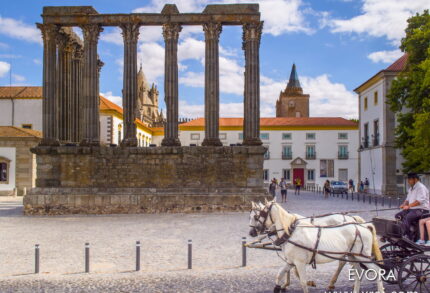
- Podium: a base of large granite blocks, about 3.5 metres high, almost intact.
- Columns: fourteen Corinthian columns with granite shafts, and bases and capitals of white Estremoz marble.
- Plan: the original rectangular plan of the temple, which remains despite later changes.
- Forum setting: excavations in the 20th century found traces of a portico and a pool of water around the temple.
History of the Roman Temple of Évora
- 1st century AD: the temple is built on the forum of the Roman town.
- Middle Ages: the temple is enclosed by later walls and buildings, which protect the columns.
- 17th century: the Jesuit Manuel Fialho puts forward the theory that the temple was dedicated to Diana.
- 1860s: the later masonry around the temple is removed, and the monument is restored under the architect Giuseppe Cinatti.
- 10 January 1907: the temple is classified as a National Monument.
- 1986: the temple is included in the UNESCO World Heritage site of the Historic Centre of Évora.
Visiting the Roman Temple of Évora
- Access: the temple stands in an open square and can be seen at any time.
- Nearby: the Museu de Évora, the Lóios convent and Évora Cathedral are around the same square.
Places to visit in Évora
Évora, Portugal
Historic Centre of Évora
Historic Centre of Évora
You're reading Roman Temple of Évora article
Roman Temple of Évora
Évora Cathedral
Évora Cathedral
Chapel of Bones
Chapel of Bones
Água de Prata Aqueduct
Água de Prata Aqueduct
Almendres Cromlech
Almendres Cromlech
History of Évora
History of Évora
Visiting Évora