
The Historic Centre of Évora is a UNESCO World Heritage site inside the walls of the city of Évora, inscribed in 1986 under criteria (ii) and (iv). UNESCO describes the city as the finest example of a city of the golden age of Portugal, with a Roman temple, Moorish fortifications, and churches and palaces built after the 15th century, when Évora became a residence of the Portuguese kings.
The whitewashed houses of the 16th to 18th centuries, with tiles and wrought-iron balconies, are a typical feature of the old town, and its monuments inspired Portuguese colonial architecture in Brazil.
Monuments in the Historic Centre of Évora
- Roman Temple: a temple of the 1st century AD on the site of the Roman forum, probably dedicated to the cult of the emperor Augustus.
- Évora Cathedral: a granite cathedral begun in 1186 and completed in 1250, on the highest point of the city.
- Chapel of Bones: a chapel of the Church of São Francisco lined with human bones and skulls by Franciscan friars in the 17th century.
- Água de Prata Aqueduct: a 16th-century aqueduct of about 18 kilometres that still carries water into the city.
- Praça do Giraldo: the main square of the old town, with its marble fountain.
- University of Évora: the Jesuit college founded in 1559, the second university founded in Portugal.
- Palaces and convents: the Lóios convent, the Cadaval palace, the Church of Graça and the palaces of the nobility who followed the court to Évora in the 15th and 16th centuries.
- Walls: the medieval walls that still enclose much of the old town, with gates such as the Porta de Alconchel and the Porta da Lagoa.
History of the Historic Centre of Évora
- 1st century AD: the Roman town builds its forum and temple on the hilltop.
- 1165: Geraldo Sem Pavor takes Évora for the Portuguese crown.
- 1186 to 1250: the cathedral is built.
- 15th and 16th centuries: the kings spend long periods in Évora, and palaces, convents and colleges are built.
- 1531 to 1537: the Água de Prata Aqueduct is built.
- 1559: the university is founded.
- 1986: UNESCO inscribes the Historic Centre of Évora on the World Heritage List.
Visiting the Historic Centre of Évora
- On foot: the old town is compact, and the main monuments are a short walk from Praça do Giraldo.
- Nearby: the Almendres Cromlech, a Neolithic stone circle, lies in the countryside west of the city.
Places to visit in Évora
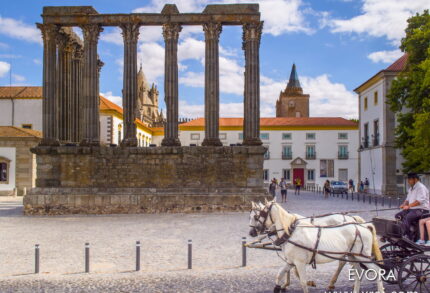
Évora, Portugal
You're reading Historic Centre of Évora article
Historic Centre of Évora
Roman Temple of Évora
Roman Temple of Évora
Évora Cathedral
Évora Cathedral
Chapel of Bones
Chapel of Bones
Água de Prata Aqueduct
Água de Prata Aqueduct
Almendres Cromlech
Almendres Cromlech
History of Évora
History of Évora
Visiting Évora