
The history of Évora runs from Neolithic stone circles on the surrounding plain to the Roman town of Ebora Liberalitas Julia, a Muslim city, a royal residence of the 15th and 16th centuries, and a university city. UNESCO inscribed the Historic Centre of Évora as World Heritage in 1986.
This page lists the main dates in the history of Évora and the people linked to the city.
Timeline of Évora
- 6th to 3rd millennium BC: Neolithic communities raise the Almendres Cromlech west of the future city.
- 1st century AD: the Roman town of Ebora Liberalitas Julia builds its forum and the Roman Temple.
- Muslim period: the city is ruled by Muslim powers for more than four centuries.
- 1165: Geraldo Sem Pavor, known as Gerald the Fearless, takes Évora for King Afonso Henriques.
- 1166: Évora receives its first charter.
- 1186 to 1250: Évora Cathedral is built.
- 15th and 16th centuries: the kings of Portugal spend long periods in Évora, and noble families build palaces in the city.
- 28 March 1537: the Água de Prata Aqueduct opens.
- 1559: Cardinal Henrique founds the university, entrusted to the Jesuits, the second university in Portugal after Coimbra.
- 17th century: Franciscan friars build the Chapel of Bones.
- 1979: the University of Évora takes its present name.
- 1986: UNESCO inscribes the Historic Centre of Évora on the World Heritage List.
People linked to Évora
- Geraldo Sem Pavor: the knight who took Évora in 1165, remembered in the name of Praça do Giraldo.
- King João III: the king in whose reign the aqueduct and the Church of Graça were built.
- Cardinal Henrique: the archbishop of Évora, later king, who founded the university in 1559.
- Francisco de Arruda: the royal architect who built the Água de Prata Aqueduct.
- Artists and scholars of the 16th century: the poet Garcia de Resende, the sculptor Nicolau Chanterene, the painters Frei Carlos and Gregório Lopes, and the humanists André de Resende and Francisco de Holanda lived or worked in the city.
Places to visit in Évora
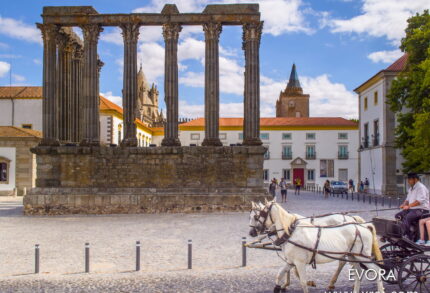
Évora, Portugal
Historic Centre of Évora
Historic Centre of Évora
Roman Temple of Évora
Roman Temple of Évora
Évora Cathedral
Évora Cathedral
Chapel of Bones
Chapel of Bones
Água de Prata Aqueduct
Água de Prata Aqueduct
Almendres Cromlech
Almendres Cromlech
You're reading History of Évora article
History of Évora
Visiting Évora