
The Água de Prata Aqueduct is a 16th-century aqueduct that carries water about 18 kilometres from springs at Graça do Divor into the centre of Évora, built from 1531 and opened on 28 March 1537. The royal architect Francisco de Arruda directed the work for King João III, probably over the line of a Roman aqueduct.
The aqueduct is a National Monument since 1910 and part of the Historic Centre of Évora, a UNESCO World Heritage site. It is one of the few aqueducts of its time still in use.
What to see at the Água de Prata Aqueduct
- Arches in the city: in the north-west of the old town, the arches enter the city, and houses have been built into them.
- Water box of Rua Nova: a Renaissance water box by Francisco de Arruda, with twelve Tuscan columns, on the spot where the aqueduct cut through the old walls.
- Fountains: public fountains along the route through the old town, fed by the aqueduct.
- Countryside route: a walking and cycling path that follows the aqueduct for about 8 kilometres through farmland and cork oak woods.
History of the Água de Prata Aqueduct
- 1531: construction begins during a stay of the court of King João III in Évora, paid for largely by the local nobility.
- 28 March 1537: the aqueduct is opened, with a fountain in Praça do Giraldo.
- 1873: the Renaissance end structure near the Church of São Francisco is demolished.
- 1910: the aqueduct is classified as a National Monument.
Visiting the Água de Prata Aqueduct
- In the city: the arches can be followed from the Porta da Lagoa into the old town, along Rua do Cano.
- In the countryside: the path along the aqueduct starts outside the Porta da Lagoa.
Places to visit in Évora
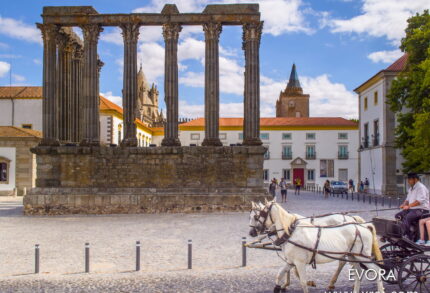
Évora, Portugal
Historic Centre of Évora
Historic Centre of Évora
Roman Temple of Évora
Roman Temple of Évora
Évora Cathedral
Évora Cathedral
Chapel of Bones
Chapel of Bones
You're reading Água de Prata Aqueduct article
Água de Prata Aqueduct
Almendres Cromlech
Almendres Cromlech
History of Évora
History of Évora
Visiting Évora