
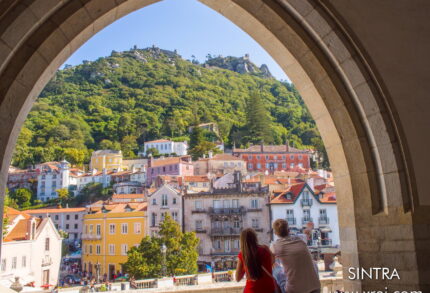
Sintra is a town in the Lisbon district, about 24 kilometres north-west of central Lisbon in a straight line, at the foot of the Sintra hills. Most visitors come for the palaces and parks of the Cultural Landscape of Sintra, which start in the historic centre and continue up into the hills.
This page covers how to reach Sintra, how to move between the monuments, and the food and wine of the area.

Getting to Sintra
- By train: trains on the Sintra line leave Lisbon from Rossio, Entrecampos and Oriente stations and end at Sintra station, on the edge of the town.
- By road: the IC19 comes from Lisbon, the IC30 from Mafra, and the EN9 from Cascais by way of the A5.
- Parking: traffic in the historic centre is limited to residents, so visitors leave their cars in the car parks around the town and continue on foot or by bus.
Getting around Sintra
- On foot: the walk from Sintra station to the National Palace of Sintra takes 10 to 15 minutes.
- Walking trails: Parques de Sintra marks trails into the hills. The Santa Maria Trail starts in São Pedro de Sintra and is 1,770 metres long, and the Seteais Trail starts at the Palace of Seteais and is 2,410 metres long.
- By bus: buses run from Sintra station and the historic centre up to Pena Palace and the Moorish Castle, where the access road is closed to private cars.
- Sintra tram: a historic tram runs for about 11 kilometres from the Estefânia area of Sintra to Praia das Maçãs, in about 45 minutes. The line opened in 1904 and reached Azenhas do Mar in 1930.
Food in Sintra
- Travesseiros: puff pastry filled with an egg and almond cream. The Piriquita bakery, founded in 1862 by Amaro dos Santos and Constância Gomes in the historic centre, created the travesseiro in the 1940s and keeps the recipe in the family.
- Queijadas: small tarts of fresh cheese, eggs and cinnamon in a thin crust. Historians date their production on a larger scale to 1756, with Maria Sapa in Ranholas, near São Pedro de Sintra.

Wine in Sintra
- Colares wine region: the region was demarcated on 18 September 1908 and covers the parishes of Colares, São Martinho and São João das Lampas, between the Sintra hills and the Atlantic.
- Grapes: Ramisco is the main red grape and Malvasia de Colares the main white grape.
- Vines in sand: the vines grow in sandy soil where the phylloxera insect cannot survive, so the region kept its ungrafted vines when phylloxera destroyed vineyards across Europe in the 19th century.
- Adega Regional de Colares: the cooperative winery of the region, founded in 1931 to guarantee the origin and quality of Colares wine.
Beaches in Sintra
Adraga beach
- LocationSintra
- Beach typeOcean beach
Grande Sul beach
- LocationSintra
- Beach typeOcean beach
Grande Norte beach
- LocationSintra
- Beach typeOcean beach
Maçãs beach
- LocationSintra
- Beach typeOcean beach
Azenhas do Mar beach
- LocationSintra
- Beach typeOcean beach
Magoito beach
- LocationSintra
- Beach typeOcean beach
S. Julião beach
- LocationSintra
- Beach typeOcean beach
Golf in Sintra
Belas Clube de Campo Golf Course
- LocationBelas Clube de Campo
- Course classChampionship
- Holes18
- Par72
- Length6 112 m
6 684 yd
Lisbon Sports Club
- LocationBelas
- Course classChampionship
- Holes18
- Par69
- Length5 309 m
5 806 yd
Quinta da Beloura Golf Course
- LocationQuinta da Beloura
- Course classChampionship
- Holes18
- Par72
- Length5 716 m
6 251 yd
Estoril-Sol Golf Course
- LocationSintra (Santa Maria e São Miguel, São Martinho e São Pedro de Penaferrim)
- Course class9 hole
- Holes9
- Par31
- Length1 860 m
2 034 yd
Penha Longa Mosteiro Golf Course
- LocationPenha Longa
- Course class9 hole
- Holes9
- Par35
- Length2 588 m
2 830 yd
Guides to Sintra
Sintra, Portugal
History of Sintra
History of Sintra
You're reading Visiting Sintra article
Visiting Sintra
Cultural Landscape of Sintra
Cultural Landscape of Sintra
Pena Palace
Pena Palace
Moorish Castle
Moorish Castle
Quinta da Regaleira
Quinta da Regaleira
National Palace of Sintra
National Palace of Sintra
Monserrate Palace
Monserrate Palace
Capuchos Convent
Capuchos Convent

Queluz National Palace
Cabo da Roca