Évora, Portugal

Évora, Portugal

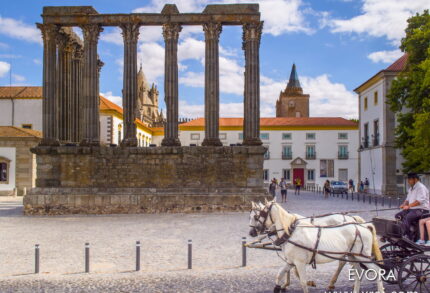
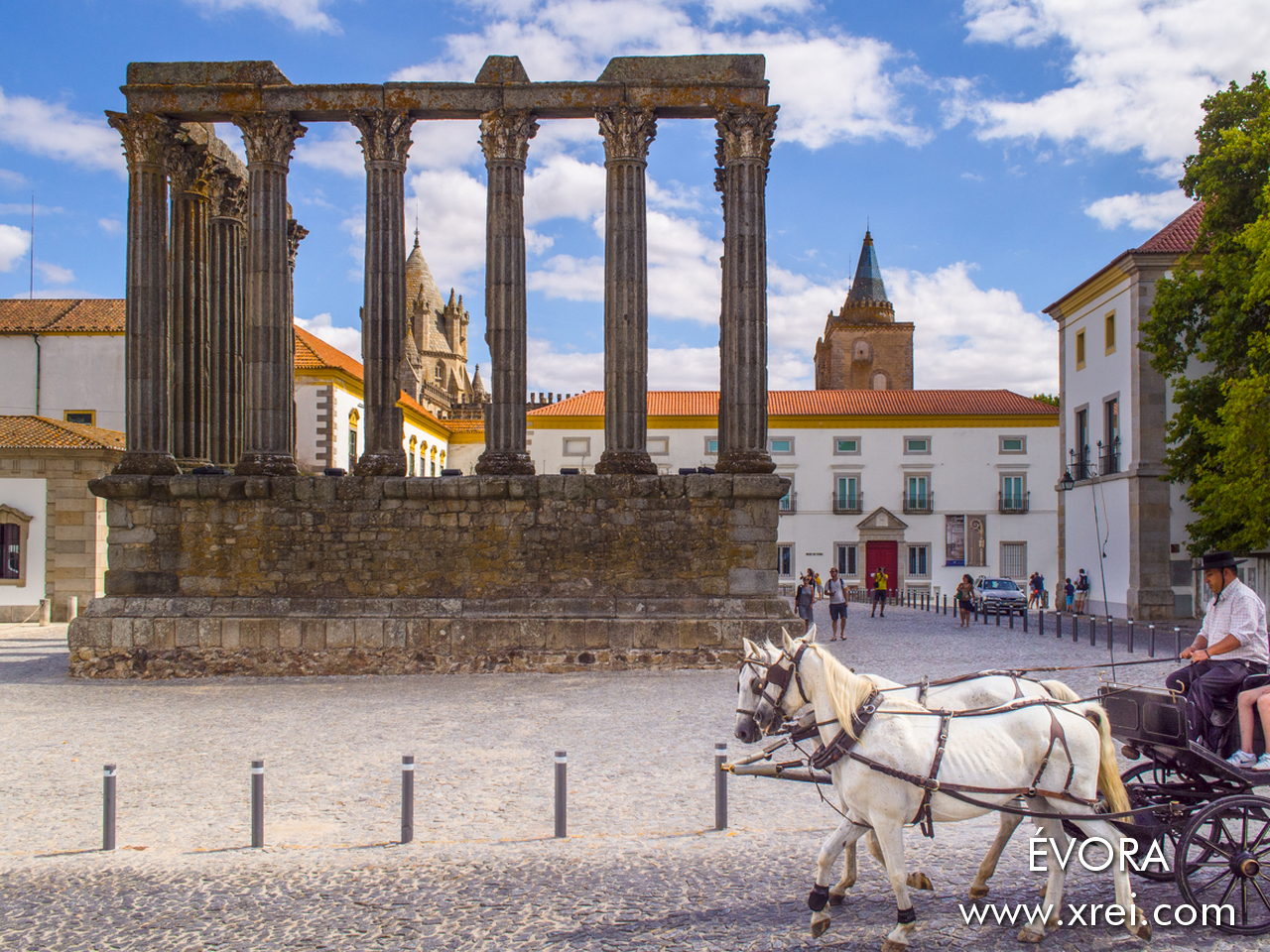
Roman Temple in Évora, in Largo do Conde de Vila Flor

Évora

Évora is an ancient Portuguese city situated in the Centre region, with one of the richest historic centres in Portugal in terms of monuments. The city of Évora has been called the Museum-City owing to its historic centre, classified as a World Heritage Site by UNESCO in 1986. Évora has a history of more than five millennia, with Neolithic settlements such as Castelo de Giraldo — continuously inhabited from the 3rd millennium to the 1st millennium BC — and megalithic monuments that can be visited today, such as the Anta do Zambujeiro and the Cromeleque dos Almendres. The medieval city of Évora is enclosed by the cerca medieval de Évora — 14th-century walls approximately 2,000 metres long, covering an area of 100,000 square metres, with Roman defensive towers from the 2nd or 3rd century.

Places to visit in the centre of Évora (top 25)

1. Historic Centre of Évora

Historic Centre of Évora: classified as a UNESCO World Heritage Site since 1986, it comprises the city enclosed within the cerca medieval de Évora. Inside the walls of the cerca medieval de Évora we find a city defined by labyrinthine streets between historic buildings, well-maintained traditional Alentejo single-storey houses painted with coloured yellow and grey bands, balconies with decorative wrought-iron railings, tiled roofs and narrow streets paved with natural stone, where monuments abound. Praça do Giraldo marks the centre of the old city, with several restaurants, retail shops, the Igreja de Santo Antão, the Évora tourist office and the Chafariz da Praça do Giraldo — a white marble fountain, classified as a National Monument, marking the centre of the old city of Évora in Praça do Giraldo. The fountain is decorated with eight spouts symbolising the eight streets that connect to Praça do Giraldo. The historic city centre also features the Capela dos Ossos, the Convento dos Lóios, the Igreja de São Francisco, the Palácio de Dom Manuel, the Sé Catedral de Évora, the Templo Romano de Évora (known as the Temple of Diana), the Universidade de Évora, traditional restaurants and shops and much more.

2. Templo Romano de Évora

Templo Romano de Évora: also erroneously known as the Temple of Diana, this is a 1st-century Roman temple that remains from the forum of the city of Évora. Strikingly imposing in the city centre and built over two centuries, it is located in Largo Conde de Vila Flor and is the most visited monument in the historic centre of Évora. The Templo Romano de Évora is inscribed on the UNESCO World Heritage List and classified as a National Monument. During the “barbarian” invasions of the 5th century the temple was destroyed; in the 14th century it served as a slaughterhouse and stronghold for the Évora castle, and was remodelled in the 19th century. What remains of the Templo Romano de Évora is the 4-metre-high granite ashlar podium, part of the colonnade with 14 columns — 12 of them complete — in white Estremoz marble, and traces of the staircase. Recent excavations have revealed that the temple was originally surrounded by a monumental portico and a reflecting pool. The Templo Romano de Évora was long considered a dedication to Diana, daughter of Jupiter in the Roman Empire; however, it is now more widely accepted that the Évora temple is a dedication to the imperial cult of Augustus.

3. Chapel of Bones

Chapel of Bones: a striking chapel with walls and pillars lined with thousands of bones and skulls, and mummies displayed in glass cases, from the burial grounds associated with the convent. The Chapel of Bones is located within the Igreja de São Francisco, built in the 17th century with the intention of prompting reflection on the transience of human life and the consequent commitment to a permanent Christian way of living. The chapel ceilings are decorated with illustrations of biblical passages and instruments of the Passion of Christ, dated to 1810. A visit to the chapel is an experience of many sensations — the unusual feeling of being surrounded by so many bones is simultaneously unsettling and intensely interesting. The message at the entrance alludes to the thought: “We bones that are here await yours.”

4. Sé Catedral de Évora

Sé Catedral de Évora: also known as the Basílica Sé de Nossa Senhora da Assunção, this is a Romanesque and Gothic cathedral classified as a National Monument, situated at the highest point of the city of Évora. The cathedral was built in granite during the 12th and 13th centuries and was awarded the title of Minor Basilica by Pope Pius XI in 1930. The imposing exterior of the cathedral is notable for its façade, bell tower, portico with atlante figures of the Apostles and lantern tower — the cathedral’s defining feature, visible as the highest point in the entire city of Évora. The interior is equally imposing, with naves 80 metres long, marble statues, a pipe organ, chapels, a marble high altar and chancel, and richly ornamented cloisters. In the Museu de Arte Sacra, located in the former Colégio dos Moços do Coro da Sé in the cathedral building, several pieces of sacred art can be seen, including collections of goldsmithery, vestments, painting and sculpture, as well as an ivory triptych depicting the life of “Nossa Senhora do Paraíso” in nine episodes. The panoramic view from the top of the cathedral over the city and surroundings is magnificent, conveying the full extent of Évora, its boundaries and the fields on the horizon.

5. Igreja de São Francisco

Igreja de São Francisco: a 16th-century Manueline church classified as a National Monument. The original church is believed to have been founded in the 13th century, was remodelled from the late 15th century through the 16th century, and became known as the Convento do Ouro during the 16th century before being entrusted to the Third Order of the Penitence of Saint Francis. Today the church is one of the most visited attractions in Évora owing to its grandeur and history, and for housing the Chapel of Bones and the Museological Nucleus created in the former friars’ dormitory — a collection of paintings, sacred goldsmithery and sculptures from the 16th to 18th centuries from the suppressed Franciscan convents of Évora.

6. Aqueduto da Água de Prata

Aqueduto da Água de Prata: one of the few 16th-century aqueducts still in operation. Built on the orders of King Dom João III, it is classified as a National Monument, forms an integral part of the Historic Centre of Évora included on the UNESCO World Heritage List, and is part of the biennial World Monuments Watch list. The Aqueduto da Água de Prata extends 18 km and was built with the aim of supplying the city of Évora with water from the springs on the lands of the Convento São Bento de Castris, in the parish of Graça do Divor. Along its 18 km, the aqueduct passes through woodland, cork oak groves and cultivated fields before entering the city of Évora, creating landscapes of unique beauty in harmony with the natural environment and within the city itself, where houses have been built into the arches of the aqueduct. It is an excellent attraction to photograph along a walk of several kilometres.

7. Jardim Público de Évora

Jardim Público de Évora: a 19th-century Romantic-style garden (1866) included within the city’s historic centre, covering 33,000 m² in the southern part of the city of Évora. Here visitors find large trees, swans, ducks and peacocks, a kiosk, shaded areas, garden benches, picnic tables, a children’s playground, water fountains and historic buildings, notably the Ruínas Fingídas. The garden is bounded by a long stretch of the former Fernandine wall. It can be accessed from Rua da República, Largo de São Francisco and Rua do Raimundo. The Ruínas Fingídas are a Gothic monument — a recreation of false ruins of an imaginary two-storey palace, originally created as a promenade feature for the Jardim Público de Évora by architect José Cinatti. The Ruínas Fingídas feature Moorish windows, Manueline shutters and columns, originating from the remains of a medieval tower repurposed from ruined or previously demolished architectural structures of the Palácio de Vimioso beside the Sé Catedral de Évora — the former residence of the Bishop of Évora, Dom Afonso de Portugal. The Ruínas Fingídas include a staircase giving access to the tower, from which the viewpoint over the Jardim Público de Évora can be reached.

8. Museu do Relógio — Évora Branch

Museu do Relógio — Évora Branch: an extension of the Museu do Relógio de Serpa, a museum with a collection of 2,500 mechanical clocks dated from 1630 to the present day. The Évora branch of the Museu do Relógio holds a collection of 500 clocks and is located in the Palácio do Barrocal in the city centre of Évora. The Museu do Relógio is recognised as the only privately run self-sustaining museum in Portugal. It offers a clock restoration service to the public through its Master Clockmakers in its restoration workshop. The Museu do Relógio also designs and produces mechanical clocks under the “Museu do Relógio” brand in partnership with German and Russian manufacturers.

9. Igreja da Graça

Igreja da Graça: also known as the Convento de Nossa Senhora da Graça, this is an early 16th-century Renaissance church classified as a National Monument. The church is situated in the historic city centre of Évora. Its spectacular façades feature the atlante figures of the “Meninos da Graça”. Since the suppression of religious orders in Portugal in 1834, the Igreja da Graça was nationalised and converted into a military barracks, which remains its current use.

10. Museu de Évora

Museu de Évora: also known as the Museu Nacional Frei Manuel do Cenáculo, this is a museum with a collection of 20,000 pieces ranging from archaeology, painting and sculpture to goldsmithery and other themes. Here visitors can find the “Políptico da Sé de Évora” — a work comprising 13 oil paintings dated between 1495 and 1510, considered one of the foremost examples of Flemish art in Portugal. The Museu de Évora is situated in the city centre of Évora, in the former episcopal palace, facing the Templo Romano de Évora.

11. Mosteiro de Santa Maria Scala Coeli

Mosteiro de Santa Maria Scala Coeli: known as the Convento da Cartuxa, this is a 16th-century monastery of notable architectural richness, comprising the largest cloister in Portugal at 98 metres, a marble portico and façade, and a gilded woodwork altarpiece, classified as a National Monument. The monastery has been a place of habitation and prayer for monks since 1598. In 1834 the monks were expelled following the suppression of religious orders, and the monastery was converted by the Portuguese state into an agricultural school, with the church used as a granary. In 1871 the ruined Mosteiro da Cartuxa was purchased by the Eugénio de Almeida family. Over time it was restored, and in 1960 the monks were invited by the founder of the Fundação Eugénio de Almeida to return, and the Mosteiro de Santa Maria Scala Coeli — Convento da Cartuxa — once again became a place of prayer and contemplation in Évora. The Convento da Cartuxa is situated 1 km north of the Portas da Lagoa, facing the Aqueduto da Água de Prata, beside the Quinta de Valbom and the Adega da Cartuxa — a winery with a tradition in school and university education since the 16th century, producing wine and olive oil, where wines of internationally recognised excellence are now produced, including Vinea Cartuxa, EA, Foral de Évora, Cartuxa, Scala Coeli and Pêra-Manca.

12. Alentejo Wine Route

Alentejo Wine Route: the Tasting Room is a wine tasting space located at Rua 5 de Outubro, no. 88, beside the Museu de Évora in the city centre of Évora. Évora is fully integrated into the Alentejo Wine Route — a tourist circuit map with points of interest related to wine cellar visits, the history of Alentejo wines, and useful information on wine production in Portugal.

13. Igreja do Espírito Santo

Igreja do Espírito Santo: a 16th-century church with an imposing façade, situated in Largo dos Colegiais in the historic centre of Évora, forming part of the Universidade de Évora building. The church has a religious, educational, Mannerist and Baroque architectural character, with an interior featuring a high choir and side chapels decorated with tiles, Mannerist, Baroque and Joanine gilded woodwork altarpieces. The Universidade de Évora, located on the same site as the Igreja do Espírito Santo, is a traditional university with the right to use the “capa e batina” (academic gown and cassock) since the 19th century, granted by Queen Dona Maria II. The Universidade de Évora was founded under the name Universidade do Espírito Santo in 1559, making it the second university to be established in Portugal after the University of Coimbra. It began as the Colégio do Espírito Santo, founded by Cardinal Dom Henrique, and Dom João III then founded the university with the consent of Pope Paul IV, with the right to teach all subjects except Medicine, Civil Law and the contentious part of Canon Law — which were already taught at the University of Coimbra. In 1973 it was designated the Instituto Universitário de Évora, and in 1979 it was granted the title of Universidade de Évora.

14. Igreja da Misericórdia

Igreja da Misericórdia: one of the most beautiful churches in Évora — despite its discreet façade, the interior is imposingly decorated with blue and white tile panels on the walls, overlaid with oil canvases depicting the Acts of Mercy, and a gilded woodwork altarpiece. The church is situated in Largo da Misericórdia, near the Sé Catedral de Évora.

15. Igreja de São Tiago

Igreja de São Tiago: a small 17th-century Baroque church situated in the city centre of Évora, between Rua de São Tiago and Rua de Dona Isabel. The church is very understated on the exterior; however, the interior is of exceptional beauty and simplicity, with the side walls decorated with tile panels and the vault decorated with fresco paintings.

16. Pátio de São Miguel • Fundação Eugénio de Almeida

Pátio de São Miguel • Fundação Eugénio de Almeida: the headquarters of the Fundação Eugénio de Almeida, comprising a group of buildings situated at the highest point of the historic centre of Évora, in a historically defensive location. The buildings open to visitors today were restored in the 15th century and fully rehabilitated in the 20th century by the Eugénio de Almeida family. The Paço de São Miguel, also known as the Palácio dos Condes de Basto, is a palace of imposing architecture featuring Gothic portals, 16th-century galleries, Manueline-Mudéjar windows, interiors with ceilings decorated with magnificent 16th-century frescoes, and pleasant gardens. Historically, the Pátio de São Miguel was reintegrated into the Crown as a royal palace and served as a residence for all kings up to Dom Duarte. Today it is a cultural attraction where visitors can explore the Paço de São Miguel, the Ermida de São Miguel, the Arquivo e Biblioteca Eugénio de Almeida, the Carriage Collection, the garden and the cafeteria with a pleasant terrace view. The Pátio de São Miguel is held by the Fundação Eugénio de Almeida — a Portuguese private law institution of public utility, created by the testamentary disposition of Vasco Maria Eugénio de Almeida. The Foundation is headquartered in Évora in a heritage building, and its statutory aims are fulfilled in the cultural, educational, social and spiritual domains, with a focus on the full, integral and sustainable human development of the Évora region. https://www.youtube.com/watch?v=dAT0m10J8zg&t=12s

17. Convento dos Lóios

Convento dos Lóios: also known as the Convento de São João Evangelista, this is a Manueline church classified as a National Monument, built in the 15th century over the ruins of a medieval castle, situated facing the Templo Romano de Évora. The main attraction of the Convento dos Lóios is the interior lined with 17th and 18th-century tile panels. In the building adjacent to the Convento dos Lóios, the Pousada do Convento dos Lóios de Évora has been created — a boutique hotel with two suites and 31 rooms in the former cells of the Regular Canons. The former monks’ refectory now serves as the breakfast and dining room.

18. Palácio dos Duques de Cadaval

Palácio dos Duques de Cadaval: known as the Palácio Cadaval or Palácio das Cinco Quinas, this is a 14th-century manor house in Mudéjar, Gothic and Manueline architectural styles, built over the Romano-Visigothic walls of the ancient Castelo de Évora. The Palácio de Cadaval is situated in the historic centre of Évora, facing the Templo Romano de Évora. It is the property of the Casa Cadaval, comprising the Palácio do Cadaval and the Igreja dos Lóios, held by the Dukes of Cadaval. Today visitors can tour the Palácio de Cadaval and discover temporary art exhibitions, a collection of illuminated codices, sculptures, paintings and armoury with pieces dating from the 15th to the 18th century, and visit the Jardim do Paço inside the palace, where the terrace restaurant of the same name can be enjoyed.

19. Centro de Arte e Cultura • Fundação Eugénio de Almeida

Centro de Arte e Cultura • Fundação Eugénio de Almeida: a centre for temporary artistic and cultural exhibitions housed in a requalified heritage building in Évora, comprising the Palácio da Inquisição, the Casas Pintadas and the Centro de Arte e Cultura. The arts and culture centre is spread across 1,200 m² with 2 exhibition rooms, an auditorium, multipurpose rooms, a conference and meeting centre, restaurant, cafeteria, wine bar and shop. Outside the centre there is the Páteo de Honra and gardens, including the Jardim das Casas Pintadas with 16th-century fresco paintings — a unique palatial mural painting in Portugal depicting imaginary figures including dragons, centaurs, mermaids, birds, leopards, foxes, deer and cockerels, recreating a world rich in symbolism across more than 3,000 m². The space is classified as a Property of Public Interest. The Centro de Arte e Cultura is situated facing the Jardim de Diana in the historic centre of Évora.

20. Jardim de Diana

Jardim de Diana: a small garden situated in front of the Templo Romano de Évora, with shaded areas, the figure of Liberalitas Julia — representing the personification of Évora’s Roman designation — beside a bust in homage to Dr. Barahona, a former Évora resident who contributed greatly to the restoration of the city’s monuments, including the restoration of the Ermida de São Brás, the repair of the Aqueduto da Água de Prata, the construction of the Market and the Bathhouse, the founding of the Amadores de Música Eborense band, the founding of the newspaper Notícias de Évora, the donation of his sculpture collection to the Museu de Évora and a decisive contribution to the construction of the Teatro Garcia de Resende, among other acts of patronage. Here visitors also find a fountain featuring “O Beijo” — a marble sculpture situated at the Miradouro do Jardim de Diana — a viewpoint from which the rooftop landscape of Évora and the rural scenery beyond can be admired.

21. Biblioteca Pública de Évora

Biblioteca Pública de Évora: a library housed in a 17th-century building beside the Convento dos Lóios. The Biblioteca Pública de Évora has two centuries of history, founded in 1805, and is considered one of the richest and oldest libraries in Portugal, with a collection comprising 664 incunabula, 6,445 printed books from the 16th century, various manuscript documents, cartographies, musical scores and more than 20,000 periodical titles, as well as a bibliographic collection of 612,000 volumes.

22. Gates of the Castelo de Évora

Gates of the Castelo de Évora: these provide entry to the Fernandine wall of the city of Évora and comprise the Porta de Alconchel — the main city gate, protected by two large towers — the Porta de Avis, the Porta de Mendo Estevens or Porta do Moinho de Vento, and the Porta da Alagoa, defended by a tower. The Porta do Raimundo was demolished in 1880; a symbolic marble representation now exists approximately 75 metres from its original location.

23. MADE • Museu do Artesanato e do Design de Évora

MADE • Museu do Artesanato e do Design de Évora: a museum holding the collection of the former Museu do Artesanato / Centro de Artes Tradicionais, with the aim of safeguarding traditional Alentejo crafts and adapting them to modern design. MADE is a partnership between the Alentejo Regional Tourism Entity (ERT), the Municipality of Évora and collector Paulo Parra.

24. Aeródromo Municipal de Évora

  • Aeródromo Municipal de Évora: the aerodrome situated 3.5 km south of Évora, considered one of the most complete aerodromes in Portugal, with a Rescue and Fire Fighting Service, an Aerodrome Brigade Service, a Parachuting Centre, a Freefall School, a Pilot School and repair workshops. The Aeródromo Municipal de Évora was named the best aerodrome in 2005 in the Type II category at national level.

Places to visit near Évora

Castelo de Monsaraz

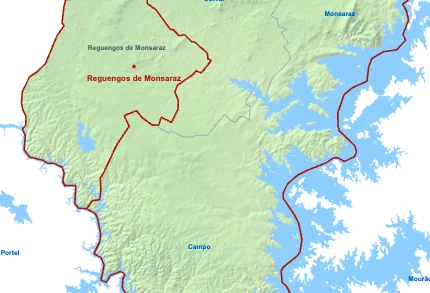
Castelo de Monsaraz: considered an open-air museum — a fortified medieval village with three bastions enclosed by a wall of schist and granite. The village is situated in a spectacular location on a high hill overlooking the plains of the Alentejo and the Alqueva reservoir lake. Access to the village can be made through the Porta da Vila — a north-west entrance where the bell tower stands — the Porta de Évora, the Porta da Cisterna or Porta do Buraco, and the Porta da Alcoba. Upon entering the fortified village visitors feel transported back in time, with the natural schist stone ground, typical single-storey houses with thick whitewashed walls and small windows built along streets carved from the original rock. Along the streets there are houses, craft and local commerce shops, traditional cuisine restaurants and a central area with the Pelourinho de Monsaraz, the Igreja da Misericórdia and the Igreja de Nossa Senhora da Lagoa. At the south-west corner of the castle is the castle viewpoint, from which a sweeping panoramic view over the Alentejo fields and the Alqueva lake can be admired. The Castelo de Monsaraz has always been a sentinel point over the Guadiana river.

Praia Fluvial de Monsaraz

Praia Fluvial de Monsaraz: a supervised river beach with an extensive sandy area and shaded zone, and a first aid post, situated on the Alqueva reservoir 4 kilometres from Monsaraz. Here visitors find the Centro Náutico de Monsaraz, with supporting facilities including a bar and restaurant, a boat launch ramp, moorings, public toilets, public showers, a children’s playground, a picnic area and an ecological waste station. At the Centro Náutico de Monsaraz it is possible to hire various water leisure equipment, including a 1913 Dutch sailing vessel of 17 metres, a semi-rigid boat, SmartKat sailing catamarans and rowing boats — all for boat trips on the Alqueva reservoir.

Castelo de Estremoz

Castelo de Estremoz: a castle situated in an important medieval Alentejo fortified stronghold classified as a National Monument, dating from the 12th century, on the hill of the city of Estremoz. Inside the stronghold visitors can tour the Castelo de Estremoz in Gothic and modern styles, converted into the luxury hotel Pousada da Rainha Santa Isabel, the imposing Torre de Menagem standing 27 metres tall, the Medieval Paços do Concelho or Galeria Dom Dinis — the place where Queen Santa Isabel died in 1336 — the Capela da Rainha Santa, the statue of Queen Santa Isabel, the parish church of Estremoz (Igreja de Santa Maria), the Museu Municipal Professor Joaquim Vermelho, and the medieval walls with a wall walk serving as a viewpoint over the Alentejo plains and the contemporary city of Estremoz. The Cerca da Vila and the Torre de Menagem of the Castelo de Estremoz were built to strengthen the settlement’s defences during the reign of Dom Afonso, following the charter of 1258. During the reign of Dom Dinis, construction of the walls continued and the Paço Real was also built beside the castle. The Torre de Menagem was only completed around 1370 during the reign of Dom Fernando de Portugal. Within the town wall, visitors can stroll through stone streets lined with traditional houses built over the past several centuries.

Fluviário de Mora

Fluviário de Mora: a freshwater aquarium situated in the Parque Ecológico do Gameiro, in the parish of Cabeção. The Fluviário de Mora comprises a collection of aquaria dedicated to freshwater ecosystems, exhibiting representative habitats of the course of an Iberian river from its source through its estuary to the sea. The Fluviário de Mora has scientific and educational programmes presented across several themes, including the Lontrário (otter enclosure), the Saramugo Room, the Monstros do Rio Room, the Multimedia Exhibition Room, a classroom, an auditorium and the Habitats Exóticos Room — featuring species from the Amazon river and the African Great Lakes. It is a particularly enjoyable attraction for families and children, and a special place to learn about nature. Near the Fluviário de Mora visitors can explore the village of Mora, where the Museu Interativo do Megalitismo can be found — a museum in the former Mora railway station, awarded the “Best Public Project” prize, where the megalithic heritage of the Municipality of Mora can be discovered through three spaces representing aspects of daily life, dedicated to the themes “Life, Death and Contemplation” via a 3D video portraying life in a Neolithic settlement.

Parque Ecológico do Gameiro

Parque Ecológico do Gameiro: a natural park surrounding the Fluviário de Mora in the village of Cabeção, featuring a river beach, campsite, picnic area, children’s playground, bar/cafeteria, Gameiro wooden boardwalks along the Ribeira da Raia, a sports court and an Environmental Interpretation Centre. The Parque Ecológico do Gameiro is an excellent place to enjoy a day in nature, with a football pitch, café, showers, ample shading and a clean and well-maintained environment.

Cromeleque dos Almendres

Cromeleque dos Almendres: a natural monument located in Évora in the parish of Nossa Senhora de Guadalupe. This stone circle, approximately 7,000 years old, is considered one of the largest megalithic monuments in Europe and the most important on the Iberian Peninsula. Composed of relatively small phallic or stellar monoliths arranged on the plain, the stone circle creates a mystical atmosphere evoking Iberian pagan worship and transporting visitors to the Polished Stone Age. Some of the standing stones are visibly decorated with inscriptions and relief carvings, including anthropomorphic figures and solar discs. The site offers an idyllic setting for lovers of natural beauty, as well as for nocturnal sky observation and astrophotography, thanks to its low light pollution.

Paço Ducal de Vila Viçosa

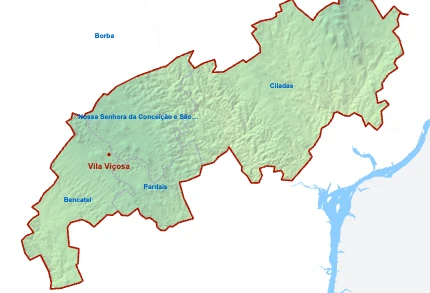
Paço Ducal de Vila Viçosa: a palace and museum located in the Terreiro do Paço de Vila Viçosa, in the district of Évora. The 16th-century building has a façade richly clad in local marble, in a Mannerist style that also retains Renaissance, Baroque and Neoclassical elements typical of civil and residential architecture. Perfectly preserved, the building has more than 50 visitable rooms, richly decorated and displaying diverse pieces from collections as varied as armoury, goldsmithery, state carriages and ceramic ware. One of the most notable floors is the Noble Floor, where the richest collections are found alongside walls and ceilings extensively decorated with period paintings recreating a play of colour and history. Tapestries, sculptures, tiles and frescoes also form part of what visitors discover during a visit to the Paço Ducal de Vila Viçosa. This palace was formerly the seat of the House of Braganza.

Castelo de Évora Monte

The Castelo de Évora Monte: a 12th-century monument located in the parish of Évora Monte (or Evoramonte). Situated at one of the highest points of the Serra de Ossa, with a singular architecture combining Gothic and Renaissance features, the Castelo de Évora Monte has visually interesting and unique contours. It is also the only Iberian castle that simultaneously combines a Renaissance palace with a military-defensive structure. The Italian inspiration of its architecture is expressed in a castle of predominantly granite stone, with a square plan and circular towers at its corners. The fact that some of its structures date from later periods — including the 14th and 15th centuries — brings additional aesthetic elements evoking other architectural styles, as seen in the details of the ogives, towers and inscriptions adorning the gates and posterns. The rich natural and earthy surroundings, together with the medieval character of the castle, are particularly noteworthy.

Monte Selvagem — Animal Reserve

The Monte Selvagem animal reserve: a themed park enabling contact with the natural world. Located at Monte do Azinhal in Lavre, the reserve is dedicated to the preservation of various animal species, adopting an ecological and sustainable approach. This open-air reserve covers approximately 20 hectares, with various leisure facilities in an environment that is home to more than 300 species of wild and domestic animals. Monte Selvagem — Animal Reserve aims to provide experiences of adventure, learning, rest and engagement with nature, encouraging visitors to capture images of the natural and animal world. Monkeys, llamas, kangaroos, crocodiles, zebras and lemurs are among the species that can be found in this animal reserve.

Castelo de Arraiolos

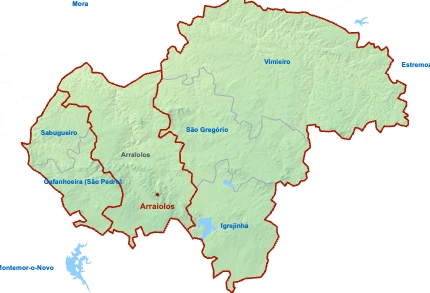
Castelo de Arraiolos: (or Paço dos Alcaides) is a fortress in the locality of Arraiolos, in Évora, ordered to be built during the reign of Dom Dinis in the 14th century. This castle stands at the top of Monte de São Pedro — a conical hill with gentle slopes — and is visually distinguished from other castles by its rare circular floor plan. The main architectural features are Gothic and Romantic, with the Torre de Menagem, the Torre do Relógio and the Igreja do Salvador standing out. The visual setting of this castle in its surrounding region deserves mention, with extensive views over the typical verdant Alentejo plains.

Castelo de Vila Viçosa

Castelo de Vila Viçosa: a castle in the municipality of Vila Viçosa, in Évora, built in the 14th century during the reign of Dom Dinis. This castle stands apart from other castles in Portugal owing to its location at the top of a hill overlooking two tributaries of the Guadiana river which, despite its central position, places it within a green and earthy setting. The castle served various purposes over the centuries as part of a rich history that left traces of several periods on the architectural fabric visitors see today. The fortress plan is that of an artillery castle, having served military functions during the 16th century. Preserving elements of military and Gothic architecture, the Castelo de Vila Viçosa has a quadrangular layout with circular towers. Inside, two museums can be visited — the Museu da Caça and the Museu da Arqueologia — along with the Santuário de Nossa Senhora da Conceição de Vila Viçosa, where the original image of the National Patron Saint is displayed.

Castelo de Viana do Alentejo

Castelo de Viana do Alentejo: a monument whose exact age is still debated, though it is known that its construction predates the 14th century. The castle comprises an imposing wall enclosure, within which the Igreja Matriz de Nossa Senhora da Anunciação and the Igreja da Misericórdia can be visited. It is believed to have housed, throughout history, the first Paços do Concelho and the first cemetery of Viana do Alentejo. Its design features two access gates and five cylindrical towers. The churches display architectural features predominantly in the Gothic and Manueline styles, with Renaissance details and Mudéjar influence. Surrounding the castle, the fabric of the village can be observed, with low whitewashed houses with orange and brown roof tiles as the settlement’s defining characteristics.

Castelo de Alandroal

Castelo de Alandroal: a castle situated at the highest point of the village of Alandroal, integrated into the urban fabric. With a walled military structure, military architecture and a Gothic style, construction began in the 13th century during the reign of Dom Dinis. The Castelo de Alandroal is an oval-shaped fortification with a polygonal floor plan, pyramidal battlements and four square towers, of which the Torre de Menagem is the most notable. The Torre de Menagem, like the Igreja de Nossa Senhora da Graça, features a Renaissance design. The clock tower found within the castle precinct was built later in the 18th century — a more modern aesthetic element featuring three valuable bells in cast bronze located on the terrace.

Alto de São Bento

Alto de São Bento is a panoramic observation space featuring a viewpoint and a small museological nucleus, created from the requalification of now-inactive windmills. This vantage point offers panoramic views over Évora and is particularly sought out by those wishing to photograph the sunrise and sunset. The location of Alto de São Bento makes it a point of interest with a rich visual panorama of historical, traditional, cultural, environmental and natural significance.

Observatório do Lago Alqueva (OLA)

OLA — Observatório do Lago Alqueva is a sensory and educational space located in Monsaraz. Oriented towards astronomy and astrophotography enthusiasts, the Observatório do Lago Alqueva invites visitors to experience nocturnal sky observation from an excellent location with minimal light pollution, enabling the observation of galaxies, stars and nebulae using the equipment available on site. The visual expedition through the Alentejo sky at the OLA allows visitors to use astronomy equipment and explore the legends related to the stars that mark the sky. Guided learning sessions of one and a half hours are available. On overcast days, astronomical observation remains possible through simulation using astronomy software.

History of Évora

Évora has more than five thousand years of history, having been inhabited since Prehistory by various peoples including Lusitanians, Romans, Visigoths and Arabs. Évora has had several designations, with the Roman name Ebora Liberalitas Julia being most notable. The city of Évora was conquered in 1165 by Geraldo Sem Pavor and received its first charter in 1166, with the city and surrounding lands being entrusted to the Order of Calatrava — the future Order of Avis. The Sé Catedral de Évora was built in the 13th century. The city’s urban perimeter began to grow from that century, with a Jewish quarter and a Moorish quarter outside the walls. Évora reached its peak in the 16th century, particularly in artistic and cultural spheres, owing to the presence of important figures including the poet Garcia de Resende and the sculptor Nicolau de Chanterene. The Universidade de Évora was established in 1559. Évora was classified as a UNESCO World Heritage Site in 1986.

Geography and Climate of Évora

The most important rivers in the district of Évora are:

Rio Guadiana: a river that forms a natural border between Portugal and Spain. The Guadiana rises in Spain at approximately 1,700 metres altitude at the Ruidera lagoons and flows into the Gulf of Cádiz, between the Portuguese city of Vila Real de Santo António and the Spanish city of Ayamonte. The Rio Guadiana has a total length of approximately 829 km, of which approximately 260 km lie in Portugal between the Algarve and the Alentejo. The Alqueva dam is located on the Guadiana.

  • Rio Degebe: a tributary of the Guadiana that rises north of Évora at Monte das Fontainhas, with a length of approximately 95 km, passing through the municipalities of Portel and Reguengos de Monsaraz.
  • Rio Xarrama: a tributary of the Sado with a length of approximately 70 km, rising at Graça do Divor, north-west of Évora. The Rio Xarrama flows into Alcácer do Sal. Its main points of interest are the Barragem de São Brissos, the Barragem de Vale do Gaio and the Barragem Trigo de Morais.

The main mountain ranges in the district of Évora are:

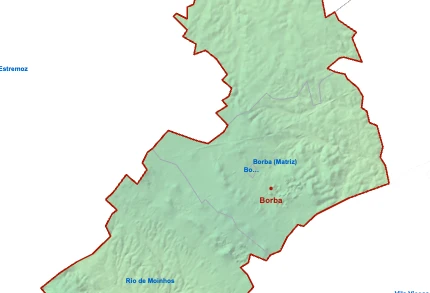
  • Serra d’Ossa: part of the Natura 2000 network, the range has an altitude of approximately 650 metres and covers the municipalities of Borba, Estremoz and Redondo. It is the largest range in the district of Évora, where the Marble Zone (the “white gold”) is found, encompassing the municipalities of Alandroal, Borba, Estremoz and Vila Viçosa.
  • Serra de Monfurado: with a maximum altitude of approximately 430 metres, it covers the municipalities of Évora and Montemor-o-Novo. The main points of interest in the Serra de Monfurado are the Castelo de Giraldo, the Cromeleque dos Almendres, the Gruta do Escoural and the Mina da Nogueirinha.

Gastronomy of Évora

The Alentejo is a region of Portugal with a very ancient, rich and varied gastronomic tradition. The basis of the diet in the district of Évora, as throughout the Alentejo, is pork and lamb, olive oil and bread. Among the many specialities of Évora cuisine, the highlights are cured meats, presunto, Alentejo-style gazpacho, beldroegas soup, dogfish soup, tomato soup, bacon soup, Alentejo-style açorda, cabeça de xara, lamb stew, Alentejo-style migas, pork trotters with coriander, sarapatéis, bolo Joana, cernelha de Montemor-o-Novo, encharcada from the Convento de Santa Clara, granadas de Vendas Novas, pão de rala, pastéis de toucinho de Arraiolos, queijadas de Évora, sheep’s and goat’s cheeses, and egg trouxas.

Administrative Organisation of Évora

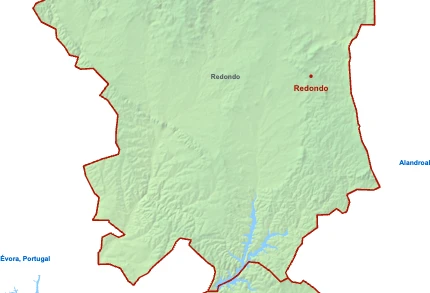
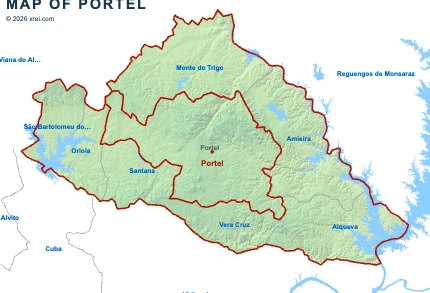
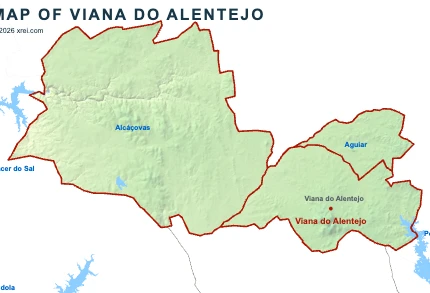
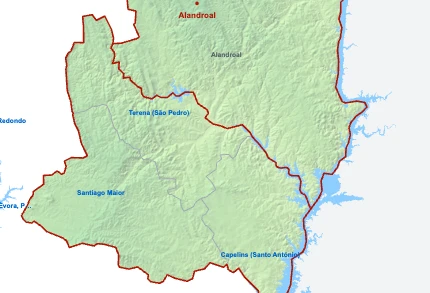
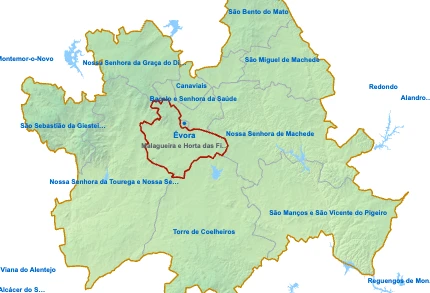
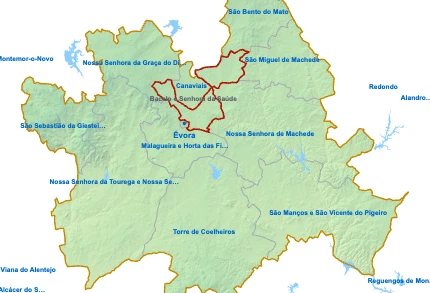
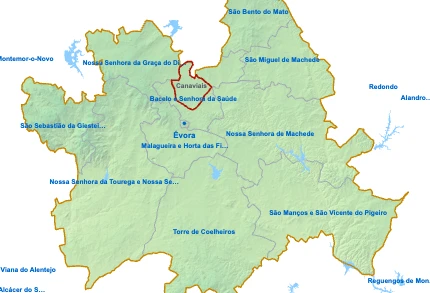
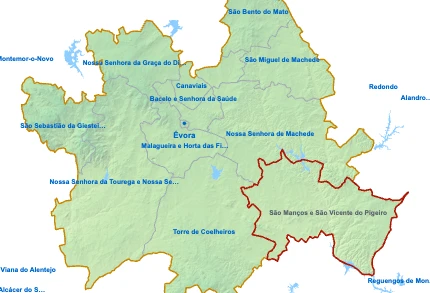
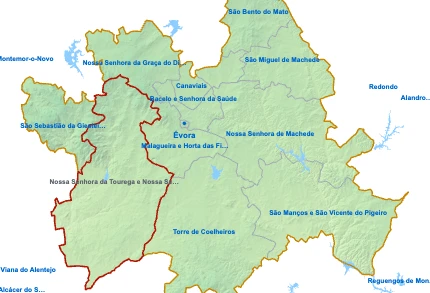
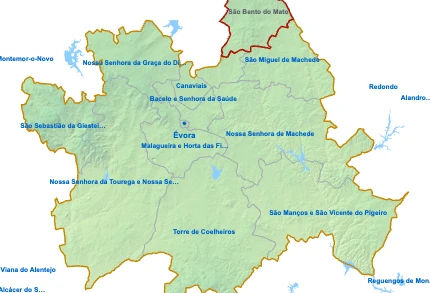
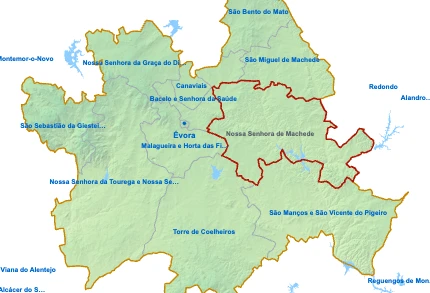
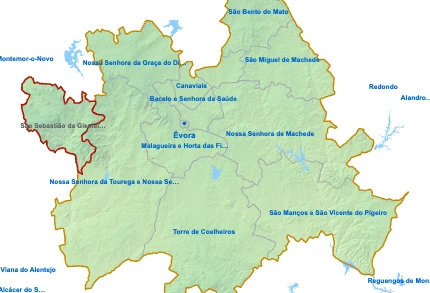
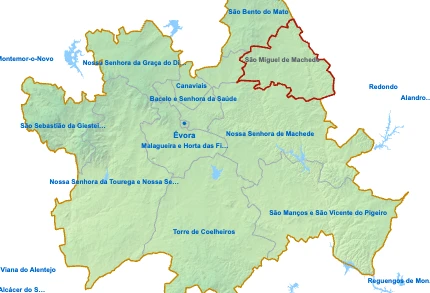
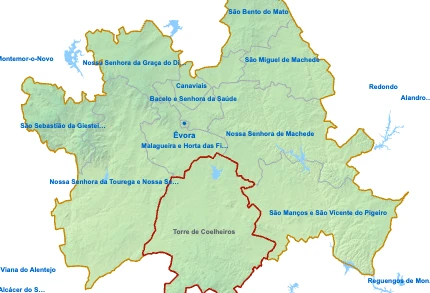
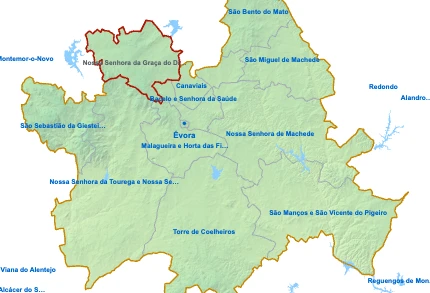
Évora borders Arraiolos to the north, Estremoz to the north-east, Redondo to the east, Reguengos de Monsaraz to the south-east, Portel to the south, Viana do Alentejo to the south-west and Montemor-o-Novo to the west. Évora is approximately 130 km from Lisbon, 90 km from the port of Sines, 80 km from Beja Airport and 650 km from Madrid. Évora is administratively organised into twelve parishes: São Miguel de Machede, São Bento do Mato, Nossa Senhora de Machede, Nossa Senhora da Graça do Divor, Torre de Coelheiros, Canaviais, São Manços e São Vicente do Pigeiro, Nossa Senhora da Tourega e Nossa Senhora de Guadalupe, São Sebastião da Giesteira e Nossa Senhora da Boa Fé, Évora (São Mamede, Sé, São Pedro e Santo Antão), Bacelo e Senhora da Saúde, and Malagueira e Horta das Figueiras.

Fairs and Pilgrimages of Évora

  • Festa de Nossa Senhora das Candeias e São Brás: held annually in February.
  • Feira de São João: held annually in the months of June and July.
  • Portugal Air Show: the largest aeronautical festival on the Iberian Peninsula, held annually in September.

Five-star tourist accommodation in Évora

Five-star tourist establishments:

  • Convento do Espinheiro Hotel & Spa Évora
  • M’AR de Aqueduto Hotel Évora
  • Pousada dos Loios

Four-star tourist establishments in Évora:

  • Évora Hotel: Alma Alentejana
  • Hotel M’AR de Ar Muralhas

نحن قريبون منك

تعمل XREI من مكاتب في جميع أنحاء البرتغال — من بورتو إلى الغارف.

الشمال

بورتو — Edifício ICON

Rua Direita de Francos, 165 Piso 1 · 4100-211 Porto

منطقة لشبونة الكبرى

لشبونة — Rua Castilho

Rua Castilho, 39 · 1250-068 Lisboa

منطقة لشبونة الكبرى

إيستوريل

Avenida Aida, 353A · 2765-187 Estoril

ساحل ألنتيجو

كومبورتا

Av. 18 Dezembro, 37 · 7570-779 Carvalhal

الغارف

فيلامورا — Marina Plaza

Av. da Marina, 3 · Marina Plaza Loja 14/15 · 8125-401 Quarteira