
Bairro Alto
The Bairro Alto is a traditional Lisbon neighbourhood situated at the top of a hill, located close to the cosmopolitan Chiado, the transport hub of Cais do Sodré, the charming Príncipe Real and the historic Largo do Carmo. The main arteries of the Bairro Alto are Praça Luís de Camões, Largo Trindade Coelho, Rua do Norte, Rua da Rosa, Rua do Século and Rua do Diário de Notícias. The neighbourhood has two main meeting points: Praça Luís de Camões and Largo Trindade Coelho. Praça Luís de Camões, at the southern entrance to the Bairro Alto, marks the boundary between the Bairro Alto and Chiado — regarded by Lisboetas as the capital of Lisbon. From here it is possible to head towards Rua da Rosa, Rua do Norte or Rua da Atalaia. Largo Trindade Coelho, located in the northern part of the Bairro Alto, is also known as Largo do Cauteleiro owing to the presence of a statue in honour of the lottery ticket vendor, or Largo de São Roque after the Igreja de São Roque. From Largo Trindade Coelho it is possible to reach the Miradouro de São Pedro de Alcântara, the Elevador da Glória, Rua da Misericórdia, Rua do Grémio Lusitano and Largo do Carmo.
The Mixed Character of Bairro Alto
The Bairro Alto presents two distinct lifestyles — one during the day and another at night.
During the day the Bairro Alto is a calm and tranquil neighbourhood of small local shops, business offices and modest restaurants serving traditional Portuguese cuisine, with the typical bustle of a big-city neighbourhood — people moving from one place to another on their way to offices, neighbours chatting at windows, laundry on the lines, balconies decorated with flowerpots, and restaurants full of locals and tourists at lunchtime.
At night the Bairro Alto transforms into a bohemian centre of Lisbon nightlife. It is the Bairro Alto that sets virtually all the trends in Lisbon's nocturnal scene — a neighbourhood dedicated to the night. There are bars of every kind, nightclubs, restaurants, tea houses, tascas and fado venues. It is possible to experience the night out in the street itself in the early hours, though entertainment venues close at two in the morning.
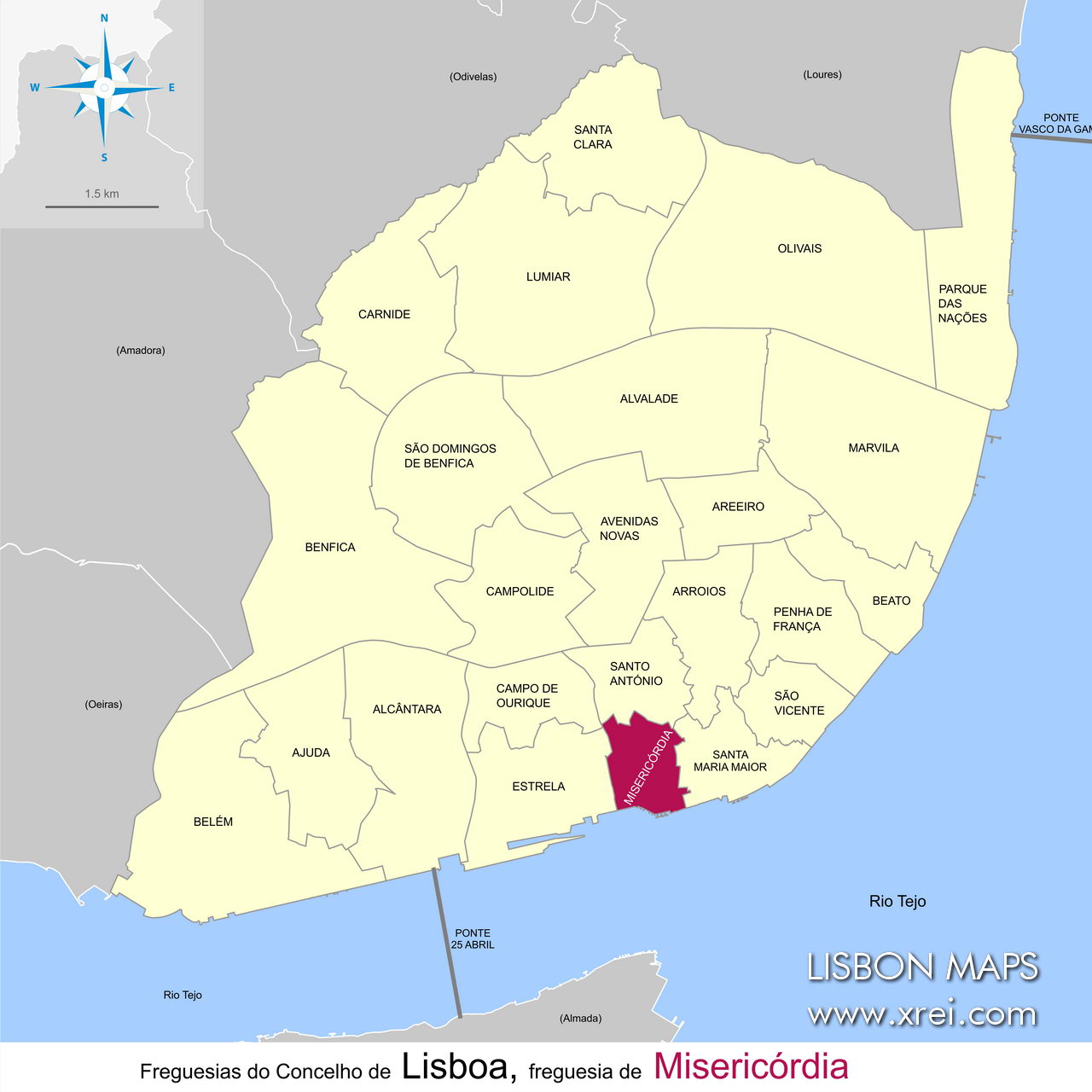
The Bairro Alto and Rua de Santa Catarina are part of the Junta de Freguesia da Misericórdia.
Top 10 Attractions in Bairro Alto
1. Miradouro de São Pedro de Alcântara: The Miradouro de São Pedro de Alcântara is a garden park and viewpoint offering one of Lisbon's most beautiful panoramas, with views over the entire old city including the Castelo de São Jorge on the opposite hill. It is located on Rua de São Pedro de Alcântara, between Príncipe Real and the Bairro Alto. The main highlights are:
-
- View over the Castelo de São Jorge, the Graça hillside, the Baixa, Martim Moniz, Alfama, the Tagus River and the Serra da Arrábida;
- The Statue of Eduardo Coelho, founder of the Diário de Notícias, one of the country's most important newspapers;
- The azulejo panel depicting the city of Lisbon, by Fred Kradolfer, produced in 1952;
- Eight busts representing historical figures, including Vénus, Ulisses, Vasco da Gama and Camões.
2. Igreja de São Roque: notable for the contrast between its plain exterior façade and its extraordinarily rich interior, located on Largo Trindade Coelho between Rua da Misericórdia and Rua Dom Pedro de Alcântara. The Igreja de São Roque was established in 1553 as the headquarters of the Jesuits in Portugal. The Society of Jesus arrived in Portugal in 1540 and built their first church and headquarters on the site of the former Ermida de São Roque. The architect responsible for the Igreja de São Roque was Afonso Álvares (c.1510–1580). The main highlights of the Igreja de São Roque are:
-
- Capela de São João Batista: commissioned by King Dom João V (1689–1750) from two Italian architects — Luigi Vanvitelli (1700–1773) and Nicola Salvi (1697–1751) — in 1740, and built between 1742 and 1747. On 15 December 1742 it was blessed by Pope Benedict XIV (1675–1758) and transported to Lisbon directly from Rome in three vessels. The points of interest of the Capela de São João Batista are the Carrara marble; the painting depicting the Baptism of Christ by Agostino Massucci (1691–1758); "Pentecost" represented on the canvases to the left and "The Annunciation" on the canvases to the right, both by Agostino Massucci (1691–1758); and the outer arch bearing the Portuguese Royal Arms and the monogram of Dom João V.
- Capela de Nossa Senhora da Doutrina: inaugurated in 1612, featuring the image of Saint Anne and the Virgin dating from the late 17th century, the images of Saint Joachim and Saint Anne from the 17th century, and the emblem of the Irmandade da Doutrina.
- Capela de São Francisco Xavier: inaugurated in 1634 and designed by António Gomes de Elvas. Highlights include a 17th-century sculpture of São Francisco Xavier, paintings depicting two moments from the life of São Francisco Xavier — Dom João III receiving São Francisco Xavier in audience, and Pope Paul III dispatching the first Fathers of the Society of Jesus to Portugal — both by José de Avelar Rebelo (1600–1657).
- Capela de São Roque: on the site of the former Ermida de São Roque, notable for the image of São Roque, images of Saint James and Saint Sebastian, six silver-painted wooden sculptures representing the Apostles Saint Peter and Saint Paul and the four Evangelists — Saint Matthew, Saint Mark, Saint Luke and Saint John; the painting depicting The Apparition of the Angel to São Roque, dating from the second half of the 16th century, by Gaspar Dias; 16th-century azulejo panels with scenes from the daily life of São Roque by Francisco de Matos; and the coat of arms of the Confraria de São Roque.
- Capela do Santíssimo: designed by Luíza Fróis and inaugurated in 1636. The highlights are the image of Nossa Senhora da Assunção; two 17th-century lateral paintings depicting The Death of the Virgin and the Assumption and Coronation of the Virgin by Bento Coelho da Silveira (1617–1708); and the silver lamp of 1877 made in Porto.
- Chapel-Mor: built between 1625 and 1628. The main points of interest are four frontal niches representing the principal saints of the Society of Jesus — Saint Ignatius of Loyola (1491–1556), Saint Francis Xavier (1506–1552), Saint Aloysius Gonzaga (1568–1591) and Saint Francis Borgia (1510–1572); a 17th-century sculpture of Our Lady with the Christ Child; sculptures of the Lord of the Green Cane, Saint Bridget, Saint Gregory the Wonderworker and the Immaculate Conception; four lateral paintings depicting Saint Stanislaus Kostka (1550–1568) and the three martyrs of Japan — Saint Diego, Saint John Mary and Saint Paul Miki; and the Tombs of Dom Fernando Martins de Mascarenhas (1548–1628) and Dom Tomás de Almeida (1670–1754).
- Capela de Nossa Senhora da Piedade: designed by Martim Gonçalves da Câmara and inaugurated in 1613. The main points of interest are the painting of Nossa Senhora da Soledade; a polychrome wooden Pietà from the 17th century; the image of Nossa Senhora da Boa-Morte; and two sculptures of Saint Longinus and Saint Veronica.
- Capela de Santo António: rebuilt after the earthquake of 1 November 1755. The highlights are the 19th-century Neoclassical fresco ceilings; a 17th-century image of Santo António; and two paintings depicting scenes from Santo António's religious life — The Saint Preaching to the Fish and The Temptation of Santo António — by Vieira Lusitano (1699–1783).
- Capela da Sagrada Família (Capela do Menino Perdido), inaugurated in the 17th century. The points of interest are a central painting depicting Jesus among the Doctors by José de Avelar Rebelo (1600–1657); two paintings of The Adoration of the Magi and The Adoration of the Shepherds by André Reinoso; and three 17th-century sculptures of the Holy Family.
- Ceiling: the painting by Francisco Venegas (1525–1594), executed between 1587 and 1589 — the only Mannerist-style ceiling remaining in Lisbon.
- Pipe Organ: built in 1784 by Xavier Machado e Cerveira (1756–1828).
- Museu de São Roque: inaugurated on 11 January 1905. The major highlights are five permanent exhibitions: the exhibition dedicated to the Ermida de São Roque, the exhibition dedicated to the Society of Jesus, the Oriental Art exhibition, the exhibition of the Treasury of the Capela de São João Batista and the exhibition dedicated to the Misericórdia de Lisboa.
3. Elevador da Glória: The Elevador da Glória is a funicular connecting Praça dos Restauradores to the Bairro Alto over a route of approximately 255 metres with a height difference of 48 metres. It is the busiest funicular in the city, carrying approximately three million passengers per year. The Elevador da Glória was inaugurated on 24 October 1885 to a design by Mesnier du Ponsard (1848–1914) and operated until 1915 using a water counterweight system to ascend and descend. From 1915 a second, electrified car was added. The Elevador da Glória was classified as a national monument in 2002.
4. Museu da Maçonaria Portuguesa: The Museu da Maçonaria Portuguesa is a space where visitors can explore the historical evolution of Freemasonry in Portugal and visit the oldest Masonic lodge in the country. The Masonic Museum is housed within the headquarters of the Grande Oriente Lusitano on Rua do Grémio Lusitano. The museum is organised into two main spaces: a permanent exhibition displaying objects used in Masonic rites, and a temporary exhibition space featuring individual pieces belonging to 18th- and 19th-century Freemasons used during rituals, a collection of aprons and embroideries, and a ceramics collection.
5. Igreja de Santa Catarina: one of Lisbon's most important churches for its gilded woodcarving, particularly the high altar built during the reign of Dom João V. The Igreja de Santa Catarina has been located on Calçada do Combro since its inauguration in 1647. The attractions of the church are the Chapel-Mor, considered the most imposing gilded woodcarving monument in Portugal; the ceiling painting depicting the Holy Trinity by António Pimenta Rolin; the image of Santa Catarina; six paintings representing "Christ in the Desert" and "The Multiplication of the Loaves" by Vieira Lusitano (1699–1783); the Holy Trinity depicted in the central medallions of the ceiling by João Grossi and Toscanelli; the gilded 18th-century organ; and the Saints of the Order of São Paulo da Serra da Ossa painted by Bento Coelho da Silveira and André Gonçalves.
6. Museu da Cinemateca: a museum dedicated to documenting the evolution of cinema to the present day, located on Rua Barata Salgueiro. The museum is organised into the Pre-cinema space, displaying objects key to the emergence of cinema; Small Format, showcasing cameras, editing equipment and accessories in formats from 17.5 mm to 8 mm; Large Format, featuring equipment in formats from 35 mm to 70 mm; and the Instruction Manuals space, tracing the evolution of instruction manuals for cameras, projectors and accessories.
7. Palácio do Marquês de Pombal: a 17th-century building on Rua de O Século, built to serve as the family residence of Sebastião de Carvalho e Melo — grandfather of Sebastião José de Carvalho e Melo, known as the Marquis of Pombal. The highlights of the Palácio do Marquês de Pombal are the Fountain by Carlos Mardel; the stairway ceiling depicting "Death and Love" by João Grossi (1715–1780); and the gardens inspired by the Palace of Versailles, designed by Carlos Mardel, with the Cascata dos Poetas and the Fonte das Quatro Estações as centrepieces.
8. Miradouro de Santa Catarina: one of Lisbon's viewpoints offering views over the city's riverside, particularly the movement of ships arriving and departing from Lisbon — giving rise to the popular Lisbon saying "seeing ships from Alto de Santa Catarina." The Miradouro de Santa Catarina is located on Rua de Santa Catarina, with highlights including the view over the Port of Lisbon and the cityscape with its laundry lines and flowerpots; and the marble statue of Adamastor — a figure from Greco-Roman mythology depicted in the Lusíadas of Luís Vaz de Camões (c.1524–1580) as "the being that sank ships attempting to round the Cape of Storms" — today the Cape of Good Hope in South Africa. The statue is by Júlio Vaz Júnior (1877–1963).
9. Elevador da Bica: a funicular connecting Rua de São Paulo to Largo do Calhariz, designed by Mesnier du Ponsard and inaugurated in 1892, located on Rua da Bica de Duarte Belo, classified as "the ninth most beautiful street in the world" according to the St Christopher's Inn hotels ranking.
10. Museu da Farmácia: a museum dedicated to the history of pharmacy and medicine in Portugal, inaugurated in 1996 and located on Rua Marechal Saldanha. The highlights of the Museu da Farmácia are reconstructions of Portuguese pharmacies from the 18th to the 20th centuries; a reconstruction of a traditional Chinese pharmacy; and a reconstruction of a military pharmacy.
Further Attractions in Bairro Alto
Praça Luís de Camões: located between Chiado and the Bairro Alto, it is one of Lisbon's largest squares. The square takes its name from the monument in honour of Luís Vaz de Camões. The statue was inaugurated on 9 October 1867 to mark the third centenary of Camões's death. Praça Luís de Camões is one of the main meeting and resting points of the Bairro Alto and Chiado, a venue for regular concerts and a thoroughfare connecting Rua da Misericórdia, Rua do Alecrim, Rua do Loreto, Largo do Chiado and Cais do Sodré. The main attractions are the Monument in honour of Luís Vaz de Camões by Vítor Bastos (1830–1894), featuring eight statues of important figures in Portuguese history — Fernão Lopes, Jerónimo Corte-Real, Fernão Lopes de Castanheda, Francisco Sá Menezes, Gomes Eanes de Zurara, Vasco Mouzinho de Quevedo and João de Barros; the statue of Luís Vaz de Camões, four metres tall; and the Convento da Conceição dos Cardais, a home for the visually impaired since the dissolution of religious orders in 1834 and one of the principal buildings constructed in the Estilo Nacional — the designation given to the earliest years of the Baroque in Portugal. Dona Luísa de Távora (1609–1692) commissioned the Convento da Conceição dos Cardais on the current street — Rua Eduardo Coelho — in 1681. Points of interest include: the façade with sculptures of Nossa Senhora da Conceição and Saint Joseph by João Antunes (1643–1712); the Roda dos Expostos — a rotating hatch once common in convents as a means of communication with the outside world, later used as an anonymous "letterbox" through which families in hardship could leave newborn infants in the care of the nuns; Santa Teresa d'Ávila depicted in azulejo panels by Jan van Oort; and the Chapel-Mor built in Estilo Nacional by woodcarver José Rodrigues Ramalho (1660–1721).
Galeria Zé dos Bois: a non-profit cultural association located in the Palácio Baronesa de Almeida — where Almeida Garrett worked — on Rua da Barroca. The Galeria Zé dos Bois was created with the aim of promoting and researching the visual and performing arts.
Monumento a Eça de Queiroz: a stone statue by Teixeira Lopes, inaugurated in 1903 on Largo Barão de Quintela.
Palácio do Barão de Quintela: a dining and events space known as the Palácio Chiado, located on Rua do Alecrim. The Palácio do Barão de Quintela was built in the late 18th century in Neoclassical style and served as the general headquarters of General Junot during the First Invasion by Napoleon Bonaparte's army in 1807.
Edifício da Imprensa Nacional: Portugal's oldest continuously operating industrial establishment, in uninterrupted operation since the 13th century. The Imprensa Nacional was established in 1769, initially named Impressão Régia, then Régia Oficina Tipográfica, and finally Imprensa Nacional from 1933, with the functions of publishing the Diário da República; producing identity documents such as passports and citizen cards; and minting coins.
Igreja das Chagas is a church on Rua do Ataíde dedicated to the patron saints of sea-related professions, particularly sailors and fishermen. Frei Diogo de Lisboa commissioned the church, which was inaugurated in 1542 to provide the sailors of the India Route with a place to pray before their voyages. The church was rebuilt after the 1755 earthquake and features the Ceiling painting depicting Nossa Senhora da Piedade das Chagas de Cristo by Francisco Figueiredo; and a 17th-century organ.
Convento e Igreja de São Pedro de Alcântara is a 17th-century building notable for housing the most complete collection of azulejo tilework relating to the life of São Pedro de Alcântara in Portugal, located on Rua de São Pedro de Alcântara. It was inaugurated in 1672 to a design by João Antunes, built to celebrate Portugal's independence from Spain and the victory at the Battle of Montes Claros in 1665 — the final battle of the Restoration War (1640–1668). The main points of interest are the Capela dos Lencastres, built in 1690 in memory of the Cardinal of Lisbon Dom Veríssimo de Lencastre — with fresco-like paintings by Francisco Pais, the marble column altar and Dom Veríssimo's coat of arms, and resistant to the 1755 earthquake; the gilded woodcarving altars depicting "The Coronation of the Virgin" by Pierre Antoine Quillard and "The Preaching of Saint John the Baptist" by Pedro Alexandrino de Carvalho; the ceiling painted by Pierre Bordes; the High Altar in Rococo style with gilded woodcarving and "The Ecstasy of São Pedro de Alcântara" by Bento Coelho da Silveira; and the azulejo panels — the most complete in Portugal — depicting scenes from the life of São Pedro de Alcântara.
Palácio Ludovice: considered one of the most important palaces in Lisbon for the palatial urban architecture of the reign of Dom João V (1689–1750). The Palácio Ludovice, located on Rua de São Pedro de Alcântara, was the residence of the Royal Architect João Frederico Ludovice (1673–1752) and houses the Solar do Vinho do Porto — a bar where more than 300 varieties of Port Wine can be tasted.
Chafariz do Século: a fountain on Rua de O Século inaugurated in 1762 to supply the Palácio Pombal with water, designed by Carlos Mardel (1695–1763).
Main Streets and Squares of Bairro Alto
Rua de O Século: a street of the Bairro Alto connecting Praça do Príncipe Real to Calçada do Combro and one of the most important streets in this historic neighbourhood. Rua de O Século is a typical street of historic Lisbon, with several attractions including noble 18th- and 19th-century palaces, traditional residential buildings, Portuguese cobblestone pavement, restaurants, bars, local accommodation, the Igreja do Convento dos Cardaes, the Tribunal Constitucional, the Palácio Pombal and the Escola de Dança do Conservatório Nacional. Rua de O Século, formerly Rua Formosa, acquired this name as the former location of the headquarters of the newspaper O Século, which operated in Lisbon between 1880 and 1977.
Rua da Misericórdia: connecting Praça Luís de Camões to Largo Trindade Coelho, it is an important road artery providing access to and from the historic city centre. Rua da Misericórdia is well frequented by tourists and Portuguese visitors for attractions including the Igreja de São Roque, the Bairro Alto, restaurants, the Igreja de Nossa Senhora do Loreto and its place on the route of the famous Tram 28. Rua da Misericórdia takes its name from the presence of the Misericórdia de Lisboa on Largo Trindade Coelho.
Calçada do Combro: connecting Rua de São Bento to Largo do Calhariz, this is the street that marks the boundary between the Bairro Alto and the Bica, and is one of the busiest streets in the Bairro Alto area owing to points of interest such as the Rooftop Park, the Elevador da Bica, the Igreja de Santa Catarina and its role as one of the routes of Tram 28. Calçada do Combro acquired its name from its elevated and isolated position within the city, having been built during the growth of the Bairro Alto.
Rua da Rosa: connecting Rua Dom Pedro V to Largo do Calhariz, known for its nightlife, numerous tascas and restaurants and the Convento dos Inglesinhos. Rua da Rosa is also known as Rua da Rosa das Partilhas, a name it has held since 1597.
Rua da Atalaia: connecting Rua da Rosa to Rua do Loreto, with several points of interest including the Museu Maçónico Português, restaurants and bars. Rua da Atalaia and Rua da Rosa are the most lively streets for nightlife in the Bairro Alto, always full of tourists and locals at weekends. Rua da Atalaia takes its name from the Arabic toponym Atalaia, meaning a high place or watchtower.
Rua do Diário de Notícias: connecting Travessa da Cara to Rua das Salgadeiras, much sought after by tourists and locals wishing to experience the cuisine of the restaurants, fado houses and local bars. Rua do Diário de Notícias, formerly Rua dos Calafates, acquired its current name in 1885 to celebrate the twenty-first anniversary of the newspaper Diário de Notícias.

Further Places of Interest in Bairro Alto
Largo Trindade Coelho: located between the Miradouro de São Pedro de Alcântara and Praça Luís de Camões, it is known as Largo do Cauteleiro or Largo de São Roque. The square takes its name from writer José Francisco Trindade Coelho (1861–1908) and its main highlights are the Igreja de São Roque, the statue of the lottery ticket vendor, the statue of Saint Francis Xavier and the headquarters of the Santa Casa da Misericórdia. Largo Trindade Coelho is one of the meeting points of the Bairro Alto.
Igreja Paroquial das Mercês: located on Largo de Jesus. The Igreja Paroquial das Mercês incorporated the former Convento de Jesus and, since 1838, the Academia das Ciências. The project is by Frei Manuel do Cenáculo. The main highlights are:
-
- Main façade and steps
- Side chapels
Igreja Paroquial de Santa Catarina: located on Calçada do Combro, it is known as the Igreja dos Paulistas because it was inaugurated in the 17th century for the faithful of São Paulo da Serra de Ossa. From 1835 it was incorporated into the parish of Santa Catarina. The main points of interest are:
-
- Monstrance of the Blessed Sacrament
- Two bell towers
- Joanine gilded woodcarving of the high altar
- Organ decorated with gilded woodcarving
Galeria Subterrânea do Loreto: one of the five galleries of the Aqueduto das Águas Livres, covering approximately 410 metres along the following route:
-
- Starting at the Casa do Registo
- Descending from Rua das Amoreiras to Largo do Rato
- Passing through Rua da Escola Politécnica
- Passing through Rua Dom Pedro V
- Passing through Rua Paiva de Andrade
- Ending at Largo de São Carlos
Convento de São Pedro de Alcântara: inaugurated in 1681 on Rua de São Pedro de Alcântara. The Convento de São Pedro de Alcântara was built in honour of the Spanish saint São Pedro de Alcântara in consequence of Portugal's independence in 1640. It was rehabilitated by architect Manuel da Maia after the earthquake of 1 November 1755. The main highlights are the Capela dos Lencastre inaugurated in 1690 and built in memory of the Cardinal of Lisbon Dom Veríssimo de Alcântara — with the ceiling by Francisco Pais depicting the martyrs Saints Veríssimo, Máxima and Júlia; the gilded woodcarving altars; the Painting of the Coronation of the Virgin by Pierre Antoine Quillard; the Painting of the Preaching of Saint John the Baptist by Pedro Alexandrino Carvalho; the ceiling by Pierre Bordes inaugurated in 1878; the Ecstasy of São Pedro de Alcântara by Bento Coelho da Silveira; and 18th-century azulejo panels with scenes from the daily life of São Pedro de Alcântara.
Convento dos Cardaes: located on Rua do Século, it is one of the best-preserved Baroque monuments in Lisbon. The Convento dos Cardaes was inaugurated in 1681 by Dona Luísa de Távora (1609–1692) for the Order of Discalced Carmelites. The main points of interest are:
-
- Church with paintings by António Pereira Ravasco and André Gonçalves depicting the rules of the Order, and azulejo panels depicting scenes from the daily life of Santa Teresa d'Ávila
- Exterior marble sculpture of Nossa Senhora da Conceição by João Antunes
- Exterior marble sculpture of Saint Joseph by João Antunes
- The rotating hatch that allowed the passage of objects and was later used by mothers to leave children anonymously — known as the Roda dos Expostos
Palácio Pombal: a 16th-century building in the plain style (estilo chão) on Rua de O Século. The Palácio Pombal was the residence of the Melo family until the earthquake of 1 November 1755. It was commissioned by Sebastião de Carvalho e Melo — grandfather of Sebastião José de Carvalho e Melo, Marquis of Pombal and Prime Minister of Dom José I (1714–1777). The main highlights are the two-storey grand staircase; four marble sculptures representing Hercules and Venus; the ceiling depicting Death and Love by João Grossi; and the garden with benches, azulejo panels with scenes of daily life, a lake and two nettle trees (Celtis australis).
Hemeroteca Municipal: located on Rua Lúcio de Azevedo, its aim is the creation of a digital library of newspapers and magazines in the public domain. The Hemeroteca Municipal was inaugurated in 1931. The main points of interest are 18th- and 19th-century newspapers. The oldest item in the collection is a Gazeta de Lisboa dated 10 August 1715.
Solar do Vinho do Porto: located on Rua de São Pedro de Alcântara, notable for the opportunity to taste more than three hundred Port Wines. The Solar do Vinho do Porto is housed within the Palácio de Ludovic, between the Miradouro de São Pedro de Alcântara and Príncipe Real. The bar was inaugurated on 19 February 1946 and designed by designer Paulo Lobo.
Centro Antiquário do Alecrim: located on Rua do Alecrim, housed in the former Fábrica Âncora building. The Centro Antiquário do Alecrim sells antique books, engravings, photographs, maps and other documents.
Restaurants of Bairro Alto
100 Maneiras: located on Rua do Teixeira, notable for offering tasting menus at accessible prices. The restaurant is owned by chef Ljubomir Stanisic, inaugurated in 2009 with just thirty covers. The signature dish is the Estendal do Bairro.
Casanostra: located on Travessa do Poço da Cidade, a popular Italian restaurant owing to its varied cuisine. It was inaugurated in 1986 by Italian Maria Paola with the aim of introducing the Portuguese to Italian cooking beyond pasta and pizza.
Fumeiro de Santa Catarina: located on Travessa Alcaide Lisboa, a restaurant specialising in charcuterie and appetisers.
Tantura: located on Rua da Trombeta, named after a locality in Israel. Owners Elad Bodenstein and Itamar Eliiyahuo lived in Tantura, Israel, and opened the restaurant in the Bairro Alto with the aim of introducing Israeli cuisine to Portugal.
Adega das Mercês: located on Rua das Mercês, noted for fresh fish and traditional Portuguese cuisine.
Petiscos do Bairro: located on Rua da Atalaia, noted for its petiscos, including pataniscas, pica-pau and peixinhos da horta.
O Trevo: located on Praça Luís de Camões, known for the bifana — pork steak in a bread roll — and for having been one of the locations featured in Anthony Bourdain's American food programme No Reservations on Lisbon cuisine. O Trevo is considered to offer the best bifanas in Lisbon.
Cantinho do Bem Estar: located on Rua do Norte, it is a typical Lisbon tasca serving Alentejo cuisine.
Fado Houses of Bairro Alto
O Faia: located on Rua da Barroca, a landmark fado venue in Lisbon. O Faia was inaugurated in 1947 and has hosted renowned artists including Lucília do Carmo, Carlos do Carmo, Alfredo Marceneiro, Fernando Maurício and Camané.
A Severa: located on Rua das Gáveas, the fado house that has remained in the same family for the longest time. A Severa was inaugurated in 1955 and was named in honour of the fadista Severa, the founding figure of fado.
Adega Machado: located on Rua do Norte, notable for the Sala da Fadistagem, created exclusively for groups. Adega Machado was inaugurated in 1937 and has hosted numerous fadistas including Amália Rodrigues, Fernando Maurício, Maria da Fé and Mariza.
Café Luso: located on Travessa da Queimada, housed in the former cellars and stables of the Palácio Brito Freire. Café Luso was inaugurated in 1927 on Avenida da Liberdade and in 1939 in the Bairro Alto. Amália Rodrigues created the most celebrated moment in the restaurant's history with a concert here in 1955.
Mascote da Atalaia: located on Rua da Atalaia, its main attraction is fado vadio — informal, spontaneous fado. Mascote da Atalaia has been open for more than fifty years and has seen countless fadistas pass through, with Artur Batalha, Fernando Maurício and Chico do Carmo among the highlights.
A Tasca do Chico: located on Rua do Diário de Notícias, its main points of interest are fado and petiscos, particularly grilled cheeses and chouriço. A Tasca do Chico was inaugurated in 1993 by Francisco Gonçalves and currently operates two venues — one in the Bairro Alto and one in Alfama.
Illustrious Figures of Bairro Alto
Guedelha Palaçano: one of the wealthiest men in Portugal in the 15th century, owner of two estates near the Portas de Santa Catarina — today Praça Luís de Camões: the Herdade de Santa Catarina and the Herdade da Boavista. Guedelha Palaçano held numerous roles, including physician, astrologer (he drew up the coronation horoscopes of Portuguese kings Dom Duarte and Dom Afonso V), the first surgeon appointed to the Hospital de Todos-os-Santos, and chief rabbi during the reign of Dom Afonso V. He was the author of several works, including a treatise on Divine Providence. He eventually fled to Spain and later Italy after being accused of plotting to overthrow King Dom João II in 1483.
Ana Queimado: a wealthy noblewoman and landowner in the Bairro Alto who granted the Jesuits a charter to build the Igreja de São Roque.
Camilo Castelo Branco (1825–1890): one of Portugal's most important writers and first Viscount of Correia Botelho. Camilo Castelo Branco was born in Lisbon in the Bairro Alto on Rua da Rosa in 1825 and died by suicide in 1890. The writer participated in several events throughout his life, including the Revolta da Maria da Fonte in 1846. His notable works include A Filha do Arcediago (1855), Onde está a Felicidade (1856), O Morgado de Fafe (1861), Amor de Perdição (1862), A Queda de um Anjo (1865), O Regicida (1874) and Novelas do Minho (1875–1877).
Manuel Maria Barbosa du Bocage (1765–1805): known as "Bocage", one of Portugal's greatest poets, born in Setúbal and died in Lisbon. He joined the literary academy Nova Arcádia in 1790, was imprisoned by the Inquisition in 1797 and held at the Hospício das Necessidades in 1798. Bocage published several works, including As Rimas, written between 1799 and 1804.
Tomás Quintino (1820–1898): Portuguese journalist and businessman, co-founder of the Diário de Notícias in 1864 in the Bairro Alto together with Eduardo Coelho.
Eduardo Coelho (1835–1889): Portuguese writer and journalist, co-founder of the Diário de Notícias in 1864 in the Bairro Alto together with Tomás Quintino. Eduardo Coelho was one of the founding members of the Sociedade de Geografia de Lisboa in 1875.
Fernando Tavares Farinha (1928–1988): a fadista who began singing fado at the age of nine in a neighbourhood competition representing the Bica in 1937 — an event that earned him the name Miúdo da Bica throughout his career. He became a professional fadista at eleven and sang in various Lisbon neighbourhoods including Alto do Pina, Ajuda and Santo Amaro. He recorded his first album in 1940, made his first tour to Brazil at twenty-three, won the competition Voz Mais Portuguesa de Portugal in 1960 and from 1965 toured the United States, France, Belgium and Germany. Among his most celebrated songs are Um Fado à Marceneiro, Estações de Amor and Lugar Vazio.
Bairro Alto Curiosities
- The Bairro Alto was the first neighbourhood in Lisbon to be built with wider streets to allow coaches to pass.
- The Bairro Alto served as a reference for the reconstruction of the Baixa Pombalina after the earthquake of 1 November 1755, having survived the disaster almost entirely intact.
- The poet Bocage died at number 25 Travessa André Valente.
- The writer Camilo Castelo Branco was born at number 13 Rua da Rosa.
- The writer Almeida Garrett lived at number 46 Rua da Barroca.
- In the 19th century prostitution was legal in the Bairro Alto.
- The Bairro Alto was the birthplace of the modern Portuguese press, with two of the first major Portuguese newspapers of the 19th century founded here: O Século and the Diário de Notícias.
- The sports newspaper A Bola is the only newspaper that retains its headquarters in the Bairro Alto.
- The nightclub Frágil opened in 1982 and revolutionised nightlife in the Bairro Alto and in Lisbon.
- On 17 May 1986 the Manobras de Maio emerged — innovative fashion shows that were groundbreaking at the time.
- Figures such as Bocage, Almeida Garrett, Camilo Castelo Branco and Júlio Verne lived in the Bairro Alto.
- Lisbon's last gas street lamps were replaced by electric ones in 1965 in the Bairro de Santa Catarina.
Educational Establishments
- Escola Básica e Secundária Passos Manuel
Health Institutions
- Hospital St Louis
- Hospital de Jesus
Four- and Five-Star Tourist Accommodation
- Bairro Alto Hotel
- Dear Lisbon Charming House
- Orange 3 House — Chiado Bed & Breakfast & Suites
Shops and Shopping
- Alêtheia Livraria
- Cais Pimenta Rosa
- Casa das Vellas Loreto
- Cork & Co
- Fábrica dos Chapéus
- Fátima Lopes
- Galeria Zé dos Bois
- Garrafeira Alfaia
- Garrafeira Nacional
- Livraria Luis Burnay
- Maison Nuno Gama
- Naftalina Vintage Shop
- Ratton
- Sat'Anna
- Solar do Vinho do Porto
Transport and Access
The Bairro Alto is served by the following transport options:
- Lisbon Metro:
- Baixa-Chiado Metro Station (Blue and Green Lines)
- Tram 28
- Ascensor da Glória
Car Parks
- Parque da Calçada do Combro
- Parque do Largo Camões
History of Bairro Alto
The Bairro Alto began to take shape from 1506, when the area was identified as a suitable location for burying victims of the Black Death — the plague against which São Roque, the patron saint of the afflicted, was invoked. The Ermida de São Roque was the site chosen for this purpose. The first residential development was established in 1513 in the former Vila Nova de Andrade, and by 1527 the area already had approximately 1,600 inhabitants. Later, in 1553, the Society of Jesus established its headquarters here and inaugurated the Igreja de São Roque and a hospital. The majority of the Bairro Alto's buildings date from the 18th century, when the Lisbon nobility relocated to the neighbourhood during the reign of Dom João V (1689–1750). From the 19th century onwards the Bairro Alto became associated with nightlife and the written press. Nightlife in this part of Lisbon emerged in the 19th century with fado and the proliferation of restaurants, fado houses, bars and traditional Portuguese tascas. The Portuguese written press reached its peak during the 1960s and 1970s with thirteen of the twenty national newspapers based here.
The History of Bairro Alto can be divided into four periods:
1. The creation of Vila Nova de Andrade:
In the 16th century, most of the Bairro Alto was owned by the Counts of Andrade and Atouguia, who joined forces to create Vila Nova de Andrade. Vila Nova de Andrade began in 1513 between the river and Rua de Santos, with approximately 500 inhabitants by 1528 and nearly a thousand by the end of the 16th century. The first residents were people engaged in maritime occupations, mainly workers at the Ribeira das Naus.
2. The establishment of the Jesuits on the Colina de São Roque:
In 1553 the Society of Jesus settled on the Colina de São Roque, building the Igreja de São Roque and a hospital. The Bairro Alto became known as Bairro Alto de São Roque and was chosen by the nobility as a residential area. Two distinct areas emerged: the Bairro Alto de São Roque and the Bairro Baixo de Vila Nova de Andrade. The Bairro Alto grew around the Igreja de São Roque and is regarded as the first rationalist urban plan in Lisbon. In the 16th century, the streets of the Bairro Alto were considered wide and well-suited to the coaches of the era.
3. The earthquake of 1 November 1755 and the reconstruction of the Bairro Alto:
The 1755 earthquake destroyed much of the Bairro Baixo de Vila Nova de Andrade, while the Bairro Alto de São Roque was largely unaffected. From this period the Bairro Alto came to be inhabited by the bourgeoisie and aristocracy, and the attic floors of buildings began to be used as residential space.
4. The transformation of the Bairro Alto from the 19th century onwards:
From the 19th century, the nobility sold most of the palaces and moved away from the Bairro Alto to other parts of the city. It was from this point that the Bairro Alto became the home of the national press: virtually all the print newspapers established themselves here. With the press came a cultural, bohemian and artistic atmosphere that endures to this day. The Bairro Alto was the home of the national press from the 19th century until 1970. Today only one newspaper remains in the Bairro Alto — the sports paper A Bola. From the 1980s the first nightlife venues appeared, notably the nightclub Frágil and the restaurant Pap'Açorda (now with a venue at the Mercado da Ribeira).
Architecture and Origins of Bairro Alto
The architecture of the Bairro Alto can be observed through its perfectly perpendicular streets, drawn with ruler and square, yet labyrinthine in feel to those visiting for the first time. The Bairro Alto was the first planned neighbourhood to be built outside the former walls surrounding Lisbon. The current Bairro Alto has its origins in the 18th century, during the reign of Dom João V (1689–1750), when the nobility fled the riverside area and relocated to the Bairro Alto, situated north of the Lisbon city centre. The Bairro Alto is Lisbon's finest example of urban planning, home to imposing churches such as the Igreja de São Roque and the Igreja de Santa Catarina, palaces including the Palácio do Marquês de Pombal and the Palácio de Santa Catarina, squares such as Largo do Carmo and Praça Luís de Camões, and gardens — particularly that of São Pedro de Alcântara, integrated within the Miradouro de São Pedro de Alcântara.
Santa Catarina and Bica — the Surroundings of Bairro Alto
The neighbourhood of Santa Catarina, built on the Santa Catarina hill, was named in honour of Saint Catherine of Mount Sinai. The main highlights of the neighbourhood of Santa Catarina are the Miradouro de Santa Catarina, the Alto de Santa Catarina, Praça Luís de Camões and Largo do Calhariz. The neighbourhood of Santa Catarina was the location of the Portas de Santa Catarina of the Fernandine Walls. Its geographical limits are defined between Praça Luís de Camões and Calçada do Combro. The neighbourhood of Santa Catarina has a unique character within Lisbon owing to its sloping terrain and the magnificent views over the Tagus River visible from almost every building. Most of the buildings are old, the streets narrow and winding. Here, as throughout the historic area of Lisbon, the atmosphere of neighbours calling from window to window, laundry hanging on lines, and the constant bustle of daily life can be experienced throughout the day and well into the night. It is a much sought-after location for both Portuguese and international visitors wishing to rest, explore and live.
The neighbourhood of Bica, located between the Bairro Alto and Cais do Sodré, has a distinctive character with numerous stepped streets, narrow lanes and stairways. Its main arteries are Rua da Bica de Duarte Belo, Calçada da Bica and Calçada da Bica Pequena. The neighbourhood of Bica came into existence following a landslide in 1597 between the Alto de Santa Catarina and the Alto das Chagas. The neighbourhood takes its name from the Fonte Bica dos Olhos, built in 1675 and reputed for its miraculous ability to treat blindness by washing the eyes with its water. The most important street is Rua da Bica de Duarte Belo, home to the Elevador da Bica. The Elevador da Bica was inaugurated on 28 June 1892 to help residents transport water and goods up the hill. Today it is one of the neighbourhood's main forms of transport, one of the most important tourist attractions in Lisbon, and connects Rua de São Paulo to Largo do Calhariz.
The Cerca Fernandina was built in 1375 in this area, which was heavily frequented as an entry and exit point of Lisbon during the 15th and 16th centuries. The Portas de Santa Catarina were demolished between 1702 and 1707 to allow the passage of the cortège of Dona Maria Ana of Austria, the future wife of Dom João V. The Portas de Santa Catarina were later replaced by Largo do Chiado and two churches: the Igreja de Nossa Senhora do Loreto and the Igreja de Nossa Senhora da Encarnação.
Location of the Misericórdia Parish (Bairro Alto) on the Lisbon Map