Coimbra, Portugal

Coimbra, Portugal

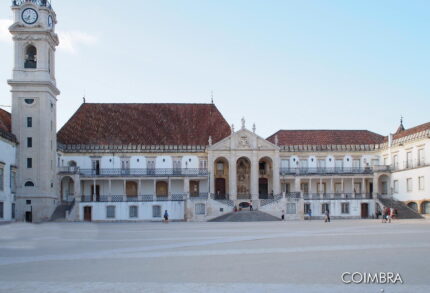
The University of Coimbra, the city's iconic landmark
The University of Coimbra, the city’s iconic landmark

Coimbra

Coimbra is the Portuguese city with the strongest university tradition. Located in the province of Beira Litoral, Coimbra is the largest city in the Centre region of Portugal. Coimbra is a city associated with youth, knowledge, movement and a relaxed atmosphere, owing to the strong presence of the University. The University of Coimbra is one of the oldest universities in Europe and the city with the most students in Portugal, with approximately thirty thousand students every year. At the University and throughout the city, students can be seen wearing the black and white academic gown. Academic traditions and fado occupy an important place in the dynamism and tourism of Coimbra.
The city of Coimbra

The city of Coimbra can be divided into two main areas:

  • Cidade Alta: this area offers a unique view over the city and the Mondego River. On this hill stands a university complex unique in Portugal, which includes: the University of Coimbra, the Biblioteca Joanina, the Capela de São Miguel, the Medieval and Academic Prison, the Sala das Armas, the Sala dos Capelos, the Sala do Exame Privado and the University Tower.
  • Baixa da Cidade: the Baixa of Coimbra is the city’s prime commercial area, offering a wide variety of establishments to visitors, including craft shops, second-hand bookshops, fado houses, bars, hotels, hostels, museums, repúblicas and art galleries.

City centre of Coimbra

The city centre of Coimbra is composed of the Alta da Cidade, the Praça do Comércio, Rua Ferreira Borges and Praça 8 de Maio — the places where the main shops are found, along streets lined with historic buildings. At the top of the Alta da Cidade stands the University of Coimbra; in the lower area, facing the Mondego River, is the main entrance of Rua Ferreira Borges, a pedestrian zone. Entering opposite the Ponte de Santa Clara over the Mondego River, through the Largo da Portagem, visitors will find a garden and the monument in honour of Joaquim António de Aguiar, surrounded by historic buildings of the city of Coimbra, notably the Bank of Portugal building. Rua Ferreira Borges is a pedestrian street paved with traditional Portuguese cobblestone, narrowed by the architecture of the old city, with residential buildings, clothing shops, banks, jewellers, restaurants, cafés with outdoor terraces, pharmacies, services and a side street leading to the monumental zone of Coimbra, accessed from the Porta de Barbacã. At the end of Rua Ferreira Borges stands Praça 8 de Maio, with the imposing Igreja de Santa Cruz, the Câmara Municipal de Coimbra and the Mosteiro de Santa Cruz de Coimbra. Running parallel to Rua Ferreira Borges is the Praça do Comércio, a spacious square with restaurants, shops, the Igreja de São Tiago and the Igreja de São Bartolomeu. From here, visitors can wander through the narrow streets, appreciate the historic architecture and photograph the details as they make their way up to the University at the top of the hill.

Places to visit in Coimbra (top 10)

1. University of Coimbra

University of Coimbra: the University of Coimbra is the city’s iconic landmark. This university city is located in the upper part of the city. The complex centres on the Pátio das Escolas, a courtyard where thousands of young people in academic gowns can be seen constantly moving from place to place. Founded in 1290, the University of Coimbra comprises a vast complex including:

  • Biblioteca Joanina: a library built in 1717, housing a collection of more than 60,000 volumes.
  • Capela de São Miguel: this chapel was inaugurated in 1517. Its main highlight is a Baroque organ built in 1733.
  • Medieval and Academic Prison: the only medieval prison still in existence in Portugal.
  • Sala das Armas: the venue for certain academic ceremonies.
  • Sala dos Capelos: the Sala dos Capelos is where the University’s most important ceremonies take place, including:
    1. Solemn Doctoral graduations,
    2. the Investiture of the Rector, and
    3. the Solemn Opening of Classes.
  • Sala do Exame Privado: this was the room where, until the 19th century, the private examination was held before proceeding to a Doctorate. The room contains portraits of the rectors of the University of Coimbra from the 16th to the 18th centuries.
  • University Tower: this tower was built to mark the beginning and end of the academic day through its bells. It was inaugurated in 1733. The Tower offers a unique view over the entire city.
  • Geophysical and Astronomical Observatory: the observatory of the University of Coimbra, created during the Pombaline Reform of the University. In 1951 it received new facilities at Alto de Santa Clara. This Observatory conducts research in Astronomy and Astrophysics as part of European Space Agency programmes. The Observatory includes a museum with a collection of astronomical and terrestrial observation and measurement instruments, as well as a collection of maps and celestial charts from the 17th and 19th centuries.
  • Statue of Dom Dinis: an imposing statue situated in Praça Dom Dinis, at the entrance to the University of Coimbra, paying tribute to King Dom Dinis, who was responsible for founding the University of Coimbra on 1 March 1290, when he signed “Scientiae thesaurus mirabilis” — the document brokered and confirmed by the Pope — thereby establishing the Estudo Geral, which brought together the universities in Lisbon and was subsequently transferred to the Royal Palace of Coimbra during the 14th century.
  • Porta Férrea: an imposing gateway featuring representations of the figure of Wisdom, of Law and Medicine, of Theology and Canon Law, the figure of King Dom João III and the figure of King Dom Dinis, the founder of the University. The Porta Férrea stands at the entrance to the former Paço da Alcáçova, the citadel of Coimbra. Today it serves as the entrance to the Paço das Escolas, where visitors will find the Via Latina, an imposing 17th-century stairway designed to facilitate access to the Paço Reitoral, the Sala dos Capelos and the Gerais.
  • The University Tower of Coimbra: home to the clock that marked the University’s hourly schedule, and the bell that defined the institution’s functioning through its sound signal. The Tower is accessed via a stairway of 180 steps along its 34 metres of height.
  • The Biblioteca Joanina, a historic multi-storey library housed in a Baroque architecture building.
  • The Academic Prison, a historic prison where University of Coimbra staff, students or professors could be tried and temporarily held as a disciplinary measure until 1834.

The University of Coimbra offers visitors three guided routes:

  1. Memorial da Irmã Lúcia: a memorial dedicated to Sister Lúcia, one of the three children who, according to believers, witnessed the miracle of Nossa Senhora de Fátima in 1917. The Memorial is located next to the Carmelo de Santa Teresa. It recreates the life of Sister Lúcia from the time of the Fátima Apparitions until her death on 13 February 2005.
  2. Museu da Água: a museum located in the Parque Dr. Manuel de Braga. It is housed in a former water intake station well worth visiting for its ancient tunnels and the water source it contains.
  3. Museu da Ciência: the Science Museum of the University of Coimbra aims to bring science to all types of visitors. In this Museum it is possible to travel back in time by visiting an 18th-century physics laboratory. The Museu da Ciência incorporates the Museums of Physics, Zoology, Mineralogy and Botany.

2. Portugal dos Pequenitos

Portugal dos Pequenitos: a theme park where children and adults learn while feeling like giants. Portugal dos Pequenitos was created by Bissaya Barreto in 1940, featuring small-scale representations of Portuguese regional houses, the main monuments of Portugal, representations of the cultures and monuments of Portuguese-speaking African countries, Brazil, Macau, India and Timor. The Portugal dos Pequenitos theme park includes train rides and pedal boat trips on the mini waterfalls. Among the monuments represented in the park, highlights include the Torre de Belém, the Mosteiro dos Jerónimos, the University of Coimbra and the traditional houses of each region of Portugal.

3. Mosteiro de Santa Cruz – National Pantheon

Igreja de Santa Cruz – National Pantheon: the most important church in Coimbra, declared a National Monument, with Romanesque and Manueline architecture, inaugurated in the 12th century. The Igreja de Santa Cruz holds the status of National Pantheon, recognised in 2003. Among the great Portuguese figures buried here are the first two kings of Portugal, Dom Afonso Henriques and his son Dom Sancho I. Jardim da Sereia or Parque de Santa Cruz: forms part of the Mosteiro de Santa Cruz complex. This park incorporates the Terreiro do jogo da Pela, a waterfall and the Fonte da Nogueira featuring a Triton, mistaken for a mermaid by the people of Coimbra. In the Parque de Santa Cruz there is a sports area with the Campo de Santa Cruz, for football and basketball.

4. Sé Velha de Coimbra

Sé Velha: the Cathedral or “Sé Velha” of Coimbra is a historic building declared a National Monument, with Romanesque, Gothic and Renaissance architectural styles, inaugurated in 1184. The Sé Velha de Coimbra is noted for the Porta Especiosa, the altarpiece of the chancel, and the Chapel of the Blessed Sacrament, which has the distinctive feature of allowing sunlight to enter the Cathedral on sunny days.

5. Conímbriga – ruins and monographic museum

Conímbriga: an ancient settlement located 17 km from the city of Coimbra, inhabited from the Copper Age until the 9th century. Today it is the largest Roman city in Portugal, classified as a National Monument. Here visitors can explore the ruins of the ancient settlement and the Museu Monográfico de Conímbriga, with an exhibition of artefacts uncovered during archaeological excavations.

6. Jardim Botânico da Universidade de Coimbra

Jardim Botânico da Universidade de Coimbra: a botanical garden with a collection of tropical plants, daffodils, ornithogalum, succulents, conifers and other species distributed across an area of 13.5 hectares. The Jardim Botânico da Universidade de Coimbra was founded in 1772 by order of the Marquis of Pombal as an integral part of the “Natural History Museum”. The Garden is located near the Department of Life Sciences of the University of Science and Technology of the University of Coimbra. The Garden is a member of the Ibero-Macaronesian Association of Botanical Gardens and of BGCI (Botanical Gardens Conservation International). This garden was created as part of the Marquis of Pombal’s reform of the University of Coimbra, with the aim of integrating and studying vegetation from around the world. The Botanical Garden is noted for its rich and lush nature, its fountains of unusual architectural beauty, the existence of a maze garden, its greenhouses, and for being a unique setting for outdoor activities. Here in the Botanical Garden, an ancient hydraulic system can be seen in operation.

7. Mata Nacional do Choupal

Mata Nacional do Choupal: an 80-hectare forested area created in the 18th century, planted with Poplar, Alder, Ash, Willow, Elm and Nettle Tree varieties, with the aim of protecting the coastal area of Coimbra from flooding by the Mondego River. Today it is one of the most popular open spaces among the people of Coimbra for recreation, leisure and sport.

8. Convento de São Francisco

Convento São Francisco: a 17th-century building of Mannerist architecture, originally conceived to house Franciscan monks. Since 2016 it has been transformed into a premier venue for national and international congresses, symposia and corporate events, positioned within the business tourism sector (MICE — Meetings, Incentives, Conferences and Exhibitions). The main auditorium of the Convento de São Francisco has a capacity of 1,125 seats, with a total capacity across all rooms and auditoriums of approximately 5,000 seats. The tourist attractions of the Convento de São Francisco are the church façade, the architectural details of the building and regular cultural events.

9. Parque da Cidade Manuel Braga

Parque da Cidade Manuel Braga: a park situated near the Mondego River. In the park, visitors will find the Museu da Água, the former Barcas Serranas used to transport goods between Penacova and Figueira da Foz, a bandstand from 1904, and various sculptures honouring personalities who lived in Portugal, including the commemorative bust of the writer Antero de Quental, a monument honouring the poet Florbela Espanca, the poet and writer António Arnaut, a statue commemorating 40 years of literary life by Manuel Alegre, and the monument honouring Dr. Manuel Braga, the great promoter of the city of Coimbra’s green spaces.

10. Mosteiro de Santa Clara-a-Velha

Mosteiro de Santa Clara-a-Velha: also known as the Mosteiro de Santa Clara de Coimbra, this is a 13th-century mendicant Gothic architecture monastery. The monastery was enlarged by decision of Queen Saint Isabel, who ordered the construction of the cloister and the church. The monastery was eventually abandoned due to constant flooding by the Mondego River. The Mosteiro de Santa Clara-a-Velha is noted for the imposing size of the cloister, the garden and the archaeological excavations visible on the exterior. Here there is an interpretation centre where visitors can learn about the history of the Monastery and view the collection of porcelain and faience, rosaries, rings and many other objects left behind by the Poor Clare nuns who lived in enclosure. The interpretation centre of the Mosteiro de Santa Clara-a-Velha is housed in a 1,000 m² space comprising the museum of the Mosteiro de Santa Clara-a-Velha, an auditorium, exhibition rooms, a shop and a café.

Other places to explore in the city of Coimbra and surroundings

  • Parque Verde do Mondego: a park located on the banks of the Mondego River next to the Ponte Pedonal Pedro e Inês, connected to the Parque Choupalino, situated on the western bank of the river, where visitors will find the Clube Fluvial de Coimbra, the Praia Fluvial do Choupalinho and companies offering water sports activities, including Stand Up Paddle, the Secção de Desportos Náuticos da AAC, historic monuments and major attractions, notably the Mosteiro de Santa Clara-a-Velha and Portugal dos Pequenitos. This area incorporates extensive green spaces, restaurants, the Piscinas Jaime Lobo, a children’s playground and exhibition centres.

Porta de Barbacã

Porta de Barbacã: also known as the Porta e Torre de Almedina, this is the main entrance to the walled historic core of the old city of Coimbra, accessed from the Porta da Barbacã, located on Rua Ferreira Borges.

Museu Nacional de Machado de Castro

Museu Nacional de Machado de Castro: one of the most important fine arts museums in Portugal, housed in the former Paço Episcopal de Coimbra and a large new building. The Museu Nacional de Machado de Castro holds a collection spanning more than two thousand years of history, comprising several thousand pieces of archaeology, sculpture, goldsmithery, jewellery, painting, drawing, ceramics, textiles, furniture and 120 pieces belonging to the National Treasure of Portugal.

Exploratório – Centro Ciência Viva de Coimbra

Exploratório – Centro Ciência Viva de Coimbra: was the first science centre to be created in Portugal. Today its role is to promote scientific culture in the Centre region of Portugal, in association with the University of Coimbra, the Câmara Municipal de Coimbra, the Instituto Politécnico de Coimbra and the Fundação Bissaya Barreto. The Exploratório is housed in a building beside the Mondego River, where visitors can experience 360° films in the Hemispherium — a cinema room with a dome-shaped ceiling — visit the exhibition “Em Forma com a Ciência” dedicated to health-related themes, organised into seven topics corresponding to each of the human body systems controlled by the brain; and enjoy many activities dedicated to younger visitors.

PO.RO.S – Museu Portugal Romano em Sicó

PO.RO.S – Museu Portugal Romano em Sicó: an innovative interactive museum using technologies that stimulate the senses, representing themes related to the Roman presence in the Terras de Sicó, with the aim of promoting the cultural history of the Sicó lands, within the realm of Conímbriga. The museum building houses a café serving regional products and a terrace with views over the Parque Verde da Ribeira de Bruscos. PO.RO.S – Museu Portugal Romano em Sicó is a museum recommended for adults and children alike, offering an easy and enjoyable way to learn about the civilisations of the Roman Empire.

Igreja de Santo António dos Olivais

Igreja de Santo António dos Olivais: a historic 13th-century church with a portico and an imposing stairway, flanked by six chapels with clay figures depicting scenes from the life of Christ.

Jardim da Manga

Jardim da Manga: also known as the Claustro da Manga, this is a 16th-century Renaissance courtyard classified as a National Monument.

Sé Nova de Coimbra

  • Sé Nova: the seat of the Diocese of Coimbra and the Parish of the Sé Nova, housed in a building of Mannerist and Baroque architectural styles. Construction of the Sé Nova de Coimbra began in 1598 and was completed in 1698. The attractions of the Sé Nova de Coimbra are its imposing façade overlooking the Largo Feira dos Estudantes, the cloister and the altar richly decorated with gilded woodwork.

Moinhos de Gavinhos

Moinhos de Gavinhos: the iconic landmarks of Figueira de Lorvão. They consist of 14 former windmills used for grinding cereals, situated at the top of the settlement of Gavinhos, with a panoramic view over the Serra do Buçaco and the Serra da Aveleira. It is a natural setting very popular for walking, landscape photography and watching the sunset. Here there is a children’s playground and a café bar.

Piscina Natural de Ançã

Piscina Natural de Ançã: a natural pool with a stone bed, fed by the Fonte de Ança, which delivers more than 20,000 litres of water per minute. This is the source of Ançã stone, a type of natural stone historically used in monuments such as the Mosteiro da Batalha.

Monumento a Joaquim António de Aguiar

Monumento a Joaquim António de Aguiar: a statue in honour of Joaquim António de Aguiar, the Portuguese politician known as “Mata-Frades” (Friar-Killer), responsible for the decree of 30 May 1834, which declared extinct “all convents, monasteries, colleges, hospices and any other houses of the regular religious orders”, with their assets secularised and incorporated into the National Treasury of the Portuguese State. The statue stands in the Largo da Portagem, the entrance to the historic area of Coimbra — an important meeting point where former merchants paid their taxes before entering the city. Today it is a pleasant spot facing the Mondego River, with outdoor café terraces and the entrance to the city’s pedestrian commercial zone.

Capela de São Miguel

The Capela de São Miguel is a 16th-century Manueline architecture chapel, located at the University of Coimbra, classified as a National Monument and UNESCO World Heritage Site. The attractions of the chapel are the Manueline-style Portal, the main altarpiece richly decorated with gilded woodwork, the imposing organ, and the ceilings painted with colourful engravings and the symbol of the Portuguese crown.

Quinta das Lágrimas

Quinta das Lágrimas: a place steeped in history, with centuries-old trees, medieval and neo-Gothic ruins, created in the 14th century with the aim of carrying water from two springs to the Convento de Santa Clara, on what was then the Quinta do Pombal. Today the Quinta das Lágrimas consists of an 18-hectare garden surrounding the Quinta das Lágrimas, a 19th-century palace converted into a luxury hotel. In the Quinta das Lágrimas, visitors will find the Fonte do Amor and the Fonte das Lágrimas, the place where the letters written by Dom Pedro I to Dona Inês de Castro were delivered. This estate owes its name to having been the site of the romance between the Portuguese king Dom Pedro and Dona Inês de Castro, and where Dona Inês is said to have been murdered.

Miradouro de Penacova

Miradouro de Penacova: also known as the Mirante Emydgio da Silva, this is a viewpoint facing the former hotel of Penacova, with a dome dating from 1908, from which there is a magnificent panoramic view over the Mondego valley at Penacova.

Livraria do Mondego

Livraria do Mondego: a geological monument of natural rock composed of Ordovician quartzites, situated on the banks of the Mondego River near Penacova. This geological monument was sculpted over hundreds of millions of years through river erosion and the pressure of tectonic forces, creating a spectacular form of vertically carved rock that resembles books on a shelf, visible from the N2 road. A wooden walkway allows visitors to view the Livraria do Mondego.

Aqueduto de São Sebastião

Aqueduto de São Sebastião: also known as the Arcos do Jardim, this is a stone Roman aqueduct composed of 21 arches, restored in the 16th century and classified as a National Monument, which formerly supplied the upper part of the city of Coimbra. The aqueduct is located next to the Jardim Botânico da Universidade de Coimbra.

À Capela

À Capela: a fado house in Coimbra housed in the 14th-century Capela de Nossa Senhora da Vitória, a historic building classified as a Heritage Site of Municipal Interest. The venue offers daily performances and a dining service.

Igreja de São Tiago

Igreja de São Tiago: one of the great Romanesque monuments of the city of Coimbra, dating from the 12th century. The Igreja de São Tiago is located in the Praça do Comércio in the heart of Coimbra’s historic centre. The church is one of the starting points for pilgrims on the way to Santiago de Compostela.

Miradouro Penedo da Saudade

Miradouro Penedo da Saudade: the place where, according to legend, King Dom Pedro went to mourn the death of Dona Inês. This rocky outcrop includes a garden and busts of figures from Portuguese culture, including António Nobre and Eça de Queiroz. From the Miradouro Penedo da Saudade, there is a panoramic view over the eastern part of the city as far as the Mondego River, the Serra do Roxo and the Serra da Lousã. Throughout the Penedo da Saudade, numerous love poems and dedications can be found written on stones.

Ponte Rainha Santa Isabel

The Ponte Rainha Santa Isabel is the bridge inaugurated in 2004 over the Mondego River, providing faster access to the southern area of the city of Coimbra.

Lapa dos Esteios

Lapa dos Esteios: also known as the Quinta das Canas, it is situated on the left bank of the Mondego River at the southern exit of Coimbra, next to the Ponte Rainha Santa Isabel. The highlights of the Quinta das Canas are the viewpoint offering a panoramic view over Coimbra and the Mondego River, a forest with vegetation from around the world, marble plaques embedded in the rock celebrating artists of the city, and a fountain surrounded by statues that all face away from the city.

Reserva Natural do Paul de Arzila

Reserva Natural do Paul de Arzila: a natural park of pine trees located outside the city, on the left bank of the Mondego River. This natural park is characterised by a very varied flora, composed of yellow iris, mare’s tail, poplars, willows, eucalyptus and pine trees. This natural park is a privileged area in Coimbra for observing migratory birds that come here to nest.

Mata Nacional de Vale de Canas

Mata Nacional de Vale de Canas: inaugurated in the 16th century, it encompasses a varied fauna and flora. It is home to the largest eucalyptus tree in Europe, standing approximately 75 metres tall. Here visitors can walk, have picnics and take part in outdoor sports activities, including running and mountain biking.

Shopping centres in Coimbra

Fórum Coimbra

Fórum Coimbra: the largest and most popular shopping centre in Coimbra, spread across three floors with 147 shops, including a restaurant area, a Continente hypermarket, a Fnac store, six cinema screens and parking.

Alma Shopping

Alma Shopping: a shopping centre with 4 floors, 114 shops, an Auchan hypermarket, a restaurant area, a cinema and other services.

Coimbra Shopping

Coimbra Shopping is a shopping centre with 2 floors, approximately 60 shops, a Continente hypermarket, a restaurant area and other services.

  • Parque Linear do Vale das Flores: a park with a pedestrian circuit and a children’s playground in the centre of the urban area, facing Coimbra Shopping. It is one of the pleasant spots in Coimbra for outdoor sports activities.

Places to visit near Coimbra

Museu do Azeite

Museu do Azeite: a museum housed in a highly contemporary building shaped like an olive branch, dedicated to the millennia-old history of olive oil production, located in the former Roman city of Bobadela, Oliveira do Hospital, near the Serra da Estrela. The collection of the Museu do Azeite presents the machines and processes developed over time for the extraction of olive oil, highlighting the history and heritage of the region alongside its contribution to tourism development. The museum houses the “Cantinho da Ciência”, a space with activities for younger visitors featuring interactive educational games, where young people play at being scientists as they discover the process from olive cultivation to olive oil production.

Lousã

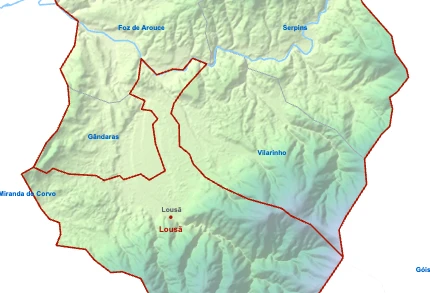
Lousã: a town in the district of Coimbra with around 18,000 inhabitants. Lousã has been inhabited since Roman times, as its subsoil is rich in gold. Lousã received a charter in 1513 during the reign of Dom Manuel I. In the 18th century the town grew thanks to the paper and spinning industries. Today Lousã is noted for its crafts, including basketry, ceramics and embroidery. The gastronomy of Lousã features roast kid, chanfana, migas, tibornada no Lagar, cornbread and rice pudding. In Lousã, the main attractions are:

  • Serra da Lousã, a mountain range with an altitude of 1,205 metres at its highest point at Trevim, forming part of the Montejunto-Estrela system. The Serra da Lousã is known for containing 12 of the 27 Schist Villages of Portugal, namely the villages of Aigra Nova, Aigra Velha, Candal, Casal de São Simão, Casal Novo, Cerdeira, Chiqueiro, Comareira, Ferraria de São João, Gondramaz, Pena and Talasnal. In addition to the Schist Villages in the Serra da Lousã, visitors will also find
  • the Parque Biológico da Serra da Lousã, a park that maintains the largest sample of wild fauna in Portugal, with the aim of preserving the wild species present in the territory. Here visitors can walk and observe eagles, owls, lynx, wolves, foxes, wild boar, fallow deer, red deer, roe deer, goats and other wild animals.
  • Castelo da Lousã: also known as the Castelo de Arouce, this is an 11th-century medieval castle classified as a National Monument, located on the right bank of the Arouce River. The castle is in good condition. Near the Castelo da Lousã, visitors can explore the Santuário de Nossa Senhora da Piedade, located near a waterfall beside a river beach, and the Miradouro da Piedade with views over the Castelo da Lousã and the Santuário Senhora da Piedade.
  • Baloiço da Lousã: a wooden swing built at 1,205 metres, at the Alto de Trevim, the highest point of the Serra da Lousã. The swing is very popular for photography and the stunning landscape, commonly known as the most famous swing in Portugal.

Figueira da Foz

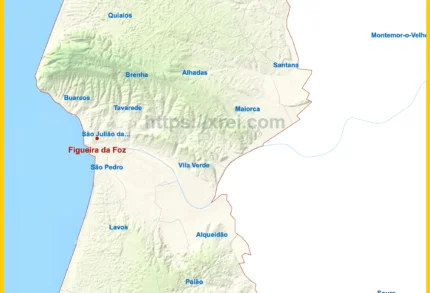
Figueira da Foz: the most important coastal city in the district of Coimbra, located approximately 40 km from the city of Coimbra, with approximately 59,000 inhabitants. Figueira da Foz is a seaside attraction that draws large numbers of tourists during the summer thanks to its extensive beaches, transforming into a unique cosmopolitan hub in the region. The notable heritage of Figueira da Foz includes the Museu Municipal Dr. Santos Rocha, the Igreja de São Julião, the Núcleo Museológico do Mar and the Forte de Santa Catarina. The gastronomy of Figueira da Foz features a number of specialities, including Figueira fish soup, Costa da Figueira prawns, raia de Pitau and the sweet pastries Brisas da Figueira.

  • Casino Figueira: the iconic landmark of Figueira da Foz, inaugurated in the late 19th century. Casino Figueira is a casino with gaming rooms for roulette, blackjack and poker, slot machines and a theatre room hosting many international arts and entertainment shows.
  • Praia de Quiaios: the beach of the small settlement of Murtinheira, a wild beach located to the north of Figueira da Foz, with an extensive stretch of sand and a landscape framed by the Serra da Boa Viagem.

Montemor-o-Velho

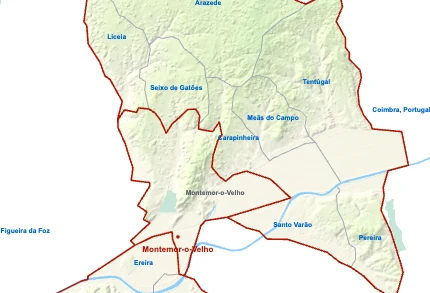
Montemor-o-Velho: a town in a strategic location in the district of Coimbra, approximately 20 km from the city of Figueira da Foz. Montemor-o-Velho has a rich heritage, fauna and flora, notably the Castelo de Montemor-o-Velho, an 11th-century castle in good condition, situated in a dominant position above the town on the right bank of the Mondego River. Within the castle walls stands the Igreja de Santa Maria da Alcáçova, an 11th-century church restored over the centuries. In Montemor-o-Velho, visitors will also find the Reserva Natural do Paúl de Arzila. In this municipality, unique gastronomic specialities can be enjoyed, including lamprey rice, fried shad, pastéis de Tentúgal and the sweet pastries Papos de Anjo.

Góis

Góis: a municipality in the district of Coimbra, located to the east of Coimbra. In Góis, highlights include the Igreja Matriz de Góis, the Igreja da Misericórdia, the Ecomuseu de Góis, the Praia Fluvial da Peneda and the Praia Fluvial das Canaveias.

Pampilhosa da Serra

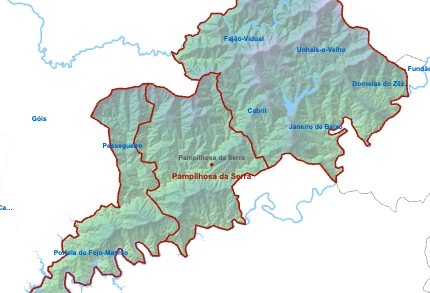
Pampilhosa da Serra: a town with fantastic views and the Cascata da Serra da Boa Viagem, a waterfall that unfortunately dries up during the warmest months. The heritage of Pampilhosa da Serra includes the Igreja Matriz, the Capela da Misericórdia, the Capela de Santo António, the Capela de São Sebastião, the Capela de São Jerónimo, the Museu Municipal and the Miradouro do Cristo Rei de Pampilhosa da Serra. Here visitors will also find the Praia Fluvial de Dornelas do Zêzere and the Praia Fluvial de Janeiro de Baixo.

Penacova

Penacova: a town located 22 km from Coimbra on the right bank of the Mondego River, surrounded by the Serra do Buçaco and the Serra do Roxo, offering a lush and unique landscape. In Penacova, highlights include the Igreja Matriz, the Capela da Senhora do Monte Alto, the Capela de Nossa Senhora da Guia, the Quinta da Ribeira, the Miradouro Raúl Lino, the Mosteiro de Lorvão, the Barragem da Aguieira and the Moinhos de Gavinhos.

Mata do Buçaco

Mata do Buçaco: the Mata Nacional do Buçaco, located in the Serra do Buçaco in the municipality of Mealhada, was planted by the Discalced Carmelite religious order in the 17th century. Here stands a convent that functioned between 1628 and 1834, when the religious orders in Portugal were dissolved. The Royal Palace of the Mata Nacional do Buçaco was built in 1888. The Mata do Buçaco was the scene of one of the most important battles against Napoleon’s troops on 27 September 1810, inflicting a heavy defeat on General Massena. In this location, the Convento de Santa Cruz do Buçaco, the Museu Militar do Buçaco and the Palácio do Buçaco are all well worth visiting.

  • Palácio do Buçaco: a hotel housed in a 19th-century Manueline-style palace, classified as a National Monument and Property of Public Interest, considered the last legacy of the kings of Portugal. The building is decorated with tile panels, frescoes and paintings depicting the Portuguese Age of Discovery, evoking Os Lusíadas, the Autos of Gil Vicente and the Peninsular War, graceful sculptures by António Gonçalves and Costa Mota, canvases by João Vaz illustrating verses from the maritime epic of Luís Vaz de Camões, frescoes by António Ramalho and paintings by Carlos Reis.

Cantanhede

Cantanhede: a city and municipality seat divided into 14 parishes: Ançã, Cadima, Cantanhede e Pocariça, Cordinhã, Covões e Camarneira, Febres, Murtede, Ourentã, Portunhos e Outil, Sanguinheira, São Caetano, Sepins e Bolho, Tocha, and Vilamar e Corticeiro de Cima. In Cantanhede, visitors can explore:

  • the Museu da Pedra, with an excellent exhibition of archaeological pieces dating from the Palaeolithic, fossils more than 65 million years old and a fascinating display of ZX Spectrum and Sinclair computers. Cantanhede is located 34 minutes from Figueira da Foz.

Serra do Açor

Serra do Açor: a mountain range in central Portugal, close to the Serra da Estrela, covering the municipalities of Arganil, Pampilhosa da Serra, Covilhã, Seia, Oliveira do Hospital and Góis. The highest point of the Serra do Açor is the Pico de Cebola, at 1,418 metres of altitude. In the Serra do Açor, visitors will find:

  • Cascata da Fraga da Pena: a 20-metre waterfall cascading through schist rock and native vegetation. The Cascata da Fraga da Pena is one of the main attractions of the Serra do Açor.

Piódão

Piódão: a village classified as a Property of Public Interest and one of Portugal’s typical traditional villages. In Piódão, visitors can explore the Capela de São Pedro, the Capela de São João, the Capela de Santa Bárbara, the Capela da Senhora da Saúde and the Capela da Senhora do Bom Parto. Here visitors will also find the Praia Fluvial de Piódão, situated on the Piódão stream.

Arganil

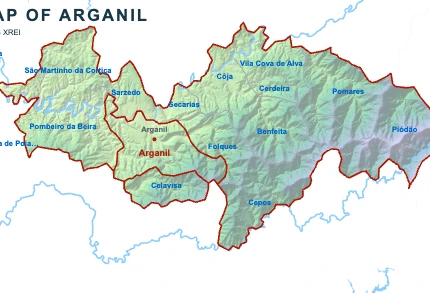
Arganil: a town and municipality seat with 14 parishes: Arganil, Benfeita, Celavisa, Cepos e Teixeira, Cerdeira e Moura da Serra, Côja e Barril de Alva, Folques, Piódão, Pomares, Pombeiro da Beira, São Martinho da Cortiça, Sarzedo, Secarias and Vila Cova de Alva e Anseriz.

Castelo de Penela

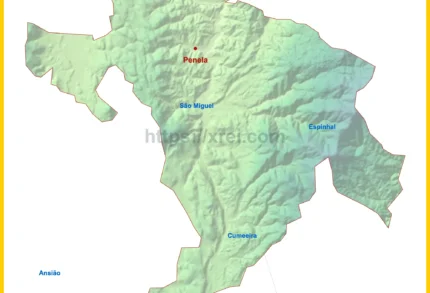
Castelo de Penela: a 12th-century medieval Gothic castle built on a hillside above the settlement of Penela. Inside the castle, visitors can explore the Igreja Matriz de São Miguel de Penela.

Cascata da Pedra da Ferida

Cascata da Pedra da Ferida: a waterfall located in the Serra do Espinhal, with a 25-metre drop through rock and vegetation.

Festivals and Fairs of Coimbra

  • Festas da Cidade de Coimbra e da Rainha Santa Isabel: held annually in July to honour the patron saint Santa Isabel. This festival takes place with a nocturnal procession and a daytime procession.
  • Feira Medieval de Coimbra: held annually in July at the Largo da Sé Velha.
  • Feira dos Lázaros: held on the Sunday of São Lázaro with the aim of recreating an ancient tradition of Coimbra, featuring the arrufadas game and the sale of sweets by children.
  • Feira de Gastronomia e Artesanato: held annually in July.
  • Festa das Latas dos Estudantes da Universidade de Coimbra: held annually in October. It is the welcome celebration for new students at the University. Over the course of one week, concerts, cultural and sports activities take place, ending with an academic procession through the city streets.
  • Queima das Fitas dos Estudantes da Universidade de Coimbra: held annually in May, this is the largest student festival in Europe. The celebration takes place over eight days, matching the number of faculties that make up the University of Coimbra. The Queima das Fitas week begins with the Serenata Monumental on the steps of the Sé Velha, followed by the University Gala Ball, the Garraiada, the Venda da Pasta, the Queima do Grelo and the Cortejo dos Quartanistas.

The gastronomy of Coimbra

The gastronomy of Coimbra is rich and varied. The typical dishes of this region include specialities unique in the world:

  • Arroz de Lampreia
  • Arroz doce à moda de Coimbra
  • Chanfana
  • Leitão Assado da Bairrada
  • Sopa de Casamento

The crafts of Coimbra

The crafts of the Coimbra region include traditions such as rag quilts, embroidery, tinwork, black clay pieces, ceramic items, wicker basketry, basket weaving, grain sacks and doormats.

The economy of Coimbra

The economy of the district of Coimbra is highly dynamic and innovative in Portugal. It is in Coimbra that the Instituto Pedro Nunes is found, considered the best technology incubator in the world, a distinction awarded through the Best Science Incubator prize. The great majority of businesses are concentrated in services, commerce and the real estate sector. In the manufacturing industries, the most notable are the bread-making industry, the timber industry, the cork industry, the non-metallic minerals industry and the metalwork products industry. Most of these industries are located in the two industrial parks in the city: the Parque Industrial de Eiras and the Parque Industrial de Taveiro. Coimbra is an important tourist attraction, with 3.3% of hotel establishments and 2.1% of available beds in the country located in this region. In Coimbra, agriculture continues to play a relevant role in the economy. Among the main agricultural produce are rice, maize, vegetables, fruit and wine.

Geographical location and climate

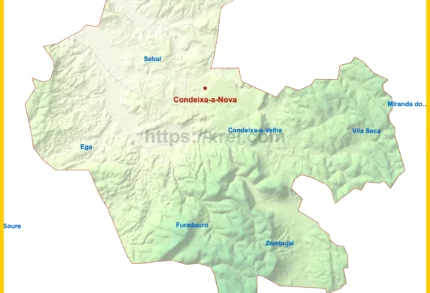
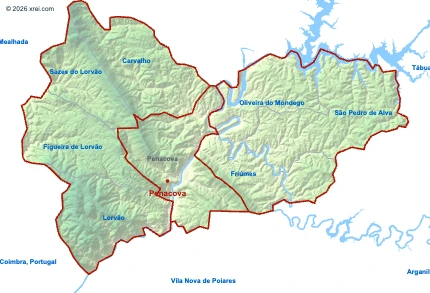
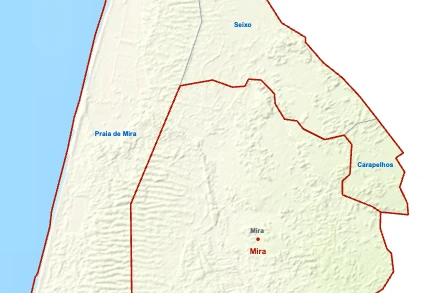
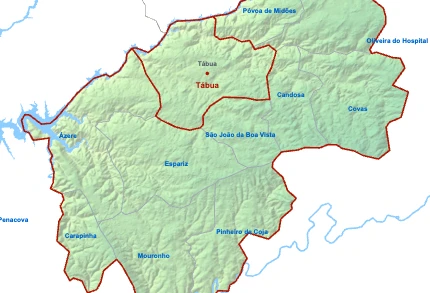
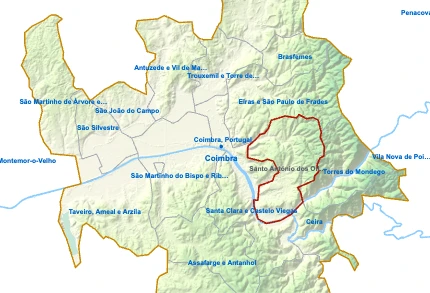
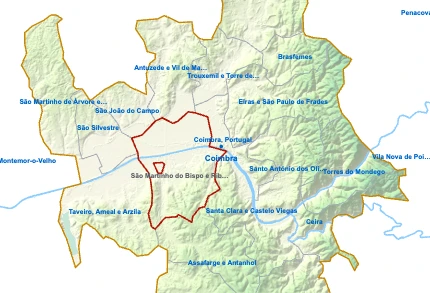
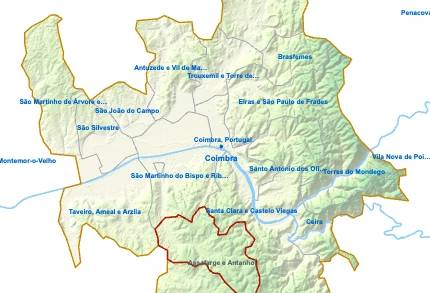
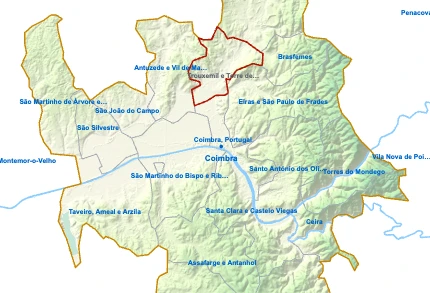
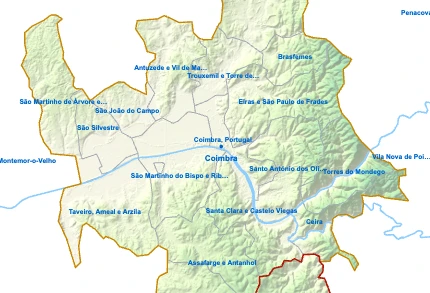
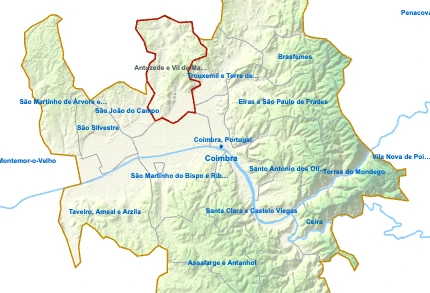
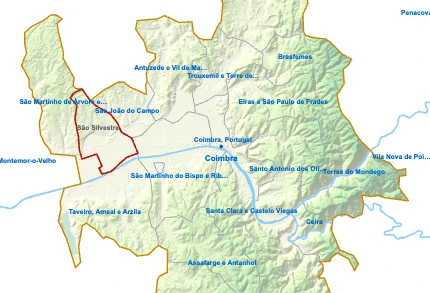
Coimbra is a city located in the centre region of Portugal, situated approximately 122 km from the city of Porto and approximately 207 km from Lisbon. A native of Coimbra is called a coimbrão, conimbricense or conimbrigense. The district of Coimbra has a mild climate with temperatures ranging between 30°C in summer and between 5°C and 14°C in winter. The district of Coimbra borders the districts of Aveiro and Viseu to the north, the district of Guarda to the northeast, the district of Castelo Branco to the east, the district of Leiria to the south and the Atlantic Ocean to the west. The district of Coimbra is divided into 17 municipalities, namely:

  • Arganil
  • Cantanhede
  • Coimbra
  • Condeixa-a-Nova
  • Figueira da Foz
  • Góis
  • Lousã
  • Mira
  • Miranda do Corvo
  • Montemor-o-Velho
  • Oliveira do Hospital
  • Pampilhosa da Serra
  • Penacova
  • Penela
  • Soure
  • Tábua
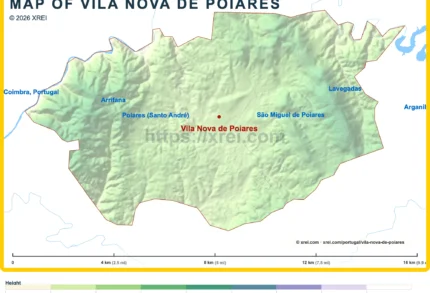
  • Vila Nova de Poiares

The most important mountain ranges in the district of Coimbra are the Açor, Lousã, Cabeço do Souto, Vieiro and Urra. The most important rivers in the district of Coimbra are: the Alva, Arunca, Corvo, Mondego and Seia. The Mondego River is the longest river flowing entirely within Portugal, with a length of 227 km. It rises in the Serra da Estrela at an altitude of 1,425 metres, in the locality of Mondeguinho in the municipality of Guarda, and flows into the sea at Figueira da Foz. The Mondego River basin covers an area of 6,644 km² and includes locations offering unique landscapes, notably the Barragens de Aguieira e Raiva and the Livraria do Mondego in Penacova.

Quick Facts about Coimbra

  • Population of the Coimbra region: approximately 433,000 inhabitants
  • Population of the city of Coimbra: approximately 134,000 inhabitants
  • Area: 319.4 km²
  • Year of municipal foundation: 1111
  • District: Coimbra
  • Former Province: Beira Litoral
  • Patron Saint: Santa Isabel de Portugal
  • Municipal holiday: 4 July

Estamos Cerca de Ti

XREI opera desde oficinas en todo Portugal — desde Oporto hasta el Algarve.

Norte

Oporto — Edificio ICON

Rua Direita de Francos, 165 Piso 1 · 4100-211 Porto

Gran Lisboa

Lisboa — Rua Castilho

Rua Castilho, 39 · 1250-068 Lisboa

Gran Lisboa

Estoril

Avenida Aida, 353A · 2765-187 Estoril

Costa Alentejana

Comporta

Av. 18 Dezembro, 37 · 7570-779 Carvalhal

Algarve

Vilamoura — Marina Plaza

Av. da Marina, 3 · Marina Plaza Loja 14/15 · 8125-401 Quarteira