Algarve, Portugal

Algarve, Portugal

The Algarve is southern Portugal
The Algarve is southern Portugal’s premier region, with stable economic growth and a high quality of life, known for its beaches, golf, tradition and the contrast between its fishing and farming communities…

The Algarve, southern Portugal

The Algarve is the tourist region located in the south of Portugal, with a coastline washed by the Atlantic Ocean to the south and west. Recognised as the country’s foremost beach destination, home to world-renowned golf courses and one of Europe’s top holiday destinations, the region stands out for its outstanding natural beauty, appealing climate and the large number of towns and villages whose religious, historical and cultural heritage is plain to see. The Algarve is often divided into two parts: the Barlavento and the Sotavento. The Barlavento covers the western zone, encompassing towns such as Albufeira, Portimão, Lagos, Sagres, Aljezur and others, and is characterised by a coastal area of dramatic cliffs and rock faces framing pale sandy beaches. The Sotavento is the easternmost zone of the Algarve, which includes the investment area of the Golden Triangle (the resorts of Quinta do Lago, Vale do Lobo and Vilamoura) and towns such as Quarteira, Loulé, Faro (the Algarve’s capital), Olhão, Tavira and Vila Real de Santo António, including the Ria Formosa Natural Park and some of the region’s most acclaimed golf courses. The Algarve is also divided by the Serra do Caldeirão, the region’s largest mountain range, which separates the coastal strip from the Algarve’s barrocal (limestone hills), accentuating the landscape contrasts — from the long pale sandy beaches framed by coastal cliffs to the natural greenery of the Algarve hills, with endemic vegetation and sites of great geological, historical and cultural interest. For the more adventurous, walking the long-distance trail known as the Via Algarviana is a must: it stretches for 300 kilometres, broken into shorter segments linking Alcoutim and Cabo de S. Vicente. The Via Algarviana passes through the main points of interest across several Algarve municipalities, providing a broad overview of the region. Alongside it, the Ecovia Litoral offers walking or cycling along cycle paths and dirt tracks, tracing a coastal route of great natural beauty with privileged views over the cliffs, escarpments and the sea, running from Vila Real de Santo António all the way to Sagres.

What to do in the Algarve

The Algarve stands out as a leading tourist destination, offering a wide range of activities suited to every type of visitor. Among the region’s most appealing features are its white sandy beaches, washed by the Atlantic Ocean and framed by reddish-toned cliffs, crystal-clear waters and dunes. Many of these beaches are internationally sought after by surfers; the west coast around Sagres is a world-class reference for surfing. Golf is another of the Algarve’s flagship sports, with numerous courses offering some of Europe’s finest golfing facilities. Alongside these green fairways, the idyllic natural landscapes highlight the Algarve as a nature destination, where hiking brings visitors into contact with remarkable scenery and wildlife-watching experiences, including birdwatching. Finally, the Algarve’s main towns and villages offer access to local culture, tradition and history through their festivals, museums with rich and varied collections, and an extensive built heritage. Local gastronomy features fresh fish dishes year-round, traditional recipes ranging from mountain flavours to the freshness of the sea, including almond, fig and carob sweets.

Municipalities of the Algarve

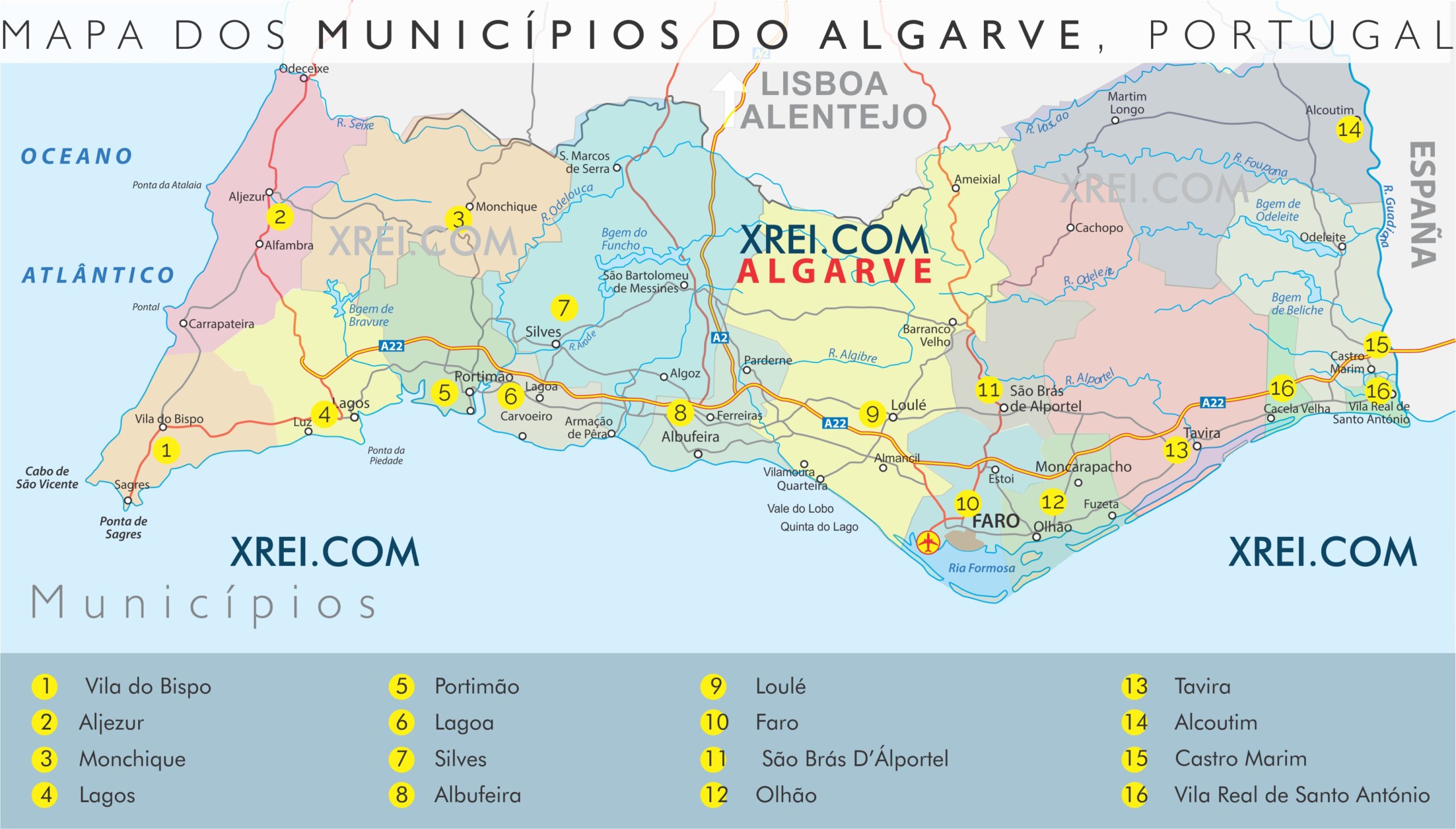
Map of the 16 municipalities of the Faro region, Algarve, in southern Portugal

The Algarve has 16 municipalities: Loulé, São Brás d’Álportel, Faro, Olhão, Tavira, Castro Marim, Vila Real de Santo António, Alcoutim, Albufeira, Portimão, Lagoa, Silves, Monchique, Lagos, Sagres (Vila do Bispo) and Aljezur. All of these encompass parishes of interest; in the case of Loulé, it includes the three resorts known as Portugal’s Golden Triangle.

Golden Triangle

The Golden Triangle in the Algarve is the name given to the three resorts of Vilamoura, Quinta do Lago and Vale do Lobo. A benchmark tourist destination in the Algarve region, thanks to the quality differential they offer visitors and residents alike. These are luxury resorts stretching along the Atlantic coast that have earned international renown as high-end tourist developments: Quinta do Lago, Vale do Lobo and Vilamoura. Sought after by investors and visitors from around the world, these modern estates are home to numerous international communities from the most diverse backgrounds, creating a multicultural, multilingual environment where plurality coexists with luxury, leisure and a permanently festive atmosphere. The Golden Triangle is widely sought after as a golf destination, sailing destination, equestrian centre and beach destination, representing a high-standard tourist destination where visitors find beaches framed by dunes and colourful cliffs, a marina accommodating vessels up to 30 metres, and 14 exclusive golf courses that host international tournaments.

Loulé

Loulé is an inland Algarve town that stands out for its historic centre, built heritage and traditional atmosphere. Points of interest include the whitewashed churches, with notable examples such as the Santuário de Nossa Senhora da Piedade, dating from the 16th century and the largest Marian shrine south of Fátima. Set within a green landscape, it is distinguished by its imposing white facade with two bell towers; inside, visitors can see a richly decorated 16th-century gilded image known as Mãe Soberana. The Castelo de Loulé is another point of interest, with military medieval architecture featuring original Islamic traces from the 8th century, notable for its flanking towers and the integrated archaeological museum, whose collection includes artefacts of Moorish, Roman and Lusitanian origin found in the region. Beyond this museum, other cultural highlights include the Casa da Cultura de Loulé, housed in the Edifício Duarte Pacheco, which promotes some of the region’s most emblematic artistic events, and the Museu Municipal de Loulé, with its various museum branches focusing on regional history from prehistoric times to the present day, including local gastronomy and architecture. Walking through the old town of Loulé from the castle to the historic centre, visitors encounter sections of the defensive walls; at Largo D. Pedro I stands the Chafariz das Bicas Velhas. Nearby, the Ermida de Nossa Senhora da Conceição is a landmark: despite its plain facade, it houses valuable 19th-century panels inside. The Mercado Municipal de Loulé is a space of great cultural and commercial value, distinguished by its rich architecture with neo-Arab and Art Nouveau influences — a white and red facade with a dome and Moorish windows — and traditional stalls selling colourful regional products such as fruit and vegetables, cheeses, chouriço, bread, regional sweets and fresh fish. Also in Loulé is the Estátua de António Aleixo, a life-size statue of the popular poet, seated on a bench with a table on which some of his verses are inscribed. Among the religious buildings in Loulé, the Antigo Convento do Espírito Santo, an 18th-century monument housing the Galeria de Arte Municipal, and the Convento de Santo António, built in the late 17th century — whose simple Capuchin architecture reflects the presence of the Franciscan order — which is currently used for various cultural events. Among the religious heritage, the Gothic Igreja Matriz de Loulé (or Igreja de São Clemente), built over a mosque, stands out for its Baroque bell tower, adapted from the former Muslim minaret. The natural beauty of the area can be appreciated at the Fonte do Cadoiço, an idyllic spot in the urban setting featuring a small waterfall over a pond surrounded by vegetation.

Other places of interest in Loulé

The municipality of Loulé has numerous sites of natural and cultural interest on the regional tourist itinerary. Sites such as Rocha da Pena, a rocky outcrop with rich biodiversity, woodland scenery and rocky hillsides. Nearby, in Salir, a farming village crowned by the ruins of an ancient castle where tradition prevails through legends and local festivities. In this area, Fonte Benémola, crossed by the Ribeira de Menalva, is a protected natural landscape whose abundant water enriches the diversity of flora and fauna in a setting dotted with mills, waterwheels, weirs and irrigation channels that can be explored on foot along its trail circuit; the wild Ribeira de Algibre nearby is equally worthy of mention. In this area, culture and nature coexist at Quinta da Tôr, a vineyard and winery that carries on the wine-making tradition and flavours of the region, extending to the parish of Ameixial, a rural mountain settlement in the Serra do Caldeirão, noted for its hospitality, customs and local crafts. Nearby is the Fonte da Seiceira, a 19th-century spring once of great importance for its iron-rich water, to which curative properties are attributed, with picnic tables in the surrounding area. Also inviting for sporting activities are the Piscinas de Loulé, with several indoor and outdoor lanes for swimming. Moving into the Sotavento Algarve, the town of São Brás de Alportel is a traditional cork-farming village spreading across the valley with views towards the hills and the ocean beyond. Here, the Museu do Traje de São Brás de Alportel, housed in a bourgeois-style building, presents a collection documenting the traditional costumes of the Algarve region. In the same town, the Igreja Matriz de São Brás de Alportel, originally from the 15th century, rebuilt in the 16th century and restored after the 1755 earthquake, features a rare marble baptistery — an uncommon material in the region’s monuments — and valuable 17th-century painted canvases of great worth in the chancel.

Vilamoura

Vilamoura is a resort belonging to the parish of Quarteira, a seaside town within the Loulé area, particularly popular for its outdoor lifestyle, golf enthusiasts and sailing aficionados. Vilamoura has several tourist facilities exclusively dedicated to golf, all of which enjoy international recognition for the quality of their courses. The Laguna course exemplifies this: an 18-hole layout set on relatively flat coastal terrain with few trees, punctuated by water hazards and bunkers. The Dom Pedro Millennium is another option, standing out for its eclectic design with open spaces and scattered pine trees; it is considered one of Europe’s finest courses, alongside the Old Course, Vilamoura’s oldest course locally known as the “Grande Dama do Algarve”, which is distinguished by its sophisticated facilities, environmental stewardship and well-maintained fairways set among stone pines. The Dom Pedro Pinhal course is an award-winning layout particularly known for its 4th hole, which presents an extra challenge by requiring a shot over a lake to an undulating green. Finally, the Pestana Vila Sol is one of the most celebrated courses in the region, where flora and fauna are carefully respected, creating a beautiful Mediterranean setting with narrow fairways and 27 holes spread across three playing loops. Vilamoura is a benchmark tourist complex in Portugal, with several points of interest — notably the Marina de Vilamoura, located between the ocean and an open space flanked by palm-lined gardens, distinguished as Portugal’s first marina and its most awarded for best national marina. The marina is visible from Praia da Rocha Baixinha Nascente, a popular summer beach where the cliffs begin to give way to dunes and a broad sandy shore. In the marina’s vicinity stands the famous Casino Vilamoura, owned by Grupo Solverde, where visitors can enjoy entertainment and shows in a lavish, contemporary setting, or take part in the main gaming rooms. Vilamoura is a popular family destination thanks to its high-quality educational facilities, including the Colégio Internacional de Vilamoura, one of the most prestigious schools in southern Portugal, offering both the Portuguese national curriculum and the Cambridge curriculum, with a focus on bilingual learning and academic excellence. Equally noteworthy is the Centro Hípico De Vilamoura, recently distinguished by “Horse Republic” with the “Award Excellence”. Beyond the family character provided by its educational and sports facilities, leisure for all the family is guaranteed at venues such as the Family Golf Park minigolf, the Observatório de Aves do Caniçal de Vilamoura and the Estação Arqueológica Cerro da Vila, offering contact with nature and the ancient history of the area. Rounding out the offer is the Praia de Vilamoura, with its calm ocean and golden sands, or the Passeio das Dunas, a pedestrian path linking Vilamoura to Quarteira — a town of fishing origins known for its beaches, coastal promenade and sea-view apartment buildings situated 20 metres from the beach. In Quarteira, the appealing Mercado do Peixe, located by the sea and easily identified by its white-and-blue facade, is a place where local traditions live on through the sale of fresh fish. From here, along the Quarteira seafront avenue, a promenade runs alongside the acclaimed Quarteira beaches, which include several beaches defined by stone breakwaters: the semi-urban Forte Novo beach (where remains of the 16th-century Forte Novo can still be seen); the Lagoa do Almargem beach, surrounded by the characteristic reddish cliffs of the Algarve, notable for forming a small lagoon between the Ribeira do Almargem and the sea; the Loulé Velho beach, with its rural setting and wide sandy shore; the Quarteira beaches extend along the shore to Ilha de Faro, passing the resort beaches of Vale do Lobo, the Ancão beach and the Quinta do Lago beach, leading to the Ria Formosa Natural Park at the entrance to Faro, on the boundary of the airport.

Faro

Faro is the administrative capital of the Algarve, presenting itself as a centuries-old city steeped in history, tradition and culture. It has an extensive natural and built heritage, with particular emphasis on its beaches and the landscapes of the Ria Formosa. Access to southern Portugal is possible via Faro Airport, a facility serving the city and the wider southern region. In Faro, visitors can stroll along more commercial streets such as Rua de Santo António, known as Faro’s main shopping street, and immerse themselves in history by walking through the historic centre to discover the walled old town, with a mandatory stop at the imposing Arco da Vila, the historic and legendary Arco do Repouso and the Porta Árabe, which is the only horseshoe arch in the Algarve still standing in its original location. In this ancient area, within walls reinforced by two flanking towers, stands the Igreja de Santa Maria (or Sé de Faro), in a square adorned by the Monumento do Bispo Francisco Gomes de Avelar, a figure of regional prominence for his contribution to the town’s development. The Sé de Faro is distinguished by its Gothic, Baroque and Mannerist architecture, dating back to the 13th century and incorporating 18th- and 19th-century details in its valuable interior, with highlights including gilded woodwork, chapel panels, azulejo tiles and reliquaries. Of equal interest, facing the statue of D. Afonso III, stands the Convento de Nossa Senhora da Assunção, a Manueline-style church distinguished by its Renaissance portal and Baroque dome, as well as the gargoyles adorning the upper floor. This convent currently houses the Museu Municipal de Faro, with a collection focused on the history of the region. Faro also offers other points of interest, such as the tree-lined Jardim Manuel Bivar, the city’s central park, where various cultural events take place. Culture also manifests itself through the exhibitions of the Centro Ciência Viva do Algarve, focusing primarily on science and the Ria Formosa ecosystem. From here, it is well worth continuing to the Marina de Faro (or Doca de Faro), where land and sea meet, providing moorings for leisure craft. Here stands the Museu Marítimo Almirante Ramalho Ortigão, with three rooms dedicated to fishing, instruments and utensils, as well as the Ginásio Clube Naval, which includes a sailing and recreational boating school. At the Cais das Portas do Mar (Cais da Porta Nova), visitors can embark on boat trips through the Ria Formosa, including to some of the most beautiful spots in the region, such as the Ilha Deserta with its Praia da Barreta. On the city’s outskirts, the Parque Ribeirinho de Faro, divided into three green zones, offers a pedestrian area and a space where Algarve culture and tradition are kept alive through the fishermen’s houses facing the ria.

Cultural, religious and historical heritage of Faro

Immersing oneself in Faro’s traditions calls for a visit to the Mercado Municipal de Faro, located near the cathedral, its white building distinguished by a central square tower. The market offers a wide range of fresh local produce, giving visitors a feel for the town’s customs. Religion is a fundamental part of this tradition, extending an invitation to explore the local churches and chapels. At Largo do Carmo stands the 18th-century Igreja do Carmo, a Baroque temple noted for its interior azulejo and gilded woodwork decoration, as well as the adjacent Capela dos Ossos, erected in the 19th century. The Igreja da Misericórdia, a Manueline and 17th-century church; the Igreja de São Pedro, with a plain facade and an interior where the Capela do Santíssimo and its rich Baroque altarpiece stand out; the Ermida de Santo António do Alto, a 16th-century chapel combining Gothic, Manueline, Baroque and Rococo architectural features; the Igreja de Nossa Senhora do Pé da Cruz, whose facade reflects the architecture of various periods and with 17th-century interior ornamentation; and the Convento de Santo António dos Capuchos, built in the 17th century, with a plain facade and simple ornamentation, which served for some years as an archaeological museum. Faro is a city of tradition and passionate football supporters, home to the Estádio de São Luís, located near the church of the same name; evidence of Roman presence in the region can be found at the Ruínas Romanas de Milreu and the Roman Bridge at Estói, as well as the Palácio de Estói, a complex of great historical value dating from the 17th century, currently operating as a pousada.

Natural heritage of Faro

The Ria Formosa Natural Park, whose headquarters are located at Quinta de Marim, is considered one of Portugal’s 7 Natural Wonders and one of the country’s most important wetlands, encompassing a great diversity of habitats conducive to equally diverse flora and fauna, set within the Sotavento Algarve between the Ancão area and Manta Rota, forming a lagoon system in harmonious connection between land and ocean. To better explore the entrance to the Ria Formosa, between Quinta do Lago and Ilha de Faro, visitors can walk the Ludo Trail, a 7-kilometre path through lagoons, salt marshes and wildlife in their natural habitat. Crossing the boardwalk that spans the Ria Formosa leads to Ilha de Faro, one of the Natural Park’s beaches and the first of the barrier islands separating the ria from the ocean. Ilha da Armona and Ilha da Culatra are also notable birdwatching destinations. These islands have small communities of local residents distinguished by their fishing traditions, clear sandy beaches, clean waters and beach and dining facilities. Near Ilha da Culatra is a small settlement called Hangares, which takes its name from the infrastructure left over from the Second World War. Among the barrier islands, Ilha do Farol is another of Faro’s natural treasures, taking its name from the Farol do Cabo de Santa Maria, visible from miles away, and presenting itself as a place of great natural beauty. Mention should also be made of the small Ilha do Coco, Ilha das Alturas and Ilhéu do Alcorão, where shellfish gatherers can be seen year-round harvesting bivalves — the primary activity of many residents of Olhão and the islands of Culatra, Armona, Farol and Hangares. Travelling through the populated areas of the Ria Formosa, small boats serving the local population can be spotted, supporting fishing activities in the ria.

Olhão

Olhão is a city that grew from a fishing village, situated facing the Ria Formosa, and constitutes an interesting urban, social and tourist centre in the Algarve. Known as the “cubist city”, it stands out for its uniquely Arab-influenced architecture, with the whitewashed cubes of its houses edged in blue or grey. Among the city’s most notable spaces are the Mercados de Olhão, rust-red industrial-architecture buildings from the 20th century, located in the riverside area, where traditional market stalls offer a glimpse of local culture. A few metres towards the city centre stands the Museu Municipal de Olhão, housing a collection of archaeological and regional interest, located directly behind the Igreja de Nossa Senhora da Soledade. At the heart of Olhão, the 18th-century Igreja Matriz de Nossa Senhora do Rosário is an imposing landmark, with the historical distinction that its bells rang out during the people’s uprising against the French invasion. Behind this church is the Capela de Nosso Senhor dos Aflitos, a place of worship historically sought out by women on stormy days when the men put out to sea. Along the Olhão waterfront, green spaces include the Jardim Pescador Olhanense, notable for benches decorated with nautical-motif azulejo patterns. In the same area, facing the Mercados de Olhão, sits the Caíque Bom Sucesso, a replica of the vessel reportedly used by Olhão residents to sail to Brazil to inform the king of the uprising that had driven Napoleon’s forces from Portuguese territory. Also in the riverside area is the Cais de embarque de Olhão, where visitors can board boats to explore several of the Ria Formosa‘s barrier islands, including Ilha de Armona, Ilha da Culatra and Ilha do Farol.

Tavira

Tavira is a coastal city in the eastern Algarve, its landscape defined by the Rio Gilão as it flows through the town and empties into the Ria Formosa Natural Park. Tavira is especially known for its religious heritage, earning it the name “City of Churches”, though its natural and archaeological heritage deserves equal recognition. In Tavira, visitors can explore the old Tavira castle, whose original construction dates to the 13th century, enjoying panoramic views over the city and the ocean from its towers. Local culture is strongly shaped by fishing activity and religious tradition, reflected in the large number of churches. The Mercado Municipal de Tavira is located on the western bank, facing the exit of the Ponte dos Descobrimentos, opposite the salt pans, on the way to the Quatro Águas quay. Among the places of worship, the Igreja de Santa Maria do Castelo is worth visiting — dating from the 13th century with Gothic elements, it is distinguished by its original clock tower, national azulejo tilework, carved wood details and the tomb of the seven knights of the Order of Sant’Iago. Also noteworthy is the Baroque Igreja Nossa Senhora do Carmo from the 18th century, with its magnificent painted dome depicting the saint after whom it is named; the 16th-century Igreja da Misericórdia, considered the most important Renaissance church in the region; the Igreja do Antigo Convento de Santo António dos Capuchos, decorated with azulejos and gilded woodwork; and the Igreja e Convento Nossa Senhora do Carmo, dating from the 18th century, which incorporates elements of different aesthetic styles, with highlights including the organ, the Baroque sacred treasury, and various Joanine and Rococo elements. Beyond the richness of its religious heritage, the passage of peoples such as the Arabs, Romans and Phoenicians through the region also left its mark on Tavira. The city is home to the Ruínas Fenícias de Tavira, with a wall dating from the 8th century BC, and the Ponte Romana de Tavira, a pedestrian bridge believed to have been rebuilt over a Roman bridge dating from the 3rd century, connecting the banks of the Rio Gilão in Tavira’s historic centre. The Ponte Ferroviária de Santa Maria, a railway bridge forming part of the Linha do Algarve, also crosses the Rio Gilão (which only takes this name here, as from its source to the bridge it is known as the Rio Séqua). The Tuna Fishing Interpretive Centre, whose collection recounts the region’s fishing history in tuna capture, is currently housed within the Vila Galé Albacora hotel. Near this centre is the Praia do Arraial Tavira, with calm, warm waters facing the Ilha de Tavira, an island that stretches 12 km westward to Fuseta. To reach Ilha de Tavira, visitors can take the ferry from the Quatro Águas embarkation quay. Where the ria meets the ocean, the Moinho dos Ilhéus can also be seen — a tidal mill now home to a farm producing some of Portugal’s most acclaimed oysters. The Salinas de Tavira are also worth visiting, with the Ciclovia das Salinas and various trails for walking through the complex, offering idyllic landscapes and the chance to observe numerous resident and migratory bird species, including flocks of flamingos. Golf is one of the activities available in the Tavira area, with several luxury developments and extensive golf courses. Near Cabanas de Tavira, Benamor Golf offers courses set within a landscape of ocean and hills, providing golf in a serene, natural environment. At Quinta da Ria, located between Cabanas de Tavira and Vila Nova de Cacela, there are two further golf courses: Quinta de Cima Golf, a challenging championship course with long fairways and numerous water hazards, set among trees; and Quinta da Ria Golf, an 18-hole course integrated within the Ria Formosa Natural Park with a beautiful natural setting. Another acclaimed option in the area is Monte Rei Golf, situated north of Vila Nova de Cacela, one of the few Jack Nicklaus Signature courses in Europe, considered Portugal’s finest golf course. Also available are the natural and challenging Quinta do Vale Golf course and the Castro Marim Golf development, notable for its three nine-hole courses and magnificent views. Colina Verde Golf, located north of Fuseta, is set in a natural rural environment with a 9-hole course suited to beginners.

Natural heritage of Tavira

The Tavira area and its surroundings offer numerous natural sites of interest, among which several beaches deserve mention. Praia da Terra Estreita is a beautiful sandy spit located east of Praia do Barril, the site where an old fishing community left a true cemetery of anchors from former tuna-fishing vessels. In the area, naturism is practised at the Santa Luzia zone, where Praia do Homem Nu is a wild and secluded beach offering a skin-to-nature experience. Nearby, Praia da Barra da Fuseta offers great tranquillity; connected to it, at the eastern tip of Ilha da Armona, is Praia da Ilha da Fuseta, facing the fishing village of the same name. Climbing the Serra de Monte Figo reveals two viewpoints for the best vistas in the region: Cerro de S. Miguel (or simply Monte Figo), with a viewpoint encompassing much of the southern Algarve coast, and Cerro de Cabeça, in the eastern part of the range, where karst formations of great geological value can be found. Another remarkable landscape is found at the Barragem de Odeleite, whose reservoir takes the shape of a blue dragon — a symbol of luck and power in Chinese culture — giving the area the name “Blue Dragon River“. Finally, further natural highlights can be found at the Mata da Conceição within the Perímetro Florestal da Conceição de Tavira, which has a picnic area and is home to resident and migratory birds, as well as the harmonious natural Cascata do Pego do Inferno, considered one of the most beautiful waterfalls in the Algarve region.

Cacela Velha & Cabanas de Tavira

Leaving Tavira southwards in the direction of Spain, visitors reach Cacela Velha, an ancient whitewashed village rich in tradition and tranquillity. Here, emblematic sites invite exploration: the Forte de Cacela Velha (or Fortaleza de Cacela Velha), with its commanding position and natural surroundings; the 16th-century Igreja Matriz de Cacela Velha; and the Cacela Velha beach, located to the south of the village. Praia da Fábrica, situated in the small settlement of the same name, is a must-stop, characterised by its position in the midst of the ocean and its access — during the bathing season, visitors purchase a return ticket and travel by small local boats. In Cabanas de Tavira, the Lacém Mar beach is a river-mouth beach set on a narrow natural strip of sand, beyond which lies the Ilha de Cabanas, a place that lends itself to observation of wading birds. In the area, it is worth walking along the Avenida Ria Formosa, which leads towards the Forte de São João da Barra, set on a hill beside the Ria Formosa east of Cabanas de Tavira. Other points of interest include the Forte do Rato (or Forte de Santo António de Tavira), located at the mouth of the Rio Gilão, and the Praia de Cabanas and Praia do Forte da Barra, both distinguished by their great natural beauty within the Ria Formosa Natural Park.

Castro Marim

The Reserva Natural do Sapal de Castro Marim e Vila Real de Santo António, established in 1975, is Portugal’s first nature reserve and one of the country’s most important wetlands. Its purpose is the conservation of local ecosystems and natural and landscape heritage; it is situated at the mouth of the Guadiana, extending between Castro Marim and Vila Real de Santo António. The reserve comprises salt marshes, salt pans and tidal inlets, where distinct landscapes shelter a great diversity of flora and fauna, making it an excellent birdwatching location. The town of Castro Marim also offers several heritage sites, among which the Castelo de Castro Marim stands out — a fortification of great historical interest, located on a commanding position on the right bank of the Rio Guadiana. The Forte de São Sebastião was built here during the Restoration Wars to defend the region, owing to the great strategic importance of the natural elevation, on the site where the chapel of the same name previously stood. Also in Castro Marim, the Estátua do Cavaleiro Medieval, an interesting iron structure, is located near the Igreja de Santiago.

Vila Real de Santo António

Vila Real de Santo António is a border city designed by Marquis of Pombal. Along an extensive waterfront avenue with historic buildings facing the Rio Guadiana stands the marina de Vila Real de Santo António. At the city centre, commercial streets lead to the Praça Marquês de Pombal, the commercial and tourist heart of the city built in Pombaline style. In the square stand the Igreja Matriz, a crowned obelisk in honour of D. José I and four turrets adorning its four corners. Beyond the built heritage, the town features emblematic natural spaces such as the Mata Nacional das Dunas de Vila Real de Santo António, and leads visitors to some of the country’s most popular beaches. Here too stands the Farol Vila Real de Santo António, with its circular tower open to visitors and still in operation today. From here, walking along the bank of the Rio Guadiana, visitors are invited to explore sites of great cultural interest, including the Arquivo Histórico Municipal António Rosa Mendes, housing a collection of historical documents about the region; the traditional Mercado Municipal; and the emblematic Centro Cultural António Aleixo, which hosts numerous regional performances. A short distance away, the Adventure Park Vila Real de Santo António tree-top activity park is ideal for outdoor adventure activities. Moving westwards, towards the sunset, visitors reach Monte Gordo, Altura and Vila Nova de Cacela, three popular southern Portuguese destinations noted for their beaches and cultural elements, with family-friendly beaches of warm waters and white sand, fully equipped with all essential leisure facilities including bars and restaurants. In Monte Gordo, the Casino de Monte Gordo offers several gaming rooms and a varied entertainment programme. In addition to Praia de Monte Gordo, visitors may opt for the natural Praia Verde, a sea beach sheltered by stone pines in the heart of the eastern Algarve. Continuing westwards, the route takes in Praia da Alagoa in Altura, Praia da Lota and Praia da Manta Rota, which extends to the Cacela peninsula.

Albufeira (gateway to the western Algarve)

The city of Albufeira is a coastal Algarve town that grew from an old fishing village, retaining much of its original heritage and culture. Albufeira has a strong tourist character, driven by the richness of its historic centre, the numerous bars providing nightlife (including the Old Town and The Strip Albufeira areas), and cultural venues such as the exhibitions of the Galeria Municipal de Albufeira, the eclectic Museu de Arte Sacra of Albufeira and the traditional Mercado Municipal dos Caliços. Religious tradition continues in places such as the 18th-century Igreja de Sant’Ana; the Igreja de São Sebastião, erected in the 13th century in Praça Miguel Bombarda, incorporating regional features and Manueline and Baroque elements; and the Convento de Nossa Senhora da Orada, of typically Algarve architecture, which, despite dating from the 16th century, was entirely remodelled in the 18th century. Albufeira’s rich historical and cultural heritage coexists with local customs and natural beauty, as seen at the Marina de Albufeira and the Miradouro Porto de Pesca, where the region’s fishing tradition lives on and the coastal scenery can be admired. Along the coast, visitors can walk the cliff path from the Miradouro do Peneco to the Igreja de São Sebastião, passing above the popular Praia do Peneco, near which Rua da Bateria and Rua Almirante Gago Coutinho offer views of the coastline. The traditional Praia dos Pescadores is one of the city’s best-known beaches, with pale sand and gentle surf. Nearby, in the square beside the beach, stands the Monumento aos Pescadores; at the top of the cliff, the Miradouro do Pau da Bandeira offers panoramic views over the town and the sea. Moving eastwards, less urban and more natural beaches appear, such as Praia dos Alemães, Leixão dos Alhos and Praia dos Aveiros, sheltered by coastal cliffs. The more celebrated Praia da Oura and Praia Santa Eulália offer natural scenery with green surroundings, golden sand and sea conditions suited to water sports. To the east, near Praia da Balaia, other sports can be enjoyed at the nine-hole Balaia Golf Course, suitable for players of all levels. Nearby, the Parque Aventura is a popular tree-top activity venue enjoyed by children and adults alike.

Galé and the Galé beaches

Galé is a coastal parish of Guia, situated west of Albufeira, known for the natural richness of its beaches and cliffs, and incorporating a tourist complex with all essential facilities. The Galé beaches run along the coastline from Praia da Galé (west) to Praia de Arrifes, sharing characteristics such as natural beauty, golden sand, steep cliffs, rocky outcrops, and their appeal as an anchorage and cruising destination for sailing and motor yachts. These beaches are connected by a cliff-top trail that reveals their full natural beauty. Following the Galé trail from west to east, visitors encounter Praia de São Lourenço, Praia de Manuel Lourenço, Praia da Balbina, Praia do Evaristo, Praia do Castelo, Praia da Coelha, Praia de Maré das Porcas, Praia das Salamitras, Praia da Ponta Grande e Pequena, Praia dos Piratas and Praia de São Rafael. These small beaches share very similar characteristics: sheltered from the wind by rocks, with clear waters, and sought after by those looking for greater tranquillity away from urban areas.

Olhos d’Água village and beach

Olhos d’Água is a village within Albufeira, with a picturesque and traditional character whose beaches mark the boundary between the eastern Algarve (characterised by sandier terrain) and the western Algarve (characterised by rocky terrain). One of the attractive beaches accessible from Olhos d’Água is Praia Maria Luísa, which stands out for the tones of its cliffs contrasting with the deep blue of the sea, with various support facilities and the option to practise sailing or windsurfing. The village’s name derives from the freshwater springs in the sand (olhos d’água) that exist there, visible at low tide, also known as Olheiros de Água Doce, situated between Praia de Olhos d’Água and Praia do Barranco das Belharucas (a beach between the long cliff and the ocean) at the western end of Praia da Falésia, a beach known for its 5-kilometre stretch of sand extending to Vilamoura, walked year-round by hiking enthusiasts. Near this beach, the Miradouro da Falésia invites visitors to pause and take in the natural beauty of the region. From Praia do Barranco das Belharucas, access is possible to Pine Cliffs Golf and Resort, a luxury tourist development offering a hotel, spa services and a 9-hole golf course, particularly known for its challenging par-3 sixth hole. Along the cliff path, the village of Açoteias is another of Albufeira’s hidden gems, where visitors can enjoy the natural cliff scenery and the tranquillity of Praia das Açoteias. Along the trail linking Olhos d’Água and Vilamoura, via the beach and cliff-top paths, two further beaches deserve mention: Praia dos Tomates, with its clay reddish cliff, and Praia da Rocha Baixinha, where the cliff begins to disappear, giving way to sandy dunes.

Paderne

Paderne is a rural village within the municipality of Albufeira, home to heritage elements of considerable value. Among these, the Igreja Matriz de Paderne or Igreja da Senhora da Esperança, dating from the 16th century and remodelled over the centuries, incorporates Manueline and Renaissance architectural elements; the most prominent visual features are the Baroque altarpieces of the chancel and the Santíssimo chapel. In Paderne, visitors can also see the Ponte Medieval, spanning the Ribeira de Quarteira near the castle, rebuilt in the 18th century. Finally, the ruins of the Castelo de Paderne, whose earliest historical record dates from the 12th century, stand in a commanding position above the Ribeira de Quarteira. This small Muslim-origin fortification, which formed part of the region’s defensive network, formed part of the region’s defensive line, and is a popular destination for nature walkers.

Theme and water parks

The Algarve region is well suited to visitors seeking theme, nature and water park facilities. One of the largest theme parks in the Algarve is Zoomarine Algarve, where visitors can observe numerous marine species, exotic birds and reptiles, interact with dolphins, watch shows and enjoy pools, slides and various theme-park attractions. Between Quarteira and Loulé, Aquashow Park is known for its wave pool and attractions including a roller coaster, gentle rides, various slides and pools suitable for all ages. Similarly, Aqualand Algarve in Alcantarilha offers activities combining adrenaline, leisure and relaxation in a family-oriented water-based environment. Finally, the well-known Slide & Splash, located between Lagoa and Portimão, offers diverse water attractions alongside shows and spa services in a themed setting suited to all ages and tastes.

Portimão

Portimão is a city with a fishing tradition, situated at the estuary of the River Arade, known for its beaches, customs, religious heritage and the preservation of local culture. Visiting Portimão, the city’s fishing soul is evident in spaces such as the Marina de Portimão, the Porto Comercial and the Clube Naval; a walk along the river on the Passeio Ribeirinho allows visitors to enjoy traditional restaurants and taste the region’s seafood flavours. The Mercado Municipal de Portimão is another place where this tradition can be experienced, with regional produce including fresh fish on sale. A visit to the Museu de Portimão, housed in the former canning factory building — still identified as such on its facade — provides insight into the city’s fishing and industrial identity. From here, the route continues to the city centre at Praça da República, where the garden of the same name, the Jesuit Igreja do Colégio (or Igreja de São Francisco Xavier), which once served as the city courthouse, and the 16th-century Igreja Matriz de Portimão (or Igreja de Nossa Senhora da Conceição) stand — the latter distinguished by a Baroque altar with gilded woodwork detail. Further afield, near the naval shipyards in the riverside area, the Igreja de São José also merits mention, both for its simple, appealing facade and for the history it evokes of the working maritime community. The ancient peoples who passed through this region can also be discovered in Portimão at the Centro de Acolhimento e Interpretação dos Monumentos Megalíticos de Alcalar or on a visit to the Ruínas do Convento de São Francisco de Portimão. For leisure, the programme at the Parque de Feiras e Exposições de Portimão and Portimão Arena is worth checking. Beyond these, set within a natural environment, the Autódromo Internacional do Algarve is a major Portimão attraction, sought after for the excitement of Formula 1 and MotoGP championships — sports that, alongside golf, place Portimão on the world map. Golf is well served by internationally renowned courses including the three courses of Penina Golf; the versatile Morgado Golf courses, suited to all levels; and Alamos Golf, a short but challenging layout. Walking along Avenida Tomás Cabreira leads to the Portimão seafront and Praia da Rocha, Portimão’s most emblematic beach, considered one of Portugal’s most beautiful, with an extensive sandy shore sheltered by cliffs and clubs dedicated to water sports such as surfing and leisure sailing. Walking along the Molhe de Portimão, visitors can stroll to the striped Farol da Praia da Rocha at its seaward tip. At the start of the breakwater, the Fortaleza de Santa Catarina is worth visiting — a 16th-century military monument built for coastal defence. On the opposite side of the beach, the Miradouro dos Três Castelos offers a different perspective on the same coast, with a privileged view over Praia da Rocha and Praia dos Três Castelos; this beach line extends to several beaches of pale sand with rocky formations set against cliffs, including Praia do Amado, Praia dos Careanos, Praia do Vau, Praia do Alemão, Praia do Boião and the secluded Praia João de Arens, somewhat challenging to access but rewarding with spectacular views of rock and sea. From Portimão, walking along the cliff to Ponta João de Arens reveals the Gruta das Baratas, viewable from a platform allowing visitors to peer down into a pit formation (algar) created by rainwater penetrating the limestone cliff. Continuing towards Alvor, the route passes the small sheltered Praia do Submarino, the romantic Praia da Prainha with small sandy coves isolated by rocky formations creating a more private setting sheltered by the cliffs, and Praia da Torralta, known for its warm, clear water. Near the fishing village of Alvor, the richness of its religious heritage, the wetlands of the Ria do Alvor estuary and Alto Golf — an 18-hole course set within Vau da Rocha in a green, tree-and-lake-dotted landscape — are all worth exploring. In Alvor, the wide and popular Praia de Alvor and the Ria de Alvor are recommended: an estuarine system forming an important national wetland where biodiversity can be observed through the presence of resident and migratory birds in a typical fishing environment.

Ferragudo

Ferragudo is a village on the eastern bank of the River Arade, one of the parishes of the Algarve town of Lagoa, encountered on the route from Portimão to Carvoeiro — a journey rich in heritage and natural points of interest. The route begins by crossing the Ponte Ferroviária de Portimão over the River Arade, distinguished by its iron arches, passing the fishing port and the Estaleiros de Portimão. The Parque Municipal do Sítio das Fontes, on the riverbank, is a small park of great natural, historical and cultural richness, with various Mediterranean environments, remarkable biodiversity and traces of the region’s medieval activities. Heading into Ferragudo along Rua Infante Santo leads to the Igreja de Nossa Senhora da Conceição, with its white and yellow facade housing a collection of 16th-, 18th- and 19th-century religious images. Nearby, Praia Grande and Praia da Angrinha are the estuary beaches of the River Arade, with sands surrounded by cliffs and vegetation. The 16th-century Castelo de São João do Arade, which once defended this river, stands here. Praia do Molhe marks the point where the river meets the ocean, with neighbouring Praia do Pintadinho close by. Following the coast, the Farol da Ponta do Altar, standing at 32 metres above sea level and built in 1893, offers views of the coastal landscape and the city of Portimão, with Praia do Torrado and Praia dos Caneiros in view. Praia da Afurada, near the Centro Hípico Casa Lusitana, is also worth noting — a quiet, almost private beach with a cave. From here, the route continues to Praia do Mato, passing the Torre da Lapa, a 16th-century watchtower classified as a monument of public interest, near the rocky and difficult-to-access Praia da Grilheria, surrounded by cliffs. On the way to the Miradouro da Arriba da Salgadeira, Praia do Vale da Lapa and Praia da Cama da Vaca lead to the acclaimed Praia dos Três Castelos de Carvoeiro, the rocky formations of Praia de Vale dos Currais and the small, unspoilt Praia do Paraíso, the latter already within the range of Carvoeiro beaches.

Lagoa

Lagoa is an Algarve city with prehistoric heritage and an agricultural tradition centred on wine production, where a strong religious tradition is evident. Beach and sporting activities have given the area a more tourist-oriented character; the three local golf courses — Vale da Pinta Golf, Gramacho Golf and Vale de Milho Golf — stand out for their natural settings and European-level facilities. Beyond golf, Sand City and its International Sand Sculpture Festival is one of the area’s landmarks, presenting itself as the world’s largest sand sculpture festival. From the modernity of the festival to the antiquity of tradition, Lagoa invites visitors to explore its religious heritage at the Convento de São José, a former enclosed convent built in the 18th century whose cloister, cistern well and foundling wheel at the entrance are highlights; and the Igreja Matriz de Porches (or Igreja de Nossa Senhora da Encarnação), dating from the 16th century, with a plain facade but an interior enriched by azulejo tiles and 19th-century religious images. Adjoining this church is the Capela dos Ossos de Alcantarilha, whose ornamentation is made from more than 1,500 human bones.

Carvoeiro

Carvoeiro is a village in the western Algarve, known for its beaches, with a fishing and maritime tradition still visible in its culture today. The Largo da Praia do Carvoeiro is the village centre, featuring a broad promenade surrounded by traditional restaurants and small shops beside Praia do Carvoeiro, where yellowish cliffs with vegetation frame the white facades of Algarve houses. This spot is located minutes from Praia do Paraíso, a small beach reached by following the road of the same name along the western cliff. In the opposite direction, also a few minutes away, stands the 17th-century Forte de Nossa Senhora da Encarnação, built to protect the area from corsair and pirate attacks; beside it, visitors can walk the Carvoeiro boardwalk to enjoy ocean views from the Miradouro da Falésia do Carvoeiro and visit Algar Seco, a place known for its rocky caves, accessible on foot, by boat, kayak or stand-up paddleboard. Here, Olhos da Boneca is the best-known algar and one of the most appreciated, thanks to its natural “windows” looking out to sea. The Carvoeiro coastal strip is an area of outstanding landscape beauty, with numerous beaches beside cliffs featuring remarkable rocky formations that make them popular for boat trips in the area. Difficult to access and small in size, Praia de Vale Covo is the first, followed by Praia do Vale de Centeanes, a beach sheltered by surrounding escarpments in a small cove where rocky formations create visually impressive caves, and the starting point of the Seven Hanging Valleys Trail, considered one of the best trails in Portugal and Europe for its dramatic position above cliffs over the sea. This trail, approximately 6 kilometres long, follows the cliff from Praia Vale de Centeanes to Praia da Marinha, offering contact with landscapes of secluded beaches, clear ocean waters, colourful cliffs and interesting rock formations (including caves and pit holes) in a unique natural setting. On the way to the small sheltered Praia do Vale Espinhaço stands the Farol de Alfanzina, a century-old lighthouse on a rocky promontory aiding local navigation. Praia do Carvalho lies on the way to Benagil, a place of fishing tradition where the Algar de Benagil stands out — one of the most famous sea caves of its kind in the world and one of Portugal’s most photographed spots, distinguished by its structure with openings to the sea and sky, accessible by boat or paddle board. Rocky formations continue along the coast, leading to natural arches in the limestone cliffs and other beaches where these create unique scenery, as exemplified by Praia da Corredoura and Praia da Marinha, known for the photograph combining two open rocks forming a heart shape. Praia da Marinha is in fact another of the region’s highlights: a beach of white sand and calm sea, ranked among the world’s hundred best beaches, offering a still largely wild natural setting surrounded by sculpted cliffs, accessible via a long staircase. Beyond this beach, the natural beauty of the Carvoeiro coastal strip continues to Armação de Pêra; along the way, Praia do Pau, Praia da Malhada do Baraço, Praia do Barranquinho and Praia da Estaquinha deserve mention. Nearby, Algar dos Capitães, Algar da Albandeira and Arco de Albandeira are notable for their remarkable natural rock formations. Before reaching Armação de Pêra, Praia de Albandeira, Praia das Fontainhas and Praia do Pontal, set in small coves of great natural beauty, are worth a visit.

Armação de Pêra

Armação de Pêra is a parish of Silves, particularly known for its natural features and beaches. Here, the 16th-century Forte de Santo António da Pedra da Galé (or Fortaleza de Armação de Pêra) can be visited before exploring the area’s valuable natural spaces. The local flora and fauna biodiversity can be observed in the wetland of Lagoa dos Salgados, connected to Praia dos Salgados and suited to birdwatching, culminating at the Herdade tourist development of the same name, where the Salgados tourist village, the Nau Salgados hotel and the Salgados Golf course operate. Praia dos Salgados is connected along the shore for approximately 4 km to Praia Grande de Pêra, a quieter beach with pale sand that shelters several protected bird species. The more urban and busy Praia de Armação de Pêra fronts the built-up perimeter, as does Praia dos Pescadores, notable for its fishing artefacts — boats and nets laid out on the sand — recalling the typical fishing practices of the region. During active fishing, a remarkable scene can still be witnessed today: fishermen transporting their boats across the sand to the sea with the help of tractors. Along this coastal stretch, Praia do Vale do Olival, Praia dos Tremoços and Praia dos Beijinhos also stand out for their cliff-edged natural settings — a characteristic shared by Praia da Cova Redonda, Praia dos Cavalos, Praia das Escaleiras and Praia da Senhora da Rocha. At the latter, visitors find the fishing harbour of the same name and the Igreja de Nossa Senhora da Rocha, dating from the 15th or 16th century, perched above the beach on the rock face. Inside this coastal church is a valuable 16th-century image of the Virgin and Child. Continuing westwards, Praia Nova and Praia do Barranco lead on to the Carvoeiro beaches.

Silves

Silves is a city in the Algarve hills, known for its traditional character, natural surroundings, river beach and built heritage. Silves was in former times the capital of al-Gharb al-Andalus (the Algarve). Among its monuments, the Castelo de Silves stands out — an Arab-origin defensive structure occupying a commanding position above the city, distinguished by its square towers and battlements. Around 600 metres away, the Mercado Municipal de Silves is located beside the River Arade; its architecture, known as Estado Novo or “Portuguese Suave” style, is reflected in its roof and the armillary sphere beside the city’s coat of arms. Among the religious heritage, the Sé Catedral de Silves (a cathedral built over a former mosque) and the 16th-century Igreja da Misericórdia de Silves, a short distance away, are both worth visiting. The Museu Municipal de Arqueologia de Silves is also nearby, the ideal place to explore a collection evoking the region’s ancient history and its former peoples. In Silves, the golf courses of Silves Golf, Amendoeira Faldo Golf and Amendoeira O’Connor Junior Golf are visited by golfers from around the world — fitting for a region where golf is one of the most acclaimed activities. West of Silves, the Cruz de Portugal, dating from the late 15th or early 16th century, is another site worth visiting: a sculpted limestone cross with Manueline and floral Gothic features. Near Silves, the natural beauty of the Funcho reservoir and the Arade reservoir offers water landscapes in a green, idyllic setting.

Monchique

Monchique is a picturesque village in the Algarve hills, particularly known for its thermal waters — to which curative properties are attributed — its monuments and its high-value natural spaces. In the village, the 16th-century Igreja Matriz de Monchique, in Manueline architecture with references to local vegetation, houses a collection of valuable religious objects in its small museum. The 17th-century Convento de Nossa Senhora do Desterro stands out against a natural landscape with Manueline traces. Moving up into the Serra de Monchique, locally known as the “Garden of the Algarve”, the Miradouro da Foia viewpoint invites visitors to take in the region’s landscape splendour. The area’s natural riches also include the Parque do Barranco dos Pisões, a green space with picnic tables crossed by a stream, home to a monumental centenary plane tree and an old watermill. In the village, the Cascata do Barbelote waterfall, the Barragem de Odiáxere reservoir (Barragem da Bravura) and the Barragem de Odelouca — the latter the main water supply reservoir for the Algarve region — are also worth visiting.

Lagos

Lagos is a coastal town in the western Algarve, known for its role in the history of the Portuguese Age of Discovery, the richness of its beaches and its extensive historical and cultural heritage. One of the highlights of the area is the old town of Lagos, enclosed within walls and accessible only on foot along its natural stone streets, being an exclusively pedestrian zone. The walls and towers of Lagos, currently known as the Castelo de Lagos, can be entered through the Porta de São Gonçalo, situated between two imposing flanking towers. In Lagos, traditional fishing can be seen at the Porto de Pesca near the Marina de Lagos, and at the Mercado Municipal, from whose terrace the Centro de Ciência Viva de Lagos can be accessed — a cultural initiative promoted by the municipality where science and technology combine with an educational and leisure programme of great interest to visitors of all ages. The Avenida dos Descobrimentos, a pedestrian avenue beside the Ribeira de Bensafrim, is distinguished by the constant sight of boats navigating the channel towards the marina and fishing port. Outside the walled area of Lagos, sites of historical and religious interest include the Igreja de Santo António, rebuilt in 1769 following the 1755 earthquake, housing the richest collection of Baroque woodcarving in the Algarve, and the Museu Dr. José Formosinho. The Núcleo Museológico Rota da Escravatura or Mercado de Escravos, an attraction in the city centre, depicts the 16th-century practice of selling enslaved people brought from Africa. Also noteworthy is the Igreja Paroquial de Santa Maria de Lagos, a 15th-century Renaissance-style church whose interior houses a valuable collection of religious images in Rococo style. On the eastern side of the Ribeira de Bensafrim, emblematic beaches and monuments are found. Praia de São Roque, with white sand and clear water, lies beside the famous Meia Praia, whose sandy shore stretches for 5 kilometres from the harbour breakwater to the Ria de Alvor. In the dunes of Meia Praia stand the ruins of the imposing Forte da Meia Praia, a 17th-century square-plan coastal fort built for defensive purposes. The range of beaches supports sand and sea sports; golf can be played at Palmares Golf, a 27-hole course facing the Ria de Alvor and the sea. From Lagos towards Vila da Luz, the Espiche Golf course offers a fine natural setting with 18 holes. En route to Sagres, notable points of interest include the Gothic-Romanesque Igreja Nossa Senhora de Guadalupe, distinguished by its plain facade set within a natural landscape beside the N125 road towards Vila do Bispo. Arriving at this village, the Igreja Matriz de Vila do Bispo — one of the most important Baroque constructions in the Algarve, with walls entirely covered in 18th-century azulejo tiles — awaits. Along this road, the entrance to Santo António – Parque da Floresta Golf, a golf course surrounded by villas extending across hills near the traditional village of Salema, can be found. Walking the cliff trail from Lagos on its circular route, departing from the Avenida dos Descobrimentos, past the Miradouro da Praia da Batata, the route reveals an interesting range of beaches and heritage, natural and archaeological sites before reaching Praia de Porto de Mós, one of the municipality’s most celebrated beaches, distinguished by its high cliffs, calm sea and blue-green surroundings. Along this path stand the Clube de Vela de Lagos and Praia dos Estudantes, as well as the Ponte Romana de Lagos, which spans the beach forming an arch in a natural landscape. Connected to it is Praia do Pinhão, followed by the Miradouro da Praia do Canavial, from which an extensive view of the coastline framed by cliffs can be enjoyed. Praia de Dona Ana, Praia do Camilo, Praia da Boneca, Praia dos Pinheiros and Praia da Balança follow this sandy line along the cliff base to the tip of Ponta da Piedade, the southernmost point of this route. At Ponta da Piedade, the viewpoint and the 20th-century Farol da Ponta da Piedade, which supports coastal navigation, can be found. Here, the Caves da Ponta de Piedade are also a must-stop. Finally, heading towards Praia de Porto de Mós, the semi-circular Praia do Barranco do Martinho and the small Praia do Canavial, surrounded by yellow-toned cliffs, complete the route.

Vila da Luz

Vila da Luz is a traditional old fishing village situated a few kilometres west of Lagos, which in ancient times formed a Roman settlement. Vila da Luz has a coastal promenade beside the emblematic Praia da Luz, a beach of pale sand surrounded by rocks and cliffs, from which the Marco Geodésico da Atalaia stands at over 100 metres above sea level, and the Rocha Negra is visible on the cliff slope towards the sea. Nearby stand a 18th-century fortress and the Praia da Luz viewpoint. The village’s historic centre is worth visiting to see the medieval Igreja de Nossa Senhora da Luz de Lagos, with Gothic, Manueline and Baroque architecture. Returning to the coast and heading towards Sagres, the urban Praia do Burgau marks the eastern boundary of the Parque Natural do Sudoeste Alentejano e Costa Vicentina; the ruins of the Forte de Almádena, also known as Forte da Boca do Rio; the traditional fishing village beach of Salema; and Praia do Zavial, just a few kilometres from Sagres.

Sagres

Sagres is a historic Algarve village, built over the ruins left by the 1755 earthquake, close to Cabo de São Vicente, the strong>extreme southwestern point of continental Europe. It is also home to the Farol do Cabo de São Vicente, visually prominent for its stone tower rising close to the cliff edge. Cabo de São Vicente is a landmark as both the starting point and endpoint of one of the European Long Distance Trails GR11-E9, which connects Cabo de São Vicente in Portugal to Narva-Jõesuu in Estonia along the western European coastline. Moving into the village of Sagres, the Farol de Sagres stands beside the 16th-century Fortaleza de Sagres, whose bastioned defensive structure, still visible today, dates from the 18th century. This fortress is close to Prainha das Poças; a few hundred metres away stands the Renaissance Igreja de Nossa Senhora da Graça, with a plain white facade inside which a gilded woodwork altarpiece and Renaissance azulejo panels are highlights. Here, the Porto de Pesca da Baleeira offers a view of traditional fishing boat arrivals; nearby are Praia da Baleeira and Praia do Martinhal, overlooked by the well-known Martinhal Sagres Beach Family Resort Hotel. Sagres has several beaches that contribute to its reputation as a world-class surf destination: the urban Praia da Mareta, Praia do Tonel and Praia do Beliche. The west coast of Sagres is recognised as a genuine world-class surf destination owing to the characteristics of its ocean swell, producing high-quality waves across a variety of beaches with distinct morphological profiles, different sand and rock bottoms and geographic orientations, creating waves for all levels of surfing. Praia do Tonel and Praia do Beliche stand out for their tranquillity and rocky formations; near Praia do Beliche, the Fortaleza do Beliche can be visited — first recorded historically in the 16th century and built to protect the area from pirate and corsair attacks. Also on the surfers’ route: the natural Praia do Telheiro; Ponta Ruiva beach with its red-toned escarpments and islets; Praia do Castelejo and the Castelejo viewpoint; Praia da Cordoama; Praia do Amado, popular with surfing families for its easy parking, facilities and wide sandy shore; Praia do Portinho do Forno; Praia da Zimbreirinha; and Praia da Bordeira, known as the point where the Ribeira da Carrapateira meets the sea and for its long sandy shore. In Carrapateira, considering the historical and present-day role of the ocean in the region, a brief visit to the Museu do Mar e da Terra da Carrapateira is recommended, where the role of the sea in local customs, practices, economy and tradition is depicted.

Aljezur

Aljezur is an Algarve town bounded by the sea and the hills, noted for its natural landscapes and historical and cultural heritage. The natural heritage of Aljezur is represented by the Parque Natural do Sudoeste Alentejano e Costa Vicentina, a protected national area extending for over 100 kilometres along the western coastal strip of Portugal, between the Alentejo town of Porto Covo and the Algarve village of Burgau, covering the Algarve municipalities of Aljezur and Vila do Bispo. This region incorporates remarkable biodiversity, including animal and plant species unique in the world. The area is distinguished by the natural beauty of its landscapes, marked by the colourful, steep cliffs that are one of the symbols of this natural park. Numerous beaches are integrated within the natural park, with rocky surroundings, pale sands and predominantly conditions well suited to sea sports, including surfing. Among the beaches, small communities facing the sea stand out for their own distinct beaches, lifestyles and atmospheres, including Porto Covo, Vila Nova de Milfontes and Arrifana. The Parque Natural do Sudoeste Alentejano e Costa Vicentina also encompasses notable examples of built heritage, including the Farol do Cabo de São Vicente and other sites that have profoundly shaped national history, such as Ponta de Sagres. Commanding the village of Aljezur, the Castelo de Aljezur, of Arab origin and military architecture, was captured in the 13th century for the defence of the territory, and today stands imposingly at the highest point of the village. Among the built heritage, the Igreja Matriz de Aljezur, an 18th-century Baroque and Neoclassical temple with a white facade and a bell tower, houses the image of Nossa Senhora da Alva, the local patron saint. Despite the rich heritage, the beaches are the region’s flagship attraction. Praia da Arrifana is a prime example: a Blue Flag beach in a cove whose extensive sand is sheltered from northerly winds; here visitors can observe the Pedra da Agulha, one of the visual landmarks of the Costa Vicentina, and enjoy a privileged panorama from the Fortaleza da Arrifana. A few kilometres north, beside Praia do Medo da Fonte Santa, north of Ponta da Atalaia, a site of high archaeological value preserves the remains of an ancient Muslim Ribat. Further north, Praia de Monte Clérigo, set within a small summer village, stands out for its wide sandy shore and the unusual rocky platform visible at low tide. Along this beach line, Praia da Amoreira with its green natural surroundings; Praia da Carriagem and its rocky formations extending into the ocean; the naturally beautiful Praia do Vale dos Homens; Praia da Samouqueira, with warm shallow bay waters and an interesting cave that can be walked through at low tide; the naturist Praia das Adegas; and Praia de Odeceixe, surrounded by coastal scrubland and black cliffs, all deserve mention.

History of the Algarve

The Algarve has been inhabited since 1000 BC by various peoples, including Celts, Iberians, Phoenicians, Carthaginians, Romans, Vandals, Suebi, Visigoths and Arabs. The period of Muslim occupation was the most enduring and most significant for the Algarve, lasting five centuries (715–1249) and reaching a high level of cultural and economic prestige, principally in Silves, capital of the al-Gharb al-Andalus of the time. Muslim influence remains visible today in many aspects of daily life in al-Gharb (meaning “the west” in Arabic), including the Algarve’s distinctive chimneys, the formation of certain words (almost all Portuguese words beginning with “al” have Arabic origins), windmills, the Portuguese caravel, nautical instruments and various agricultural techniques. The Algarve was conquered on 29 March 1249 by the Portuguese king D. Afonso III; however, it was during the Portuguese Age of Discovery that the Algarve experienced significant economic growth, particularly in the towns of Sagres and Lagos, which rose to great prominence owing to the residence of Infante D. Henrique, the great driving force behind the Discoveries. The Algarve region went through a period of impoverishment between the 17th and 20th centuries, marked by several key events: the 1755 earthquake, which profoundly affected the region;

  • the founding of Vila Real de Santo António in 1774 by the Marquis of Pombal;
  • the establishment of the Companhia Geral das Reais Pescarias do Reino do Algarve in 1773;
  • the Olhão uprising — the revolt of the Olhão people against the French Invasion on 14 April 1808;
  • the launch of steam maritime transport between Vila Real de Santo António and Lisbon on 2 June 1853;
  • and the opening of the Faro–Barreiro railway line on 21 February 1889. Since the 1970s, the Algarve economy has grown on the back of a strong commitment to tourism, initially through the creation of the Vilamoura, Quinta do Lago and Vale do Lobo tourist resorts, and subsequently from the 1990s with the promotion of the entire region as a “Sun and Golf destination”. The Algarve is currently Portugal’s leading tourist region, with quality offerings across numerous tourism niches: golf; beaches; resorts; marinas and boating; birdwatching; wine; gastronomy; equestrian sports; and a strong real estate investment component, driven by strong value appreciation and investment security.

Geography of the Algarve

The Algarve borders the Alentejo to the north, the Atlantic Ocean to the west and south, and Spain to the east, separated by the River Guadiana. It has approximately 451,000 inhabitants over a geographical area of 4,997 km², with a length of 135 km and a maximum width of 40 km. With entirely distinct characteristics across its territory, the Algarve is divided into:

  • Barlavento Algarvio (western Algarve): the western zone, encompassing the municipalities of Albufeira, Aljezur, Lagoa, Lagos, Monchique, Portimão, Silves and Vila do Bispo. The main natural highlights are the cliff-backed sandy beaches, such as Praia do Carvoeiro, the Parque Natural do Sudoeste Alentejano e Costa Vicentina, the Benagil cave and the fishing villages;
  • Sotavento Algarvio (eastern Algarve): the eastern zone, highlighted by the Ria Formosa Natural Park, a natural park extending from Quinta do Lago to Cacela Velha, between the coastal parishes and the ocean, encompassing the municipalities of Alcoutim, Castro Marim, Faro, Loulé, Olhão, São Brás de Alportel, Tavira and Vila Real de Santo António;
  • Central Algarve: the meeting point of the Barlavento and Sotavento, where the Golden Triangle is situated — a triangulation of the three tourist resorts of Quinta do Lago, Vale do Lobo and Vilamoura, the most sought-after resorts by foreign investors in the Algarve, responsible for the significant growth in international visitors since the 1970s. Around the Golden Triangle, a service economy linked to luxury investment has developed throughout the Algarve, including more than 30 golf courses, five-star hotels, Michelin-starred restaurants, architecture, engineering, interior design, landscaping, real estate agencies and luxury supermarkets (Apolónia and Baptista). The presence of the Golden Triangle in the municipality of Loulé has brought benefits to all surrounding parishes, creating employment in tourism and services. Currently, the Quinta do Lago resort is responsible for real estate transactions on individual properties that easily exceed €10 million, as is the Vale do Lobo resort. Quinta do Lago and Vale do Lobo are resorts catering exclusively to a high-end market, while Vilamoura offers a more family-oriented lifestyle, having grown with a broader market of Portuguese and international residents, while still providing a high-quality lifestyle with a wider range of services for tourists and investors.

Algarve coastline:

The Algarve coastline is the region’s most densely populated zone. With approximately 200 km of coastal strip, the Algarve is divided into three territories:

  • the Planalto Vicentino, located in the western Algarve with landscapes of fossil dune fields;
  • the Sagres Peninsula, known as the promontório de São Vicente, the part of the Algarve where nature is at its most pure and wild. The main highlights are the high-cliff beaches with strong surf suited to surfing, Cabo de São Vicente, and the Fortaleza de Sagres, also known as Castelo de Sagres or Forte de Sagres;
  • southern coastline: a territory with limestone cliffs in the west and extensive sandy beaches in the east.

Barrocal Algarvio:

The Barrocal do Algarve is the region located in the interior centre of the Algarve, between the coastline and the Algarve hills, extending from Cabo de São Vicente to Castro Marim. It is the area where some of the Algarve’s most typical products originate from native trees: almond trees, carob trees, olive trees and fig trees. The Barrocal has several sites of environmental, geological, landscape and cultural interest, including the Cascata do Pego do Inferno, Cerro da Cabeça, Cerro de São Miguel, Rocha da Pena, Fonte Benémola, Nave do Barão, Castelo de Paderne and Castelo de Salir.

Serra Algarvia:

The Serra Algarvia is the region located in the north of the Algarve, on the border with the Alentejo, covering approximately 50% of the Algarve’s territory, characterised by mountainous terrain, including:

  • the Serra de Monchique, named by the Arabs Munt Sàquir (sacred mountain), located in the western Algarve, with its highest point at Fóia at 902 metres above sea level;
  • the Serra do Caldeirão, located in the central and eastern Algarve, with its highest point at Pelados at 589 metres above sea level;
  • the Serra de Monte Figo, covering the municipalities of Faro, Olhão, Loulé and São Brás de Alportel, with its highest point at Cerro de São Miguel at 411 metres above sea level;
  • and the Serra de Espinhaço de Cão, located in the western Algarve, with its highest point at the Poldra geodesic marker at 248 metres above sea level.

Main shopping centres in the Algarve

  • AlgarveShopping, located in the parish of Guia, near Albufeira;
  • Algarve Outlet Olhão, located in the city of Olhão;
  • Aqua Portimão, located in the city of Portimão;
  • MAR Shopping, Outlet and IKEA, located near junction 13 of the Via do Infante motorway, between Loulé and Faro;
  • Forum Algarve, located at the entrance to the city of Faro;
  • Quinta Shopping, located at the entrance to the Quinta do Lago resort;
  • Tavira Gran-Plaza, located in the city of Tavira.

Faro International Airport

Faro International Airport is located four kilometres from the city of Faro. It is the gateway to the region, which has 36 golf courses and more than 300 days of sunshine per year. From Faro, domestic flights serve Lisbon, Porto, Ponta Delgada in the Azores and Funchal on the island of Madeira. Outside Portugal, the United Kingdom, Germany, the Netherlands and the Republic of Ireland account for more than 80% of flights arriving at Faro International Airport. International connections also exist between Faro International Airport and: Vienna, Austria; Brussels (Charleroi and Brussels National Zaventem), Belgium; Copenhagen, Denmark; Madrid (Barajas), Spain; Bordeaux, Lille, Lyon, Marseille (Provence), Nantes, Paris (Beauvais-Tillé, Charles de Gaulle and Orly) and Toulouse, France; Luxembourg City, Luxembourg; Oslo (Gardermoen), Norway; Prague, Czech Republic; Stockholm (Arlanda), Sweden; Basel, Geneva and Zurich, Switzerland; and outside Europe, Toronto (Pearson), Canada.

Marinas and harbours of the Algarve

The Algarve is visited by sea by sailors and cruise ships from around the world. It is one of the arrival destinations for sailors crossing the Atlantic Ocean from the Americas, the Caribbean, northern Europe and the Mediterranean.

  • Marina de Vilamoura: located in Vilamoura, it is Portugal’s first marina, inaugurated in 1974. The Marina de Vilamoura has received numerous awards, including the European Blue Flag, Best Marina in Portugal awarded by Publituris Portugal Trade Awards and the International Marina of Distinction 2015–2017. The Marina de Vilamoura is approximately 160 nautical miles from Lisbon, 140 nautical miles from Gibraltar and 190 nautical miles from Puerto Banús. It has 825 berths for vessels up to 60 metres in length and 4 metres in draught. The Marina de Vilamoura is a training venue for international regattas through the Vilamoura Sailing project, which attracts Olympic and professional sailors from around the world. Near the marina is the CIMAV, a sailing club founded in 1975 that trains young sailors and organises prestigious regattas, including the Torneio Internacional de Vela do Carnaval.
  • Marina de Albufeira: located west of Albufeira city centre, it was inaugurated in 2004 and has received several awards, including Five Gold Anchors awarded by The Yacht Harbour Association, Second Best Marina of 2015, and the European Blue Flag — the only marina in Portugal to receive this distinction for ten consecutive years. The Marina de Albufeira has 475 berths for vessels up to 32 metres in length and 4.5 metres in draught.
  • Marina de Lagos: located on the eastern bank of the Ribeira de Bensafrim, close to the historic centre of Lagos, it was inaugurated in 1994 and has received several awards, including the Euromarina Anchor Award, the European Blue Flag, Five Gold Anchors from the Gold Anchor Award and Five Stars Blue Star Marina. The Marina de Lagos has 462 berths for vessels up to 30 metres in length and 3 metres in draught.
  • Marina de Portimão: a reference for yachts up to 50 metres in length, with 620 berths for vessels up to 50 metres in length and 4.2 metres in draught. The Marina de Portimão holds several awards, including the Global Anchor Awards by The Yacht Harbour Association, the Jack Nichol Award and the European Blue Flag.
  • Porto de Recreio de Olhão: located in the city of Olhão, within the Ria Formosa, it has capacity for 320 vessels up to 15 metres in length and 2.5 metres in draught.
  • Porto de Recreio de Tavira: a recreational harbour in Tavira with capacity for 70 berths for small vessels.
  • Porto de Recreio do Guadiana: located in Vila Real de Santo António, it has capacity for 360 vessels up to 20 metres in length and 3 metres in draught. The Guadiana recreational harbour includes various services and facilities, including the Sailing School of the Associação Naval do Guadiana.

Public hospitals in the Algarve

  • Centro Hospitalar Universitário do Algarve — Hospital de Faro;
  • Hospital Distrital de Lagos / Centro Hospitalar do Barlavento Algarvio;
  • Centro Hospitalar Universitário do Algarve — Hospital de Portimão.

Private hospitals in the Algarve

  • Hospital de Loulé (24 hours)
  • Grupo HPA Saúde — Hospital Particular do Algarve (24 hours), with several units in Alvor; Gambelas, Faro; Hospital de São Camilo, Portimão; Hospital São Gonçalo de Lagos.
  • Hospitais Lusíadas

Vi er tæt på dig

XREI opererer fra kontorer over hele Portugal — fra Porto til Algarve.

Nord

Porto — Edifício ICON

Rua Direita de Francos, 165 Piso 1 · 4100-211 Porto

Stor-Lissabon

Lissabon — Rua Castilho

Rua Castilho, 39 · 1250-068 Lisboa

Stor-Lissabon

Estoril

Avenida Aida, 353A · 2765-187 Estoril

Alentejos kyst

Comporta

Av. 18 Dezembro, 37 · 7570-779 Carvalhal

Algarve

Vilamoura — Marina Plaza

Av. da Marina, 3 · Marina Plaza Loja 14/15 · 8125-401 Quarteira