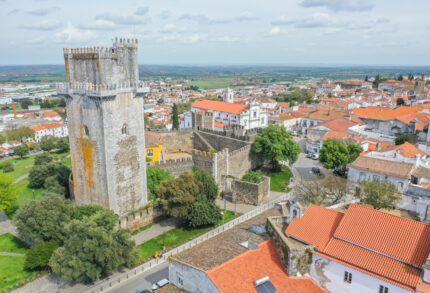
The history of Beja runs from the Roman town of Pax Julia to a Visigothic bishopric, a Muslim city, a frontier town of the Christian reconquest, and the capital of the Baixo Alentejo, where the keep of King Dinis still rises above the plain.
This page lists the main dates in the history of Beja and the people linked to the city.
Timeline of Beja
- Roman period: the town takes the name Pax Julia and becomes an important centre of the Roman province of Lusitania, with a fortress whose arch survives as the Porta de Évora.
- 1st to 4th century AD: Roman farming estates such as the Pisões Roman Villa occupy the plain around the town.
- Visigothic period: Beja is the seat of a bishop.
- 8th century: Muslim forces take the town, which remains under Muslim rule for several centuries.
- 12th century: Portuguese forces take Beja, but the Almohads recover it in 1191.
- Between 1232 and 1234: Beja returns to Portuguese rule, at the time when Moura, Serpa and Aljustrel also return.
- 1253: King Afonso III begins restoring the town walls.
- 1254: Beja receives its charter, on the model of the charter of Santarém.
- 1310: King Dinis orders the keep of Beja Castle.
- 1459: Prince Fernando and Princess Beatriz found the Convent of Nossa Senhora da Conceição, today the Beja Regional Museum.
- 1644: during the War of Restoration, new bastions reinforce the castle.
- Late 19th century: most of the Conceição convent and the ducal palace are demolished to reorganise the city centre.
- 5 October 1927: the Regional Museum opens in the former convent.
- 2011: Beja Airport opens to civil flights.
- 27 November 2014: UNESCO inscribes Cante Alentejano, the choral singing of the region, as Intangible Cultural Heritage of Humanity.
People linked to Beja
- King Dinis: the king who ordered the keep of Beja Castle in 1310.
- Prince Fernando and Princess Beatriz: the parents of King Manuel I, who lived in Beja and founded the Conceição convent.
- Mariana Alcoforado: a nun of the Conceição convent in the 17th century, presumed to be the author of the Portuguese Letters.
Places to visit in Beja