
Sintra
Sintra is a Portuguese village, part of the Greater Lisbon district. Known as the capital of Romanticism in Portugal, Sintra is considered one of the most beautiful villages in the world. It is known for being a real fairy tale, where it is possible to travel back in time without leaving the 21st century. Even today, visitors ride on horseback or travel by carriage through the Serra de Sintra to the Palácio da Pena, the Palácio de Monserrate or the Castelo dos Mouros. Close your eyes and you can visualise and journey back to the 19th century, breathing in the atmosphere of those times as you walk along roads lined with trees and plants that provide a uniquely peaceful setting. The streets of Sintra have an old-world appearance, with cobblestone paving, traditional architecture, and the everyday life of local residents and tourists who stroll through and remark on the beauty of every detail.
Location and climate of Sintra
The village of Sintra is located in a valley of the Serra de Sintra and has a microclimate similar to the subtropical Csb type according to the Köppen-Geiger classification. The village of Sintra sits at an altitude of 175 metres, reaching a maximum altitude of 529 metres, less than thirty minutes by car from Lisbon. Sintra is a small village, classified as a UNESCO World Heritage Site since 1995, known for its large number of monuments and palaces, its warm and hospitable people, its traditional pastries including Travesseiros, Queijadas and Fofos de Belas, its beaches, its lush nature and its 360º panoramic views from Lisbon to the Atlantic Ocean. The historic centre of Sintra features low-rise buildings with Germanic-style rooftops, winding narrow streets built along the foot of the Serra de Sintra, and a central square where the Palácio Nacional da Vila stands. Around the village of Sintra there are estates, palaces, centuries-old trees, lush gardens, the Volta do Duche trails linking the Castelo dos Mouros to the village of Sintra, and monuments classified as UNESCO World Heritage, namely the Palácio da Pena, the Castelo dos Mouros, Quinta da Regaleira, Palácio de Monserrate, the Chalet da Condessa d'Edla and the Convento dos Capuchos, all of which transform the village of Sintra into the capital of Romanticism in Portugal. The Serra de Sintra was reforested in the Parque da Pena by King-Consort Dom Fernando II with approximately 150 species of plants imported from various parts of the world, especially from Brazil, Mexico, Japan and New Zealand.
What to do in Sintra
Sintra is a spectacular village to visit, discover and experience — a place chosen by kings and queens, princes, princesses and noble families from the most varied countries in the world. A visit to Sintra is guaranteed to provide pleasant days in a tranquil setting full of historic attractions, nature, architecture, gastronomy, culture, social life and landscapes to admire. In this article about Sintra we will show what Sintra has to offer — the best and very best ways to spend your time during a visit:
- Carriage ride: carriage rides are a journey through the fairy-tale village, with several routes to enjoy. The Parque da Pena ride is a circuit that includes the Vale dos Lagos, Chalet da Condessa d'Edla, Quinta da Pena and Jardim da Condessa d'Edla. Carriage rides are most frequent between 1 May 2019 and 30 September 2019.
- Tourist Train: the Sintra Tourist Train allows visitors to see various locations, especially the Volta do Duche, Paços do Concelho, Palácio Valenças, the village of São Pedro, Quinta da Regaleira, the Palácio da Pena and the Castelo dos Mouros. It is a train with several stops throughout the village. The Sintra tourist train tour is a guided tour and lasts approximately 45 minutes.
- Sintra Tram: the Sintra Tram is a tourist transport service linking Sintra to Praia das Maçãs in approximately 45 minutes along 13 kilometres, with stops at Montes Santos, Ribeira de Sintra, Galamares, Colares, Banzão, Pinhal and Praia das Maçãs. The tram was inaugurated in 1904 with the aim of connecting the village of Sintra to Praia das Maçãs, reaching Azenhas do Mar in 1930.
Sintra's Top Attractions (top 10)
1. Palácio da Pena ![(38.787598, -9.390620)]: the Palácio da Pena is the Portuguese icon of Romanticism, built in the Neo-Gothic, Neo-Moorish, Neo-Manueline and Neo-Oriental styles and inspired by the castles of Ludwig II of Bavaria and the spirit of Wagner. Located at the top of a sheer rock face at an approximate altitude of 500 metres. The Palácio da Pena has been part of the European Royal Residences Network since 2013 and was built on the site of the Mosteiro de Nossa Senhora da Pena. Three distinct structures can be identified:
- Mosteiro de Nossa Senhora da Pena — the Mosteiro de Nossa Senhora da Pena was inaugurated in 1511, designed by Diogo de Boitaca (1460–1528) at the wish of Dom Manuel I (1469–1521) to house eighteen monks of the Order of Saint Jerome, formerly based at Quinta da Penha Longa. The main highlights of the Mosteiro de Nossa Senhora da Pena are:
-
- Altarpiece by Nicolau de Chanterene (1470–1551)
- Tile panel gifted by Filipe II (1527–1598) in 1619
- Palácio da Pena: the Palácio da Pena, located on Monte da Pena, was built between 1839 and 1852 at the wish of King Dom Fernando II (1816–1885), with a design by Barão de Eschwege (1777–1855) to serve as a summer residence for Dom Fernando II. The main highlights are: surrounding walls with two gates and a drawbridge
- Pátio dos Arcos: located in front of the Chapel
- Arco dos Lagartos: the Arco dos Lagartos is a triumphal arch in Oriental style inspired by the Gate of Justice of the Alcazar of Alhambra in Granada. At the top of the gate are three open roses carved in stone, symbolising knowledge, two columns with daisies and mistletoe — the plant of the Druids
- Portão Monumental: this gate is believed to have been designed by Dom Fernando, representing various motifs linked to Lisbon, the capital of the Empire, and built in three styles: Renaissance, Manueline and Medieval. The gate was inspired by the following buildings: the Palácio do Cunhal das Bolas in Bairro Alto, the Casa dos Bicos in Campo das Cebolas, and the Torre de Belém in Belém. At the top of the gate are five merlons, the central one bearing the Cross of Christ covered in animal skins
- Pórtico do Tritão: the Pórtico do Tritão was designed by Dom Fernando and inspired by a window in the Convento de Cristo in Tomar. The portico is also known as the Allegorical Portico of the Creation of the World, featuring four archivolts in Neo-Gothic style framed by Manueline coral motifs. The Triton is a mythological creature, half man and half fish, strongly associated with the era of Portuguese Expansion. The representation of the Triton was inspired by the bust supporting the window of the Sacristy of the Convento de Cristo in Tomar
- Porta da Origem: at the Porta da Origem the Manueline-style window stands out, inspired by the Manueline Window of the Convento de Cristo in Tomar. Below the window is the coat of arms of Dona Maria and Dom Fernando II, and at the top a sphere bearing the Cross of the Order of Christ flanked by two armillary spheres
- Torre do Relógio: the Torre do Relógio was inspired by the Torre de Belém
- Palace Entrance: the bust of Dom Fernando II is the main highlight
- Claustro do Mosteiro de Nossa Senhora da Pena: rebuilt by Dom Fernando II in Hispano-Moorish style and used as an exhibition hall. At the centre of the cloister stands a fountain supported by three tortoises, whose four legs represent the four elements. The tortoises bear their shells, a symbol of the Cosmos, and rest on eras representing eternity
- Quarto de Dom Carlos I: the main highlight of Dom Carlos I's bedroom is the Empire-style furniture, namely the bed, bedside table, chaise-longue and a mirror. In the bathroom there is Portugal's first water-closet and a hot and cold shower
- Atelier do Rei Dom Carlos I: the Atelier of Dom Carlos I was where the Portuguese king relaxed, particularly by painting. The highlights are the paint boxes, brushes and seven unfinished canvases
- Chapel: this room was one of the cells of the monks of the former monastery, later repurposed by Dom Fernando II as a chapel. The main points of interest are the high altar altarpiece by Nicolau de Chanterenne, a gift from Dom João III to his wife Dona Leonor, and four stained-glass windows depicting the following:
- First Window: armillary sphere and the Cross of Christ, flags bearing the arms of Portugal and Saxe-Coburg and Gotha
- Second Window: image of Nossa Senhora da Pena holding the infant Jesus
- Third Window: image of Saint George
- Fourth Window: image representing Dom Manuel I holding the Mosteiro de Nossa Senhora da Pena, Vasco da Gama contemplating the Torre de Belém, and a caravel
- Queen's Bedroom: notable for its stucco walls with gold leaf in Moorish style, and the bed, chest and sideboard made of rosewood
- Dining Room: notable for the table service used by the Royal Family, a centrepiece in the shape of a caravel supported by Neptune and the Nymphs in homage to the Portuguese Expansion, and ceilings bearing representations of the coats of arms of Portugal, the coats of arms of the Order of Christ and the Armillary Sphere
- Saxe Room: the room displays King Dom Fernando II's collection of Meissen porcelain
- Queen's Study: the study features some interesting items of furniture, namely a desk, a chair in Romantic style and an oil study by the painter Cristino Silva
- Arab Room: the highlights are the walls decorated in fresco, tempera and trompe l'oeil, designed to give the room a sense of monumentality
- Queen's Terrace: from this terrace it is possible to observe the Monte do Gigante, where a bronze statue of a warrior stands guard over the Palácio da Pena and the Atlantic Ocean
- Indian Room: the Indian Room is decorated with Indian-themed furnishings and objects. The walls are covered in Moorish and Indian-style stucco. The ceiling is wooden and decorated with neo-Moorish motifs
- Salão Nobre: the grand hall was used as the palace's reception room and its main highlights are the Indian-style furniture, the twelve upper rosettes representing the twelve houses of the Zodiac and the twelve Gates of the Celestial Jerusalem
- Sala dos Veados: the Sala dos Veados, also known as the Sala dos Cavaleiros, was used as the dining room of the Royal Family. It stands out for the display of stained-glass windows from King Dom Fernando II's collection, the scale model of the Palácio da Pena, and the plaster deer heads with projecting antlers. At the centre of the room is a column representing a tree trunk.
- Royal Kitchen: where it is possible to observe the equipment and utensils used in the daily life of the royal family.


2. Castelo dos Mouros: ![(38.792557, -9.389338)] the Castelo dos Mouros is the oldest military structure in Sintra, having been built in the 10th century during the Muslim occupation with the purpose of forming an advanced defence of Lisbon. The castle occupies an area of approximately 12,000 m², with a wall extending 450 metres. On a clear day it is possible to see as far as the Berlengas Islands. The site was deliberately chosen so that Lisbon could be warned of approaching Viking raiders. There are records of several attempts to capture the castle by Christian warriors, most notably by Sigurd the Crusader (c. 1090–1130), King of Norway, in 1109 on his way to Jerusalem. The castle had various support structures, including a communal oven, grain and legume storage silos, and dwellings. The Muslim quarter was completely destroyed in 1147 after the conquest of Lisbon, Santarém and Sintra by Dom Afonso Henriques. In 1154 the castle and the village of Sintra were donated by Dom Afonso Henriques to Dom Gualdim Pais, Master of the Templars. Over the centuries the Castelo dos Mouros gradually lost its defensive function and the village of Sintra began to grow. In 1839 King Dom Fernando II purchased and transformed the Castelo dos Mouros into a landscape castle; it was subsequently rehabilitated between 2008 and 2012. The main highlights of the Castelo dos Mouros are:
- Cavalariças do Castelo dos Mouros
- Islamic silos for storing grain and legumes
- Islamic quarter with communal oven
- 12th-century Igreja de São Pedro de Canaferrim, built over the ruins of the destroyed Islamic quarter
- Medieval necropolis
- Grande Cisterna
- Porta da Traição


3. Cabo da Roca: ![(38º 46',99 N, 09º 29',75 W)] Cabo da Roca is the westernmost point of Europe, also known as Cabo da Ofiussa, Cabo da Serpente or Promontório da Lua. The Cabo da Roca lighthouse was ordered on 1 February 1758, entered service in 1772 and was automated in 1990. The Cabo da Roca lighthouse stands 22 metres tall and was built at the top of a cliff at an altitude of 140 metres, visible from up to 48.1 km out at sea. The main highlights are the lighthouse dating from 1772, the view over the Atlantic Ocean, Praia da Ursa and Guincho.


4. Palácio Nacional de Sintra: ![(38.797679, -9.390666)] the Palácio Nacional de Sintra was one of the palaces used as a holiday residence by the Royal Family, located in the centre of the village of Sintra. The Palácio Nacional de Sintra, also known as the Paço Real or Palácio da Vila, was built over several centuries, namely:
- 10th century: it began as the residence of the Muslim governor;
- Reign of Dom Dinis: restoration works were carried out due to the deterioration of the palace, including new royal apartments, a chapel and the prison room of Dom Afonso VI;
- Reign of Dom João I: Dom João I entrusted the restoration of the palace to João Garcia de Toledo, who built several structures, including the three arches of the main entrance facing the village and overlooking the people, the construction of the Sala das Pegas, the Sala das Sereias, the Sala dos Árabes, the Sala dos Cisnes and the kitchen chimneys;
- Reign of Dom Manuel I: during this reign the Paço Real and the Sala dos Brasões were built. The Palácio Nacional da Vila de Sintra was classified as a National Monument in 1910, a UNESCO World Heritage Site since 1995 and has been part of the European Royal Residences Network since 2013. The main points of interest are:
- Sala dos Cisnes: the current paintings are a 17th-century restoration of the 15th-century originals. The swans represent the English Royal House in homage to Dona Filipa de Lencastre (1360–1414), wife of Dom João I. The swan of the English Royal House was associated with Lohengrin, one of the Knights of King Arthur's Round Table
- Sala das Pegas: the main highlight is the ceiling painting featuring an allegory of the magpie — a bird known for stealing objects — a red rose associated with the English House of Queen Inês de Lencastre, and the inscription Por Bem associated with King Dom João I
- Chapel of the Holy Spirit: the chapel's Hispano-Moorish tile panels on the walls are unique in Portugal
- Sala dos Brasões: this is the most important heraldic hall in Europe. The ceiling painting is organised in five circles: the First circle depicts the arms of King Dom Manuel I with the shield, crown and dragon from the Legend of King Arthur; the Second circle shows medallions bearing the arms of the eight children from his second marriage to Dona Maria de Aragão (1482–1517), daughter of the Catholic Monarchs of Spain, Fernando (1452–1516) and Isabel (1451–1504); the Third circle shows medallions bearing the arms of members of the Royal House; the Fourth circle shows deer within medallions; and the Fifth circle shows 72 panels of the most important noble families of the time who supported King Dom Manuel I, namely the Noronhas, Coutinho, Castro, Ataíde, D'Eça, os Menezes, Castros de Penha Verde, Cunha, Sousa, Pereiras, Vasconcellos, Melo, Silvas, Albuquerque, Andrade, Almeida, Manoel, Febo Moniz, Lima, Távoras, Henriques, Mendonça, Albergaria, Almada, Azevedo, Castelo-Branco, Abreu, Brito, Moura, Lobo, Sá, Corte-Real, Lemos, Ribeiro, Cabral, Miranda, Tavares, Mascarenhas, Sampaio, Malafaia, Meira, Aboim, Carvalho, Mota, Costa, Pessanha, Pacheco, Sotomaior, Lobato, Teixeira, Valente, Serpa, Gama, Nogueira, Bethancourt, Góis, Pestana, Barreto, Coelho, Queirós, Ferreira, Siqueira, Cerqueira, Pimentel, Fois, Arca, Pinto, Gouveia, Faria, Vieira, Aguiar and Borges. The painting of the five circles was created to demonstrate unity following the divisive times of the Reign of Dom João II.
- Kitchen: the highlights of the kitchen are the two chimneys standing 33 metres tall;
- Arab Room: this was the oldest part of the palace, where the Arab leader of Sintra would convene. The main highlight is a tank in the floor that served as a cooling feature, common in palaces of the Islamic Empire.

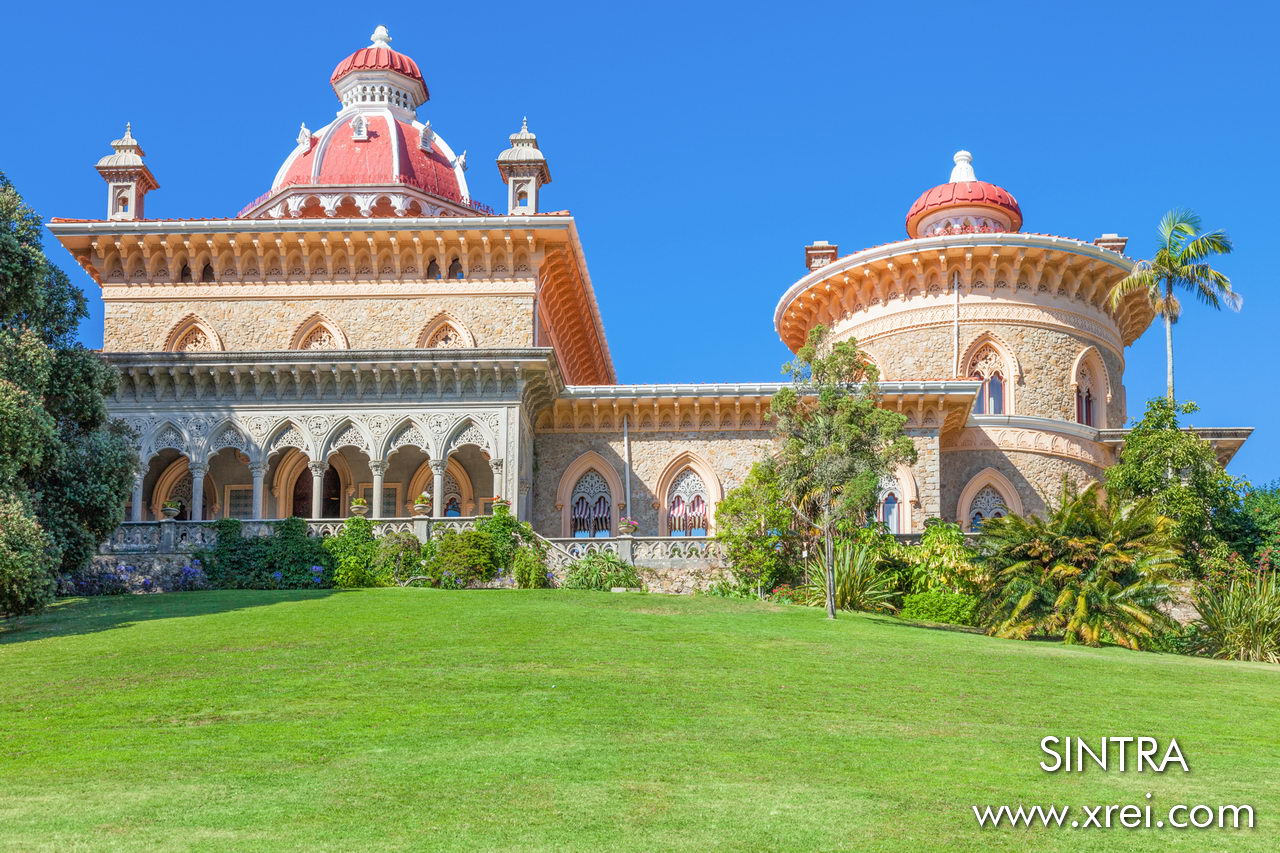
5. Palácio de Monserrate and Park: ![(38.794154, -9.420646)] the Palácio de Monserrate is a palace renowned for its architecture and landscaping, located four kilometres from the historic centre of Sintra. The name Monserrate emerged in 1540 following the construction of a chapel dedicated to Nossa Senhora de Montserrat on the estate that belonged to the Mello e Castro family between 1600 and 1790, the year in which the Englishman Gerard de Visme leased the palace. The current Palácio de Monserrate is the result of successive interventions by English citizens, namely Gerard de Visme, William Beckford and Francis Cook. Quinta de Monserrate was purchased by Gerard de Visme in 1789, a wealthy English merchant living in Lisbon, and was subsequently leased to various notable figures including William Beckford until 1794, and Lord Byron. Francis Cook (1817–1901) purchased the property in 1863 and rebuilt it according to a design blending several styles — Gothic, Indian and Moorish — by architect James Knowles. The main highlights of the Palácio de Monserrate and Park are the Jardim do México, the Jardim da África do Sul, the Roseiral de Monserrate, the Ermida de Monserrate, the Capela do Fundador, the Sala da Música, the Torreão Sul, and the Biblioteca.


6. Palácio and Quinta da Regaleira: ![(38.796449, -9.396024)] the Palácio and Quinta da Regaleira is a complex built to serve as the holiday home of a coffee entrepreneur, located on the edge of the historic centre of Sintra. The Quinta da Regaleira estate was purchased by António Monteiro from the Barons of Regaleira. Monteiro drew inspiration from the Palácio Nacional da Pena, the Hotel Palace do Buçaco and the Portuguese Epic of the Discoveries for the project, executed by Luigi Manini — who had previous experience with the Hotel Palace do Buçaco and the Teatro Nacional de São Carlos in Lisbon. Luigi Manini was the principal creative force behind the gardens, grottos, lakes, initiation well, chapel, sculptures and palace. Within the Palácio and Quinta da Regaleira it is possible to identify references to Greek mythology, Dante, Camões, the Order of Christ and the Rosicrucian Order. The Palácio da Regaleira is divided into four floors:
- Ground floor: also known as the Noble Floor, notable for the decoration of the rooms in Manueline, Renaissance and Baroque styles;
- First floor: contains the private rooms of the Monteiro family, including the study, the toy room and the Sala Lusíada;
- Second floor: features the octagonal room, designed on the basis of the Charola do Convento de Cristo in Tomar;
- Third floor: contains the neo-medieval tower, António Monteiro's office and the laboratory. The Regaleira garden features several highlights, namely:
- Alea dos Deuses: the avenue linking the Loggia dos Pisões to the Palácio da Regaleira. The highlights are nine statues of Greco-Roman deities: Fortuna, Orfeu, Vénus, Flora, Ceres, Pã, Dionísio, Vulcano and Hermes;
- Chapel: built in Neo-Manueline style, it stands out for its scenes of the Annunciation, the Coronation of Mary, the Crosses of the Order of Christ — the Portuguese heir to the Templar Order — and a tunnel connecting to the palace via the crypt;
- Initiation Well: an inverted tower approximately 27 metres deep, excavated into the earth. The initiation well features a spiral staircase representing Dante's Inferno and the relationship between Earth and Heaven.


7. Convento dos Capuchos: ![(38.784412, -9.438148)] the Convento dos Capuchos, located in the Serra de Sintra, was a very small convent built with the intention of blending into the surrounding landscape and allowing the eight monks who inhabited it to live in closer contact with the natural environment of the Serra de Sintra. It became known as the Cork Convent because cork was one of the few materials used to adorn the building. The Convento dos Capuchos was inaugurated in 1560 at the wish of Dom Álvaro de Castro, Counsellor of State to King Dom Sebastião. The convent was given the name Convento de Santa Cruz da Serra de Sintra and was entrusted to friars of the Order of Saint Francis. The Convento dos Capuchos was abandoned in 1834, the year that decreed the end of monastic and religious orders in Portugal. The highlights of the Convento dos Capuchos are:
- Terreiro das Cruzes
- Pórtico das Fragas
- Terreiro do Sino
- Terreiro da Fonte
- Capela da Paixão de Cristo
- Porta da Morte
- Dormitório
- Casa das Águas
- Cozinha
- Refeitório
- Biblioteca
- Cela da Penitência
- Quarto Superior
- Sala do Capítulo
- Claustro
- Ermida do Senhor no Horto
8. Palácio Nacional de Queluz and Gardens: ![(38.750773, -9.259061)] the Palácio Nacional de Queluz is one of the last buildings constructed in Europe in the Rococo style, located in Queluz. The Palácio Nacional de Queluz served various functions throughout history: country house of the Marquises of Castelo Rodrigo, a recreational estate during the period of Spanish occupation, a leisure and holiday residence of the Portuguese Royal Family, the Official Residence of the Royal Family between 1794 and 1807 following the fire at the Palácio Nacional da Ajuda until the French Invasions, state property from 1908, and classified as a National Monument in 1910. The Royal Family, the Court and the Nobility used the Palácio Real de Queluz as a venue for leisure and entertainment — referred to as the Real Quinta de Recreio — particularly for balls, serenades, fireworks displays, water games, boat trips along the Canal dos Azulejos, equestrian competitions and bullfights. The Palácio Nacional de Queluz was built in two phases: the first between 1747 and 1784, involving architect Mateus Vicente de Oliveira and the French goldsmith and architect Jean-Baptiste Robillion, and the second between 1784 and 1792 under the direction of architect and sergeant-major Manuel Caetano de Sousa. The first construction phase included the Sala do Trono, the Private Apartments Pavilion, the Lago das Medalhas, the Escadaria dos Leões and the Canal dos Azulejos.


The second construction phase included the Fachada de Cerimónias and the Pavilhão Dona Maria. The highlights of the Palácio Nacional de Queluz and Gardens are:
- Sala do Trono: construction of the Sala do Trono began in 1768 and was completed in 1774 in the Rococo style. The design is by Jean-Baptiste Robillion. This room was primarily used for balls organised by Dona Maria I and Dom Pedro III and for certain official ceremonies. The main highlights are the walls carved in gilded woodwork by the carver Silvestre Faria Lobo, the interplay of natural light reflected in the room's mirrors, and the paintings by João de Freitas Leitão representing Faith, the Sun, Hope, War, Justice and Charity;

Hall of Mirrors at the Palácio Nacional de Queluz - Music Room: the Music Room was built in 1759 and served several functions, particularly as a ballroom, audience chamber and kissing-of-hand hall, opera house and chamber music concert venue. The attractions of the Music Room are the columns painted to imitate marble and the gilded ceiling woodwork by Silvestre Faria Lobo
-

Ballroom at the Palácio Nacional de Queluz, with columns painted to imitate marble and gilded ceiling woodwork by Silvestre Faria Lobo - Ambassadors' Room: the Ambassadors' Room was part of Jean-Baptiste Robillion's original design. The main points of interest are the paintings by Bruno José do Vale and Francisco de Melo, the central panel painted by the Italian Giovanni Berardi depicting Dom João V, Queen Dona Vitória and their children, and the two canopies used as thrones

Ambassadors' Room at the Palácio Nacional de Queluz, with paintings by Bruno José do Vale and Francisco de Melo, and a central panel by the Italian Giovanni Berardi depicting Dom João V, Queen Dona Vitória and their children - Chapel: the design was by Mateus Vicente de Oliveira. The Chapel of the Palácio Real de Queluz was the venue for several ceremonies, particularly the Missa das Pedras when building materials arrived at the start of construction, the Maundy Thursday foot-washing ceremony normally held at the Palácio Nacional da Ajuda, the Procissão da Senhora do Cabo, and the eight baptisms of the children of Dom João VI and Dona Carlota Joaquina. The highlights are the dome of the main chapel, the gilded woodwork by Silvestre Faria Lobo, the altarpiece featuring a painting by André Gonçalves depicting the patron of Queluz, Nossa Senhora da Conceição, and the ceiling painting by Alexandrino de Carvalho with allusions to the Virgin;
- Biblioteca de Arte Equestre Dom Diogo de Bragança: this is the only library in Portugal exclusively dedicated to Equestrian Art and open to the public. The library holds approximately 2,000 publications, 294 books and pamphlets from the 19th and 20th centuries, 800 European titles from the 16th, 17th, 18th and 19th centuries, 322 illustrated works from the second half of the 20th century, and 165 original engravings and prints.
- Pavilhão Robillion: the Pavilhão Robillion was built to house the private apartments of the Royal Family. The design was by Jean-Baptiste Robillion and it was used by Dom Pedro III, Dom João VI, Dona Carlota Joaquina, Dom Miguel and Dom Pedro IV.
- Corredor das Mangas: this was where the glass sleeves used to protect candles were stored. The Corredor das Mangas is also known as the Corredor dos Azulejos on account of its tile panels from two distinct periods: the first tiles from 1764, painted by Manuel da Costa Rosado depicting hunting scenes, and the second set from 1784 by Francisco Jorge da Costa depicting the various continents, the seasons and classical mythology, alongside faience vases from the Real Fábrica do Rato and the Fábrica Viúva Lamego, and several small carriages created for moving around the gardens;
- Sala Dom Quixote: this circular-effect room stands out for its eight paintings with gilded woodwork and papier-mâché ornaments depicting scenes from the life of Don Quixote de la Mancha by Cervantes, and the central ceiling canvas featuring an allegory dedicated to music. It was in this room that Dom Pedro IV died.
Gardens of Queluz: the main highlights of the Gardens of Queluz are the statues, lakes, fountains, vast scale, vases and busts.

The main points of interest in the Gardens of Queluz are:
- Canal dos Azulejos: this was where boat trips were organised. The Canal dos Azulejos is notable for the tile panel paintings of the Lago Grande by João Antunes and Manuel da Costa Rosado. The Lago Grande served two purposes: it was one of the decorative elements of the Gardens of Queluz and the means by which water was channelled from the Ribeira do Jamor to the gardens over an approximate distance of 115 metres. The Lago Grande features two lead sculptures representing Bacchus, Ariadne, Venus and Adonis by English lead sculptor John Cheere. The Canal dos Azulejos was originally known as the Lago Grande on account of its size. It was restored during the Reign of Carlos by Pereira Cão and Carlos Alberto Nunes;
- Jardim Botânico de Queluz: the Jardim Botânico de Queluz was built between 1769 and 1776 and originally comprised 24 beds of various fruits and plants, with particular emphasis on the production of pineapple — a rare and exotic fruit in the 18th century. The Jardim Botânico de Queluz was also known as the Jardim das Estufas;
- Lago de Nereide: the main highlight is the sculptural ensemble by the Englishman John Cheere;
- Lago de Neptuno: the Lago de Neptuno was designed by Jean-Baptiste Robillion in 1771 and its main attractions are the lead sculptures by John Cheere representing Neptune, Achilles, Spring, Summer, Autumn, Meleager, Atalanta, Vertumnus, Pomona, Mars and Minerva;

Lago de Neptuno is one of the many ornamental lakes with sculptures to be admired in the gardens of the Palácio de Queluz - Jardim Pênsil: the Jardim Pênsil takes its name from the fact that it sits on a sloped terrain above a water reservoir. It is notable for its large maze, which is the hallmark of the palace;
- Jardim de Malta: the Jardim de Malta was constructed from 1754. It received this name because Dom Pedro III served as Grand Master of the Order of Malta. The main attractions are the four lakes and the sculptures representing Music, Painting, Sculpture and Architecture.
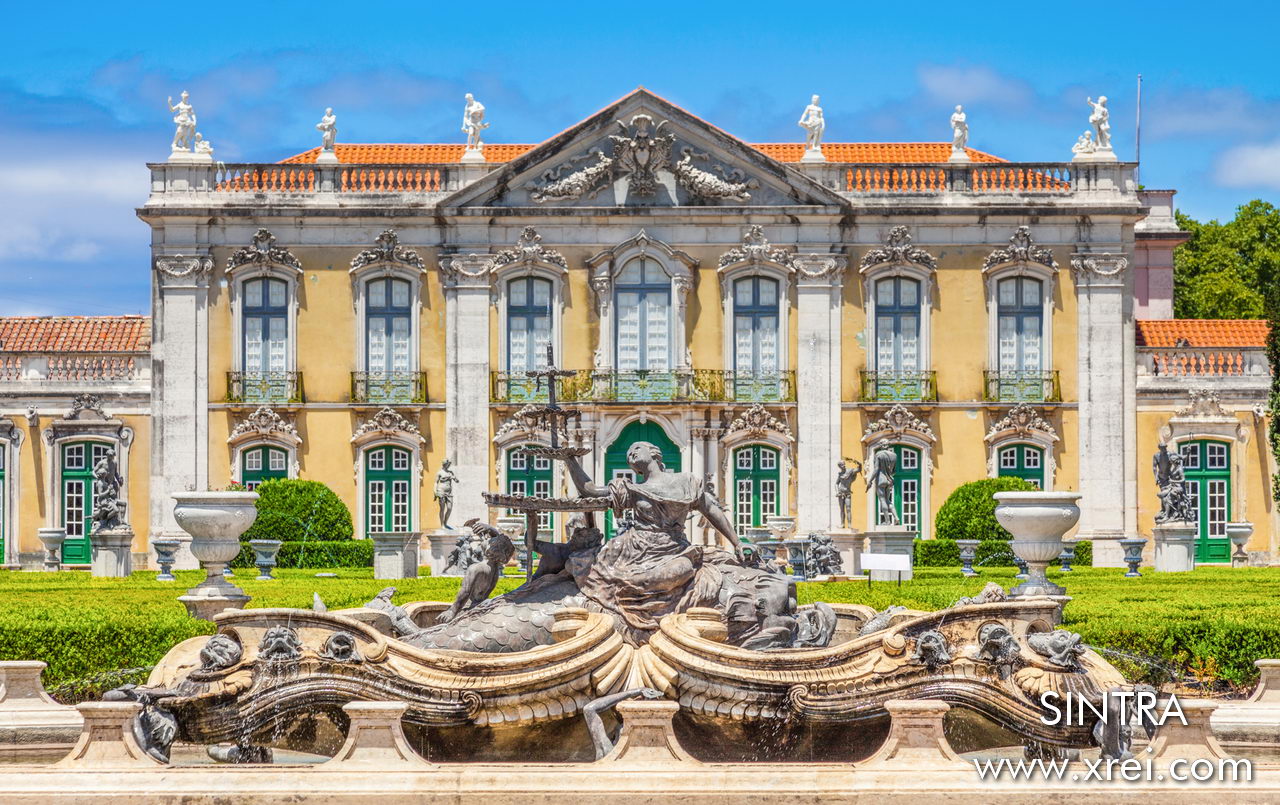
The Palácio de Queluz. The "Ceremonial Façade" of the corps de logis by Mateus Vicente de Oliveira.
9. Palácio de Seteais: ![(38.796188, -9.398261)] the Palácio de Seteais is a luxury hotel housed in an 18th and 19th-century palace, located on the road to Monserrate at the edge of the historic centre of Sintra. Near the Palácio de Seteais it is possible to visit places such as the Quinta and Palácio da Regaleira or the Quinta do Relógio. The name Seteais is linked to the Legend of Seteais, which according to tradition recounts: "that after the conquest of Sintra in 1147, the Christian knight Dom Mendo de Paiva discovered a secret gate being used as an escape route by a group of Muslims. Among the fugitives was a very beautiful Moorish woman accompanied by her handmaiden, both of whom were taken prisoner. The moment she saw Dom Mendo de Paiva, the young Moorish woman let out her first sigh. The second came when she realised she was to be made a prisoner, prompting the handmaiden to reveal the curse of the seven sighs that a sorceress had placed upon her. The curse foretold that on the day the young Moorish woman reached her seventh sigh, she would die. The knight did not believe it and continued on his way. The disclosure of the secret prompted another sigh, and Dom Mendo's disbelief was cause for yet another. Learning of the curse, Dom Mendo promised to take them to a place of safety. When he found such a place, Dom Mendo stepped away briefly — long enough for a group of Muslims to attack the Moorish women and behead the handmaiden. That was the sixth sigh. The seventh and final sigh came when she saw the dagger of one of the Muslims. By the time Dom Mendo de Paiva returned, it was too late, for both women were dead. Overcome with grief, he resolved to call the place where the two Muslim women had been killed Seteais." The Palácio de Seteais was built on the orders of Dutch consul Daniel Gildemeester (1727–1793) on an estate granted by the Marquis of Pombal (1699–1782). After the death of the Dutch consul, the palace was sold to the Marquis of Marialva, who extended it with a U-shaped design by architect José da Costa e Silva (1747–1819). The Palácio de Seteais was purchased by the Tivoli chain in 1954 and was restored and officially designated as the Tivoli Palácio de Seteais Sintra Hotel in 2009 by the Fundação Ricardo Espírito Santo. The main highlights of the Palácio de Seteais are:
- Entrance arch: inaugurated in 1802 and built to mark the visit of King Dom João VI and his wife Dona Carlota Joaquina. The triumphal arch was built in Neoclassical style.
- Gardens of Seteais: the Gardens of Seteais feature maze-shaped hedgerows from which the valley views can be enjoyed.
10. Chalet da Condessa d'Edla: ![(38.785235, -9.399112)]: the Chalet da Condessa d'Edla is a small country house belonging to the Countess of Edla, located in the western area of the Parque da Pena. The Chalet da Condessa d'Edla was built between 1869 and 1875 on the orders of Dom Fernando II, modelled on the chalets of the Alps. The Chalet da Condessa d'Edla was a private space, built with the aim of recreating the landscapes of Austria and Switzerland — the homelands of Dom Fernando and the Countess of Edla. The project for the Chalet da Condessa d'Edla was designed by the Countess of Edla herself. It was abandoned until 2006, when restoration began, and reopened to the public in 2011. The main highlights of the Chalet da Condessa d'Edla are the cork decoration, the Countess of Edla's bedroom, the garden rockeries, the plants imported from various parts of the world including the Himalayas, the United States, and Northern Europe, and the view over the Palácio da Pena and the Castelo dos Mouros.
Other places to explore in Sintra
Parque da Pena: ![(38.789333, -9.392152)] the Parque da Pena extends across 200 hectares of the Serra de Sintra, encompassing the Palácio Nacional da Pena. The main highlights of the Parque da Pena are:
- Árvore da Vida: the tree at the entrance to the Parque da Pena, representing the Tree of Eden at the gateway to Paradise
- Fonte dos Passarinhos: a fountain in Arabic and Oriental style decorated with tiles manufactured at the Fábrica Roseira in Lisbon, bearing an Arabic inscription reading "Sultan Dom Manuel built this blessed chapel in the name of Nossa Senhora da Pena in the year 1503 to commemorate the safe return of Dom Vasco da Gama from the discovery of the lands and countries he encountered, namely the Cape of Good Hope, India and others." Inside the fountain there were three small bird figurines, which have since disappeared;
- Feteira da Rainha: an area comprising several dozen tree ferns, walking trails, natural springs and a cosmic oven widely used in alchemy;
- Estufas: greenhouses designed to shelter seedlings and new plants intended for cultivation in the Parque da Pena;
- Templo das Colunas: a circular temple supported by twelve columns representing the twelve houses of the Zodiac, sheltered by an oak — the tree of the Druids. The temple door is guarded by a gnome carved in stone representing the four elements;
- Capela de Santo Amaro: according to legend, Santo Amaro was so absorbed in his reading that he walked on water without noticing. The Capela de Santo Amaro is the last stop before the Castelo dos Mouros.
Museu de História Natural de Sintra: ![(38.798113, -9.389993)] the Museu de História Natural de Sintra is a museum dedicated to preserving and promoting the natural history of Sintra, located in the Historic Centre of Sintra. The main points of interest are:
- More than ten thousand fossils;
- Trilobite collection;
- Meteorite collection, including the Nantan Meteorite from China.
News Museum: ![(38.796438, -9.389937)] the News Museum is a museum dedicated to the most important news events in the history of humanity, located in the Historic Centre of Sintra. The museum is housed in the former Museu do Brinquedo building and traces the history of the media while honouring the most significant journalists in history. Quinta do Relógio: ![(38.796292, -9.395318)] the Quinta do Relógio is an 18th-century estate located in the Serra de Sintra. The estate had several owners throughout history, including Dom Fernando Maria de Sousa Coutinho Castelo Branco e Meneses, the 15th Count of Redondo, the multimillionaire Metznar, the banker Thomas Horn, the slave trader Manuel Pinto da Fonseca and the Swede Christopher Berglund. The Quinta do Relógio became widely known when it was purchased by slave trader Manuel Pinto da Fonseca, known as the Count of Monte Cristo, who made his fortune in the slave trade. Manuel Pinto da Fonseca entrusted the design of the estate to architect António Manuel da Fonseca Júnior. The Quinta do Relógio was classified as a UNESCO World Heritage Site in 1995. Local tradition among the people of Sintra holds that it is haunted, owing to the bloodshed associated with Manuel Pinto da Fonseca's career. Parque da Liberdade: the Parque da Liberdade is a public garden in the village of Sintra, located at the Volta do Duche at the entrance to the Historic Centre of Sintra. The Parque da Liberdade was inaugurated in July 1937 and features the following points of interest:
- More than 60 different species of plants and trees
- Virtual Theatre where visitors can experience a virtual recreation of the commercial relations between Portugal and Japan during the 16th century
Centro Interactivo Mitos e Lendas de Sintra: ![(38.690424, -9.335667)] the Centro Interactivo Mitos e Lendas de Sintra is the most recent tourist attraction in the village of Sintra. The centre presents three-dimensional films about the myths and legends of Sintra, organised across four sections:
- Section 1: the visit begins on the highest floor — the virtual equivalent of the summit of the Serra de Sintra — where visitors learn about the Creation of the Rocks, the Legend of the Five Heights of the Same Name and the Different Surnames of Sintra;
- Section 2: this floor tells the History of Sintra;
- Section 3: here the Legend of the Tombs of the Two Brothers, the Legend of the Seven Sighs and the Legend of the Apparition of Our Lady are recounted;
- Section 4: this floor features a simulation of the Initiation Well of the Quinta da Regaleira and other unique three-dimensional experiences about the Serra de Sintra.
Palaeolithic / Chalcolithic Settlement: this nucleus is an archaeological site with remains from the Palaeolithic, Chalcolithic and Late Neolithic periods, located on Rua das Padarias in the old village of Sintra, with highlights including more than 400 artefacts found on site. Paços do Concelho

Inside there is a cloister with balconies decorated in neo-Manueline and Renaissance style.
Points of interest along the streets of Sintra
Exploring the village of Sintra on foot Fonte da Sabuga: the Fonte da Sabuga is one of the most important fountains in Sintra, known for the curative properties of its water, located on the road linking Sintra to Colares. The current fountain was rebuilt after the 1755 Earthquake, with blue and white tile panels as its main feature. Miradouro da Cruz Alta: the Miradouro da Cruz Alta is the highest point of the Serra de Sintra, located within the Parque da Pena at 529 metres above sea level. The main highlight is the view over the Palácio da Pena, the Castelo dos Mouros, the village of Sintra and the Atlantic Ocean. Palácio dos Ribafria: the Palácio dos Ribafria is a 16th-century palace located in Várzea de Sintra. The palace was commissioned in 1541 by Gaspar Gonçalves in the Manueline style. The main highlights are the:
- Gardens;
- Palace;
- Lake;
- Cistern.
Biblioteca Municipal de Sintra: the Biblioteca Municipal de Sintra is a public library located on Rua Gomes de Amorim in Sintra. The library is housed in Casa Mantero and offers the following services:
- In-person reading;
- Braille Section;
- Local and Regional History Section;
- Camilo Castelo Branco Collection;
- Archives of Vera Jane, Oliva Guerra, Ângelo Costa Cabral and Rodrigo Castro Pereira;
- Tea Room.
Capela de São Mamede de Janas: the Capela de São Mamede de Janas is a 16th-century chapel located in Janas. Janas is a small village in the municipality of Sintra, situated approximately one kilometre from the village of Azenhas do Mar. The chapel features the following attractions:
- Circular-plan chapel dedicated to São Mamede, the patron saint of livestock;
- A continuous bench running around the entire interior of the chapel.
Cascata dos Pisões: the Cascata dos Pisões is a small waterfall located on the road linking Sintra to the Quinta da Regaleira. Notable for the calming sound of falling water and the surrounding woodland, which creates a mystical atmosphere. Centro Cultural Olga Cadaval: the Centro Cultural Olga Cadaval is Sintra's main venue for performances and cultural activities. The centre was built in 1945 to inaugurate the Cine-Teatro Carlos Manuel, with a design by Manuel Joaquim Norte Júnior. The building was abandoned following the fire of 1985, until it was reopened under its current name in 2001 in honour of Olga Cadaval (1900–1993), Marchioness of Cadaval and patron of the arts in Lisbon and Sintra. The Centro Cultural Olga Cadaval features the following highlights:
- Auditório Jorge Sampaio: the largest auditorium in the cultural centre, with a capacity of one thousand seats;
- Auditório Acácio Barreiros: the smaller auditorium of the cultural centre.
Centro Interativo Sintra, Mitos e Lendas: the Centro Interativo Sintra, Mitos e Lendas is Sintra's most recent tourist attraction, located on Praça da República. The centre presents myths and legends about Sintra in a multidimensional format. The attractions of the Centro Interativo de Sintra are as follows:
- Floor 1: Legends of the "Túmulos dos dois Irmãos" and the "Sete Ais";
- Floor -1: Entry into a tunnel simulating the Initiation Well of the Quinta da Regaleira.
Chalet Biester: the Chalet Biester is a late 19th-century Neo-Gothic building located on the Estrada da Pena in the Serra de Sintra. The Chalet was built in 1890 as the residence of Ernesto Biester (1829–1880), impresario of the Teatro Nacional Dona Maria II, with a design by José Luís Monteiro — architect of the Rossio railway station and Parque Eduardo VII in Lisbon — and the scenographer Luigi Manini, stage director of the Teatro Nacional de São Carlos and author of the interior decoration of the Palácio da Quinta da Regaleira. The palace is currently a private residence and became widely known as the location where Roman Polanski filmed The Ninth Gate, starring Johnny Depp, as well as for the impressive stained-glass windows commissioned from France, and for the local tradition that seven underground floors exist beneath the building where a secret society would meet and where three copies of a book written by the Devil are said to be held. Fonte Mourisca: the Fonte Mourisca is a fountain dating from 1922, built to replace the Chafariz da Câmara Municipal de Sintra, located at the Volta do Duche at the entrance to the Historic Centre of Sintra. The fountain was designed by José da Fonseca and features the following highlights:
- Mudéjar-inspired tiles;
- Façade with three horseshoe arches;
- Continuous stone benches;
- Bronze spout.
Fonte da Pipa: the Fonte da Pipa is an 18th-century fountain located in the Serra de Sintra. The Fonte da Pipa is first mentioned in the 14th century, with its current appearance dating from after the 1755 Earthquake. The highlights are:
- Tile panels depicting Diana and Justice;
- Tile panels depicting pine forests.
Fonte da Mata Alva: the Fonte da Mata Alva is an 18th-century fountain located on Rua Barbosa du Bocage. The fountain was rebuilt in 1875 by Francisco, Viscount of Monserrate, in a semicircular form. The main points of interest are:
- Four panels of 16 tiles each, painted in blue and yellow
- Tile panels depicting a "tapete de maçarocas" — a tile technique widely used in the 18th century
Igreja de São Pedro de Penaferrim: the Igreja de São Pedro de Penaferrim is the parish church of Sintra, located in São Pedro de Sintra. The current church was built after the 1755 Earthquake; however, the original chapel was inaugurated in the 16th century at the wish of Dom Álvaro de Castro. The main points of interest of the Igreja de São Pedro de Penaferrim are:
- 18th-century tile panels depicting the life of Saint Peter;
- 16th-century Gothic sculpture portraying Saint Peter;
- 17th-century Luso-Oriental ivory Christ figure;
- Arms of Archbishop Dom Tomás de Almeida on the façade.
Igreja de Santa Maria: the Igreja de Santa Maria is the church of one of the oldest parishes in the country, located in Arrabalde in Sintra. The original church was built in the 13th century with a design by Prior Martim Dade. The main highlights of the Igreja de Santa Maria are:
- Original Gothic portico that survived the Earthquake;
- Manueline-style baptismal font;
- 17th-century gilded image representing Nossa Senhora da Conceição.
Igreja Paroquial de São Miguel: the Igreja Paroquial de São Miguel is a church contemporary with that of Santa Maria, located on the access ramp to the Castelo dos Mouros. The church is currently decommissioned. Igreja de Nossa Senhora da Misericórdia: the Igreja de Nossa Senhora da Misericórdia is a 16th-century church located on Largo do Pelourinho. The church was inaugurated in 1545, following the establishment of the Misericórdia de Sintra by Queen Dona Catarina, wife of Dom João III. The main points of interest of the Igreja de Nossa Senhora da Misericórdia are:
- Paintings depicting "The Adoration of the Magi" and "The Resurrection of Christ" by Cristóvão Vaz;
- High altar with a figure representing Nossa Senhora da Misericórdia.
Igreja de São Martinho: the Igreja de São Martinho is an 18th-century church located on Praça da República. The original church was built in the Romanesque style in the 12th century, restored during the Reign of Dom Dinis, and rebuilt after 1755 due to the extensive damage it suffered during the Earthquake. The main points of interest are:
- 16th-century paintings depicting the life of São Martinho de Dume
- Gothic funerary slab of 1334 by Margarida Fernandes
- Three 16th-century panels painted by the Master of São Quintino depicting "São Martinho e o Pobre", "São Pedro" and "Santo António"
Miradouro do Adro da Igreja de São Martinho: the Miradouro do Adro da Igreja de São Martinho is a privileged viewpoint over the village and serra of Sintra, located at the Igreja de São Martinho. The main highlight is the panoramic view of the Serra de Sintra, the Palácio da Pena and the Castelo dos Mouros. Miradouro da Correnteza: the Miradouro da Correnteza is one of the most sought-after viewpoints in Sintra, located on Alameda dos Combatentes da Grande Guerra. The main highlight of the Miradouro da Correnteza is the view it offers over the following locations:
- Castelo dos Mouros;
- Vale da Raposa;
- Village of Sintra;
- Palácio Nacional de Sintra;
- Atlantic Ocean.
Miradouro da Ferraria: the Miradouro da Ferraria is the viewpoint best suited to appreciating the Historic Centre of the village of Sintra, located on Rua da Ferraria. From this viewpoint it is possible to observe the Historic Centre of Sintra, the serra landscape and the Atlantic Ocean. Miradouro da Vigia: the Miradouro da Vigia is a viewpoint in São Pedro de Sintra, located approximately two kilometres from the Historic Centre of Sintra. The viewpoint allows visitors to observe the Palácio da Pena, the Castelo dos Mouros and the Castelo de São Gregório. Jardim da Vigia: the Jardim da Vigia is a garden and viewpoint located on Rua Doutor Hermínio de Sousa. From this garden and viewpoint it is possible to observe the Palácio da Pena and the Castelo dos Mouros. MU.SA: Museu das Artes de Sintra: the MU.SA (Museu das Artes de Sintra) is a contemporary art museum located on Avenida Heliodoro Salgado. The museum is housed in the former Casino building, close to the Centro Cultural Olga Cadaval. The main highlights of MU.SA are:
- Municipal Art Collection: this collection includes exhibitions by Emília de Paula Campos (1884–1943) and Dorita Castel-Branco (1936–1996);
- Figurative Art Collection;
- Photography Collection.
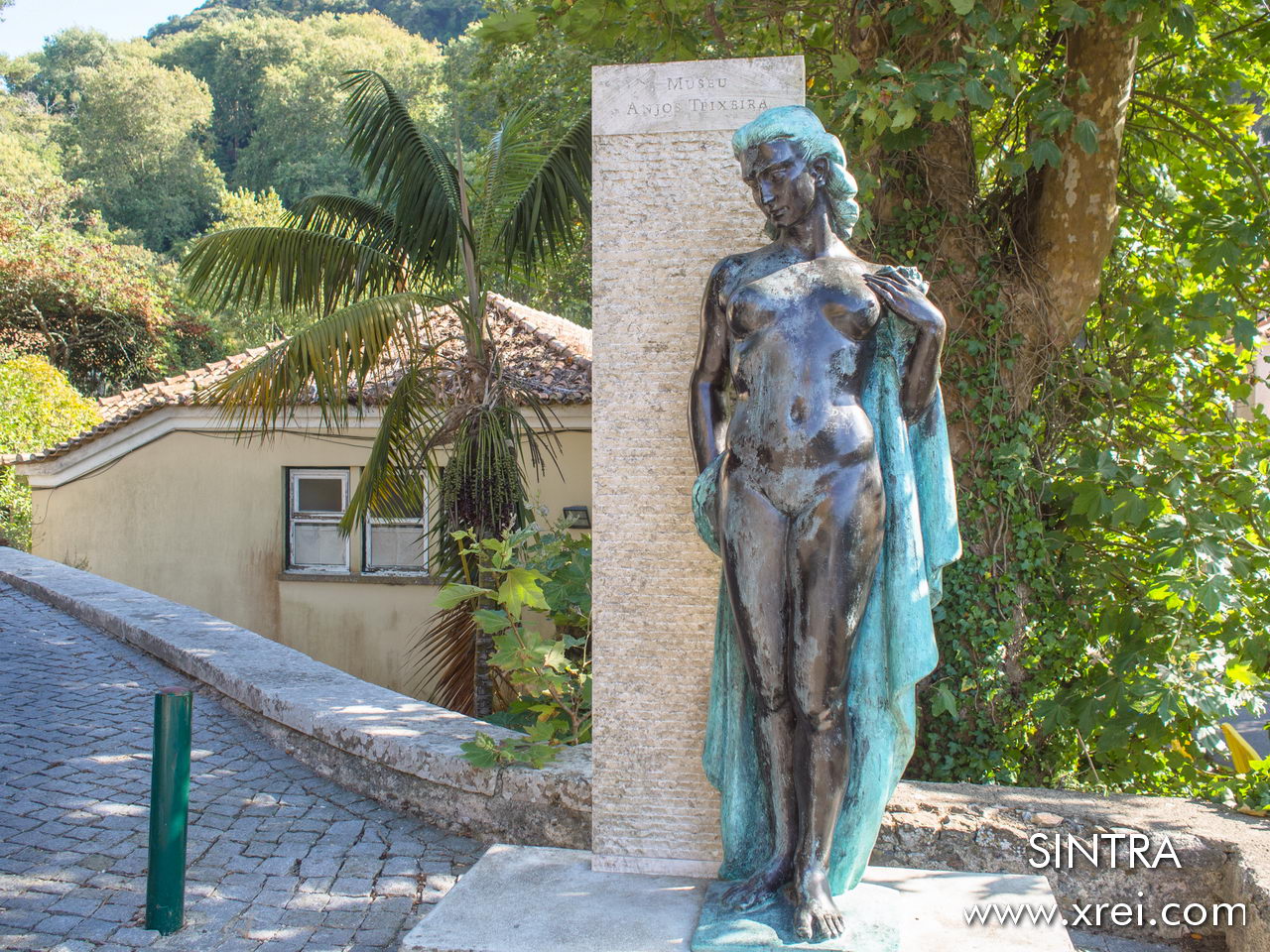
Museu Anjos Teixeira: the Museu Anjos Teixeira is a museum dedicated to two sculptors, Artur Anjos Teixeira and Pedro Anjos Teixeira, located on Azinhaga de Sintra. The museum is housed in a building that served various functions over the years, including a water mill, a stone-cutting workshop, a municipal vehicle depot, and a museum from 1976. The main highlights of the Museu Anjos Teixeira are:
- Artur Anjos Teixeira Collection;
- Pedro Anjos Teixeira Collection.
Museu do Bonsai: the Museu do Bonsai is a museum dedicated to the preservation and promotion of bonsai, located on Estrada de Chão de Meninos. The main highlights of the Museu do Bonsai are:
- Bonsai Family Residence: offers the opportunity to experience an overnight stay at the Bonsai Family Residence
- Murraya Tree: the Murraya tree is over 100 years old, stands 1.60 metres tall and was imported from China
Museu Ferreira de Castro: the Museu Ferreira de Castro is a museum dedicated to the preservation and promotion of the work of writer Ferreira de Castro (1896–1974), located on Rua Consiglieri Pedroso in Casal de Santo António. The main highlights of the Museu Ferreira de Castro are:
- Collection of Ferreira de Castro's novels;
- Paintings and writing materials belonging to Ferreira de Castro;
- Documentary archive accessible to the general public and researchers.
Museu Klaus Ohnsmann: the Museu Klaus Ohnsmann is dedicated to the work of German painter Klaus Ohnsmann, located on Rua Costa do Castelo. The painter devoted much of his career to depicting Sintra. The main highlight is the representation of Sintra in the canvases by Klaus Ohnsmann. Quinta da Amizade: the Quinta da Amizade is one of the buildings that can be visited in Sintra, located in the Serra de Sintra. The Quinta da Amizade or Vila Sassetti was built in the late 19th century to serve as the residence of Vitor Carlos Sassetti, with a design by Luigi Manini inspired by the castles of Lombardy. Vitor Sassetti was an entrepreneur born in Sintra and owner of Hotel Vitor. The main highlights of the Quinta da Amizade are its inclusion in the Vila Sassetti Trail, one of the most popular walking routes in Sintra. This route links the Historic Centre of Sintra to the Castelo dos Mouros and the Palácio da Pena. The route features the following points of interest:
- Casa do Caseiro;
- Penedo da Amizade;
- Laurel Forest;
- Tapada dos Bichos;
- Building featuring a rich blend of materials, including rustic stone and terracotta tile;
- High-relief of the Sassetti family;
- 16th-century tiles.
Quinta da Penha Verde: the Quinta da Penha Verde is a 16th-century estate located on Estrada da Pena. The Quinta da Penha Verde was built to serve as the residence of Dom João de Castro (1500–1548), Viceroy of India, with a design by Francisco de Holanda. The main highlights are:
- Ermida de Nossa Senhora do Monte;
- Capela de São Brás;
- Ermida de São Pedro;
- Ermida de São João Batista;
- Ermida de Santa Catarina.
Quinta do Saldanha: the Quinta do Saldanha is the property of the Patriarchate of Lisbon. The Quinta do Saldanha is currently decommissioned; however, it merits mention due to the history of the estate, which belonged to Marshal Duke of Saldanha (1790–1876), one of the most important politicians and military figures of the 19th century and grandson of the Marquis of Pombal.
Places to visit in the surroundings of Sintra
Colares: ![(38.807664, -9.443136)] Colares is a village known for its beach and its wine, located approximately six kilometres from Sintra. Colares is situated in a valley of the Serra de Sintra, where it is possible to observe the lush vegetation, the vineyards producing Vinho de Colares, and the tram that connects to Sintra, Praia das Maçãs and Azenhas do Mar. Colares was donated in 1385 to Dom Nuno Álvares Pereira in recognition of his loyalty to the Kingdom during the war with Spain from 1383 to 1385. From 1855 Colares became part of the municipality of Sintra as a civil parish. The main points of attraction in the village of Colares are:
- Banzão
- Cabo da Roca
- Adega Beira-Mar
- Adega Visconde de Salréu
- Adega Regional de Colares
- Santuário de Nossa Senhora da Peninha
- Convento de Santa Ana da Ordem do Carmo
- Igreja de Nossa Senhora da Conceição
- Igreja Paroquial de Nossa Senhora da Assunção
- Casa Branca
- Palácio de Dom Diniz Melo e Castro
- Quinta dos Freixos
- Quinta Mazziotti
- Quinta de Milides
Azenhas do Mar: !(38.839400, -9.460648): Azenhas do Mar is a small village located on a promontory overlooking the Atlantic Ocean, approximately 14 kilometres from Sintra. The name Azenhas do Mar originates from the eleven water mills that were powered by seawater or river water and produced bread from locally grown cereals. The village of Azenhas do Mar has approximately 800 inhabitants and forms part of the parish of Colares. The main highlights of Azenhas do Mar are:
-
- Place of origin of the Ramisco grape variety used in Vinho de Colares
- Sintra Tram
- Natural saltwater pool
- Capela de São Lourenço
Praia das Azenhas do Mar

Casa-Museu de Leal da Câmara: the Casa-Museu de Leal da Câmara is a museum space dedicated to the preservation and promotion of the work of Mestre Leal da Câmara, located on Calçada da Rinchoa in Rio de Mouro. Mestre Leal da Câmara (1876–1948) was a painter and caricaturist who lived in the building where the current museum is housed. The building served various functions over time, including as a staging post for the Marquis of Pombal when travelling between Quinta da Granja in Sintra and the Palácio de Oeiras, as a field hospital during the French Invasions, and as a museum. The main points of interest of the Casa-Museu de Leal da Câmara are:
- Núcleo dos Saloios da Casa-Museu Leal da Câmara;
- Collections of painting, caricature and drawing;
- Photographic and documentary archive;
- Tile panels.
Ecoaldeia de Janas: the Ecoaldeia de Janas is "… a collective of people united with the aim of building a non-formal education centre for sustainability …", located at Quinta do Luzio in Janas. The Ecoaldeia de Janas was launched in 2012 with the official start of the project. The main highlights of the Ecoaldeia de Janas are:
- The Environmental Education Centre, attended by more than five thousand students every year;
- The Food Farming Residence;
- The Dolmen Association;
- The Janas Nurseries;
- The Janas Educational Apiary.
Miradouro das Azenhas do Mar: the Miradouro das Azenhas do Mar is a viewpoint overlooking the Atlantic Ocean, located in Azenhas do Mar. The highlight is the beauty of the view over the village of Azenhas do Mar, with its white houses perched on the cliff face, the natural seawater pool continuing onto the beach, and the force of the Atlantic Ocean breaking against the rocks. The southerly position of the viewpoint provides a perfect angle for photography enthusiasts, making it one of the most favoured locations for the creation of postcards depicting Portugal. Azenhas do Mar is also one of the prime spots for watching the sunset reflected on the sea, transforming the horizon with warm reddish tones. Museu Arqueológico de São Miguel de Odrinhas: the Museu Arqueológico de São Miguel de Odrinhas is a museum that conserves and promotes archaeological collections from antiquity, located in São Miguel de Odrinhas. The museum was inaugurated in 1999, with a design by Alberto Castro Nunes & António Maria Braga. The main points of interest of the Museu Arqueológico de São Miguel de Odrinhas are:
- Exhibitions "O Livro de Pedra" and "O Claustro do Tempo"
- Roman ruins of São Miguel de Odrinhas
- Library
- Auditorium
- Museum Café
Museu do Ar: the Museu do Ar is a complex of museum spaces dedicated to "collecting, studying, exhibiting and promoting …", located in Pêro Pinheiro. The Museu do Ar is linked to two other sites in Ovar and Alverca, with the following highlights:
- Main Hangar: an area of approximately 3,000 m² housing 42 aircraft
- TAP: a space of approximately 700 m² dedicated to the Portuguese airline, presenting simulators and aircraft from its founding in 1945;
- ANA: a 700 m² room dedicated to tracing the history of Airports and Air Navigation through various objects, including the original scale model of Lisbon Airport and the furnishings of the first Air Traffic Control Tower
- Historic Hangars: comprising three hangars — the first hangar houses a multimedia auditorium and several civil aircraft; the second hangar is dedicated to the Portuguese Colonial War; and the third hangar displays two aircraft typically used for pilot training.
- Pioneers' Room: featuring accounts of the first flights made by Portuguese aviators, documentation and descriptions of the main aerial journeys made by Portuguese travellers around the world, including the voyages of Sacadura Cabral, Gago Coutinho, Sarmento de Beires, Brito Pais, Humberto da Cruz and Carlos Bleck
Quinta dos Pisões — the Quinta dos Pisões is an abandoned estate located on the former Estrada de Colares. The Quinta dos Pisões was built in the 16th century and features some notable historical curiosities, including the fact that it was the first house in Sintra to have central heating by boiler, and that it served as one of the meeting places for the planners of the assassination attempt on King Dom José I in 1758.
Walking Routes in Sintra
- Short Route 1: Santa Maria — the Santa Maria Route covers 1.9 kilometres and is easy to complete. The route begins in front of the Palácio Nacional da Vila, passing by the Fonte da Sabuga, the Igreja de Santa Maria and the Parque da Liberdade;
- Short Routes 2 and 3: Pena and Mouros — the Pena and Mouros Route covers 4.5 kilometres. The route begins in front of the Palácio Nacional da Vila, passing through Praça da República, Fonte da Sabuga, Igreja de Santa Maria, São Pedro de Penaferrim, Castelo dos Mouros, Palácio da Pena and Parque da Liberdade;
- Short Route 4: Seteais — the Seteais Route covers 3.5 kilometres and is a challenging route. It begins in front of the Palácio Nacional da Vila and passes by the Torre do Relógio, Igreja de São Martinho, Quinta da Regaleira, Hotel Palácio de Seteais, Rampa da Pena, Fonte da Pipa and Palácio de Seteais;
- Short Route 5: Quintas — the Quintas Route covers 2.3 kilometres, beginning in front of the Palácio Nacional da Vila. It passes through the most emblematic estates of Sintra, namely Quinta da Regaleira, Quinta do Relógio, Quinta do Castanheiro, Quinta dos Alfinetes, Quinta Dona Amélia and Quinta dos Castanheiras;
- Short Route 6: Rio da Mula — the Rio da Mula Route covers 11.3 kilometres, beginning at the Barragem Rio da Mula. The route passes by the Convento dos Capuchos, Memorial dos Soldados and Pedra Amarela;
- Short Route 7: Cabo da Roca — the Cabo da Roca Route covers 13.2 kilometres, beginning at Cabo da Roca. The route passes through Ulgueira, Praia da Adraga, Praia Grande do Rodízio, the site of dinosaur footprints, and Almoçageme;
- Short Route 8: Vinho de Colares — the Vinho de Colares Route covers 15.5 kilometres, beginning at the Adega Regional de Colares. The route passes through Pinhal da Nazaré, Ramisco vineyards, Fontanelas and Janas;
- Short Route 9: Village Route — the Village Route covers 13.5 kilometres, beginning at the Adega Regional de Colares. The route passes through São João das Lampas, Ponte Romana, Assafora and Catribana;
- Short Route 10: Peninha — the Peninha Route covers 5.9 kilometres, beginning at Largo da Peninha. The route passes by the Ermida de Nossa Senhora da Peninha, Ermida de São Saturnino, Adrenunes and Pedras Irmãs;
- Short Route 11: Capuchos — the Capuchos Route covers 4.9 kilometres, beginning at the Convento dos Capuchos. The route passes by the Convento dos Capuchos, Memorial dos Soldados, Tholos do Monge and Pedra Amarela;
- Long Route GR11: E9 — the GR11 Route covers 29.7 kilometres, beginning in Azoia. The GR11 Route takes approximately six hours and ends in Carvalhal, located about thirty minutes by car.
Traditional Pastries of Sintra
Travesseiros de Sintra: the Travesseiros de Sintra are one of the village's specialities — a pillow-shaped pastry made of thin puff pastry filled with egg and almond cream, produced at Casa Piriquita since 1862, founded by Amaro dos Santos and Constância Gomes, known in Sintra as Piriquita. Casa Piriquita began by producing queijadas — the favourites of King Dom Carlos and Queen Dona Amélia — while the Travesseiros were only created in the 1940s by Constância Luísa Cunha, daughter of the founders. The Travesseiro recipe is known only to the current owner. Casa Piriquita has received several awards, including recognition at the Sintra Regional Exhibitions in 1920, the registration of the Travesseiros da Piriquita and Pastéis de Cruz Alta trademarks in 1989, and the registration of Casa Piriquita by António Manuel Santos Cunha. Queijadas de Sintra: the Queijadas de Sintra are made with fresh cheese or cottage cheese, eggs, milk, sugar and cinnamon. The first queijadas were sold in 1756 in Ranholas by Maria Sapa, the oldest producer of queijadas at the Volta do Duche, near the historic centre of the village of Sintra. The best-known queijada producers are:
- Sapa
- Gregório
- Casa do Preto
- Piriquita Os Fofos de Belas: the Fofos de Belas are traditional pastries produced at the Fábrica dos Fofos de Belas. The Fofos de Belas are small soft sponge cakes filled with egg cream and white sugar granules. The cakes are light and have a yellowish colour, giving them a distinctive appearance and flavour. The Fofos de Belas were created by the mother of the current owner, Senhora Liberdade, for home consumption, and were originally known as Fartos de Creme.
Wine in Sintra — Vinho de Colares and the Colares Demarcated Region
Vinho de Colares forms part of the Colares Region, one of the oldest Demarcated Regions in Portugal. The Colares Demarcated Region encompasses the parishes of Colares, São Martinho and São João das Lampas, making it the westernmost Demarcated Region in Europe and the smallest in the country. Wine production began in the 13th century and gained renown for the following reasons:
- Longevity
- Resistance to climate
- Approximately 80% of the vines are planted in sandy soil
- The vines were never affected by the phylloxera insect, which devastated wine production across Europe in the 19th century. The Colares Demarcated Region, demarcated in 1908, is organised around the Adega Regional de Colares, considered the oldest in the country, having been founded in 1931. The most important grape varieties of Vinho de Colares are:
- Malvasia de Colares
- Ramisco de Colares
The main producers of Vinho de Colares are:
- Adega Regional de Colares
- Adega António Bernardino Paulo da Silva
- Adega Viúva Gomes
- Casal de Santa Maria
Golf in Sintra
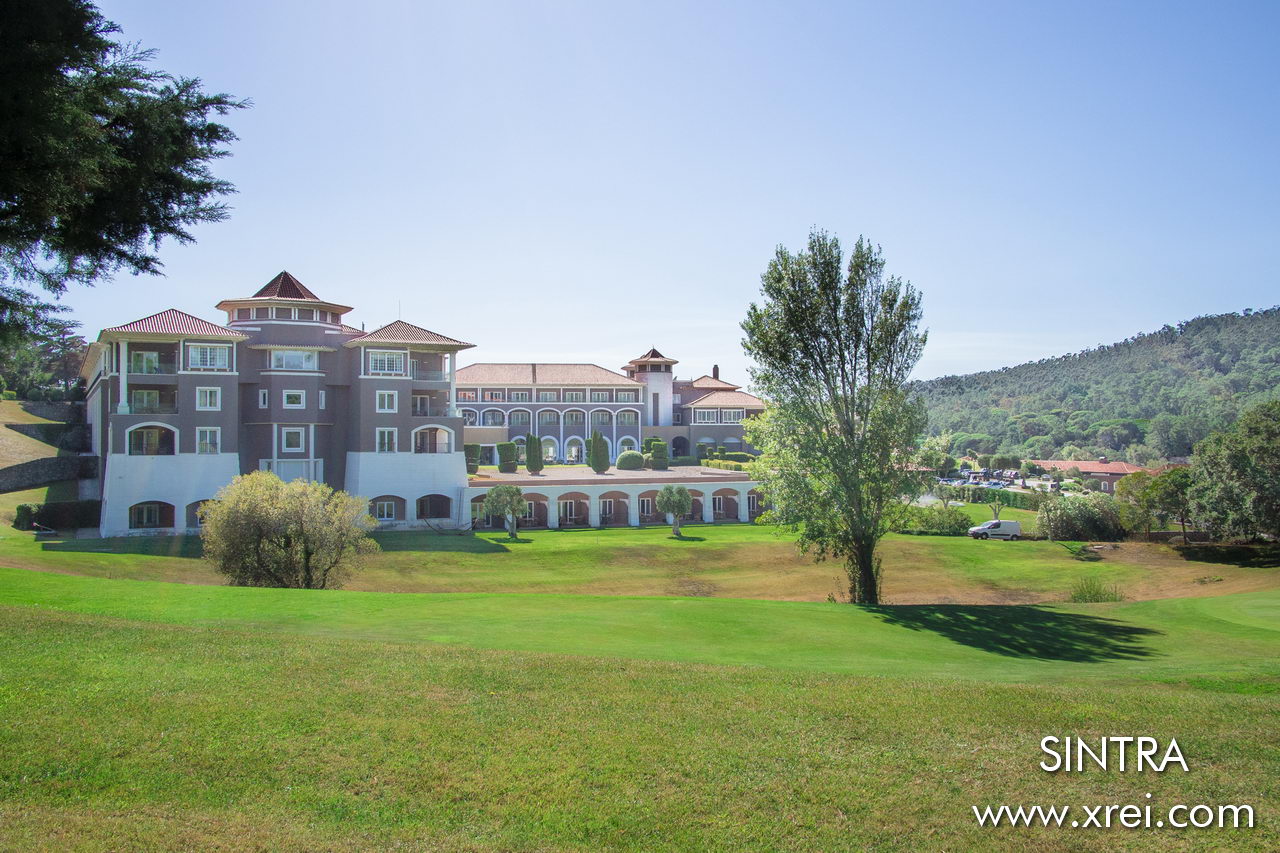
Sintra has four main golf courses, namely: Penha Longa Hotel & Golf Resort: the Penha Longa Hotel & Golf Resort, located between Sintra and Cascais, is one of the most notable golf courses in Portugal and features on the list of the thirty best golf courses in Europe. The 27-hole golf course was designed by Robert Trent Jones Jr and inaugurated in 1992 with the "Atlantic Championship" course — comprising eighteen holes — and the "Mosteiro" course, comprising nine holes. The Penha Longa course has hosted several important tournaments, including the Portuguese Open in 1994, 1995 and 2010. Among the notable features of the Penha Longa golf course is the presence of a Roman-period aqueduct alongside the par 5, as well as the Mosteiro e Igreja de São Jerónimo da Penha Longa — a monastery dating from the 14th century that belonged to the Order of Saint Jerome.


Pestana Beloura Golf: the Pestana Beloura Golf course, located between Sintra and Cascais, features eighteen holes spread across approximately 60 hectares, designed by American architect Rocky Roquemore. The course was inaugurated in 1993 and offers several points of interest:
- Forest of more than 40,000 eucalyptus trees, pine trees and magnolias
- Various lakes and watercourses
- Views of the Serra de Sintra
- Supporting facilities including a Training Academy and a Clubhouse
Belas Clube de Campo: the Belas Clube de Campo is a golf course located approximately fifteen minutes by car from Sintra, twenty minutes from Cascais and fifteen minutes from Lisbon Airport. The Belas Clube de Campo, with eighteen holes, was designed by American architect Rocky Roquemore. The main points of interest are:
- Luxury residential estate
- Views of the Palácio da Pena and the Castelo dos Mouros
- Supporting facilities including a training academy, cycle path, panoramic restaurant, clubhouse and a children's area
Lisbon Sports Club: the Lisbon Sports Club is a golf course located in the Serra da Carregueira, approximately twenty kilometres from Lisbon. The Lisbon Sports Club was founded in 1922 as a cricket club for the British community resident in Lisbon. The golf course was designed by Hawtree & Sons and inaugurated in 1992 with eighteen holes, making it one of the few typically English clubs in Portugal. The Lisbon Sports Club offers several points of interest, namely:
- Facilities and services including a Club House, weekend babysitting service, golf school and free lessons for the children of club members
The Beaches of Sintra
- Praia da Adraga: ![(N38º48'8.59'' , W9º29'05.17)] Praia da Adraga has been ranked by The Sunday Times as one of the best beaches in Europe. Praia da Adraga offers the following attractions:
- Views over the Atlantic Ocean and the cliffs
- Bay-shaped beach
- Pedra de Alvidrar or Pedra do Juízo
- Gruta do Fojo
- Praia das Azenhas do Mar: ![(N38º50'25.18'' , W9º27'42.36)] a small beach approximately thirty metres long. Praia das Azenhas do Mar features the following points of interest:
- Amphitheatre-shaped setting
- Whitewashed houses with a blue stripe
- Natural saltwater pool
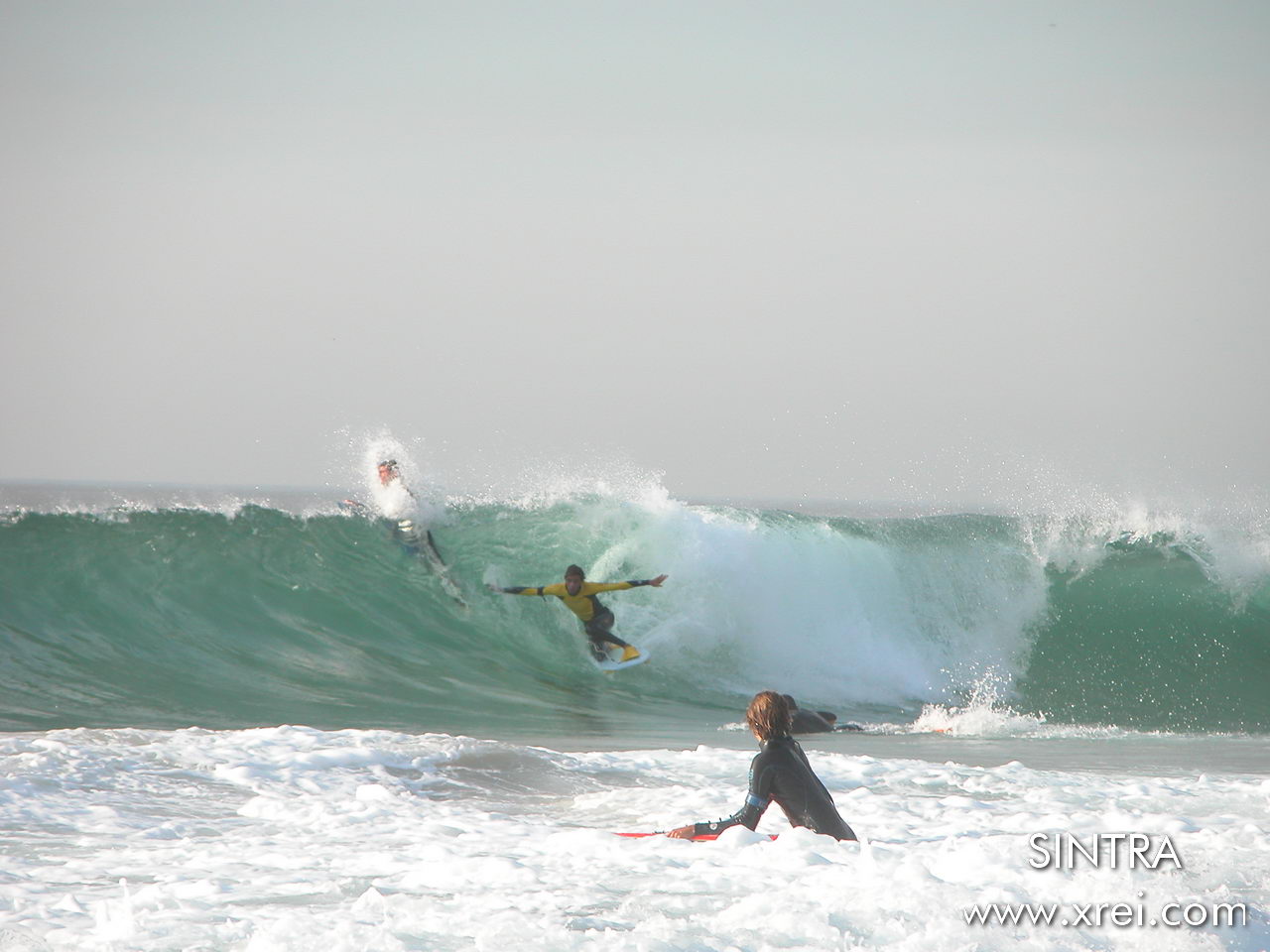
- Praia Grande: ![(N38º48'51.83'' , W9º28'36.32)] Praia Grande is the largest beach on the Sintra coastline and is highly popular with surfers and bodyboarders. Praia Grande regularly hosts competitions in these disciplines, including the World Bodyboard Championship. Praia Grande offers the following points of interest:
- Regular European and world-level nautical sports competitions, particularly surf and bodyboard;
- Several restaurants where visitors can enjoy fish and seafood caught in the Atlantic Ocean;
- Six dinosaur footprints approximately 170 million years old, located on the southern cliff of the beach.
- Praia das Maçãs: ![(N38º49'32.03'' , W9º28'09.64)] Praia das Maçãs is a beach located at the mouth of the Rio das Maçãs, so named because in former times the sea would carry large quantities of apples from the orchards that once existed in the area during the autumn season. The locality began to be settled in the 19th century with the construction of three houses — those of the priest of Colares Matias del Campo, the composer of Portugal's National Anthem Alfredo Keil, and a resident of Azenhas do Mar, Manuel Prego. The main highlights are:
- Alto da Vigia
- The village of Praia das Maçãs
- Sintra Tram
- Praia do Magoito: ![(N38'51'53.37'' , W9º26'55.91'')] Praia do Magoito, located in the village of Magoito, is known for several characteristics, namely:
- Being one of the beaches with the highest iodine content in Europe
- Its large number of rocks
- The view towards Cabo da Roca
- Praia Pequena: Praia Pequena, located near Praia Grande, is popular for being well suited to families.
- Praia de São Julião: ![(N38º55'48.41'' , W9º25'04.39)] Praia de São Julião is the northernmost beach in the municipality of Sintra. Praia de São Julião offers a stretch of sand approximately two kilometres long and is popular for surfing and bodyboarding.
- Praia da Ursa: ![(N38º47'23.98'' , W9º29'29.40)] Praia da Ursa, located near Cabo da Roca, stands out for its natural beauty and fine sand. Access to the beach is challenging, with the descent taking approximately one hour. The current name derives from the Rocha de Ursa, which through erosion has taken on the shape of a bear carrying a cub.
- Praia da Vigia: ![(N38º55'11.59'' , W9º25'27.94)] Praia da Vigia, located south of São Julião, is notable for its beach approximately two kilometres long and for being a naturist beach.
- Praia da Aguda
- Praia de Samara
History of Sintra
Sintra is a village steeped in history, referred to by the Greek historian Plutarch as the Serra da Lua. Sintra has been inhabited since the Neolithic period by various peoples, including Celts, Romans and Muslims, and is considered a magical and sacred place. The cult of the Moon was practised in Sintra by the Celts on nights of the full moon. These rituals were held particularly at locations near Peninha. The Romans called Sintra the Sacred Mount or Mount of the Moon in honour of Cynthia, the Goddess of the Moon. The name Sintra began as an association with Cynthia, the Roman Goddess of the Moon, evolving through Xintria, Zintira, Sentra and Xentra by the 19th century. The village of Sintra was captured for the first time in 1109 by Count Dom Henrique, but was only definitively conquered in 1147 by Dom Afonso Henriques, in the same year as the conquest of Lisbon. Sintra received its municipal charter on 9 January 1154. The locality was severely damaged by the earthquake of 1 November 1755. From the 18th century onwards, the village of Sintra gained prominence through the presence of famous figures, including William Burnett, William Beckford, Princess Carlota Joaquina, Gerard de Visme, Eça de Queiroz, Richard Strauss, Hans Christian Andersen, Robert Southey, Raúl Lino, Ferreira de Castro, Eduardo Viana, Milly Possoz, Alfredo Keil and Ramalho Ortigão, among many others. The current landscape of Sintra was shaped and developed over the centuries, particularly in the 19th century by King Dom Fernando II, known as the artist king. Dom Fernando created a counterpart to Schloss Neuschwanstein, built by Ludwig II of Bavaria. The result was the magnificent and unique Palácio da Pena and all that surrounds it. From 1995, Sintra was classified as a UNESCO World Heritage Site. The village of Sintra had three principal periods of development, namely:
- 10th to 15th centuries: Sintra was an important village during the Muslim occupation, during which the Castelo dos Mouros and part of the Palácio Nacional de Sintra were built. It remained strategically significant until the conquest of Lisbon in 1147 by Dom Afonso Henriques. Until the 15th century the Palácio Nacional de Sintra served as a holiday residence for the Royal Family. Sintra subsequently lost importance until the 18th century for various reasons, including the Spanish occupation between 1580 and 1640 and the preference for other palaces as holiday residences, such as the Palácio Nacional de Mafra, the Palácio de Pombal in Oeiras and the Palácio Nacional de Queluz;
- After the 18th century: Sintra regained prominence following the rise of Romanticism, a European cultural movement advocating a closer relationship with Nature and a return to the past — particularly to Rome and Greece. Romanticism in Portugal emerged across several fields, including history and literature, with the appearance of important figures such as Alexandre Herculano, Camilo Castelo Branco and Almeida Garrett. Sintra was also widely visited by foreign intellectuals, musicians, politicians and businesspeople, including Richard Strauss, William Beckford, Francis Cook, Barão de Eschwege, Lord Byron, Hans Christian Andersen, Robert Southey and António Monteiro;
- UNESCO World Heritage: Sintra gained renewed vitality in the second half of the 20th century with its classification as a UNESCO World Heritage Site on 6 December 1995 and with the arrival of more than three million tourists annually since 2017.


Sintra has a unique microclimate at the gates of Lisbon, with certain days featuring an evocative mist reminiscent of England. Sintra was designated a UNESCO World Heritage Site in 1995. From that point, the village grew and began to receive millions of tourists from around the world.

Life in Sintra is tranquil. Stepping out onto the central square of Sintra, in front of the Palácio Nacional de Sintra, visitors encounter groups of tourists of all nationalities and ages making their way to the Vila Velha de Sintra, where they can sample the famous local pastries — the Travesseiros de Sintra — and shop in the many traditional stores there, or head to the Palácio da Pena, the Quinta da Regaleira or the Castelo dos Mouros on foot, by bicycle, by bus, by carriage or by tuk-tuk.

Sintra is also a place of nature, with gardens, flowers, woodland and walking paths to explore at every turn. The fresh-water fountains deserve special mention, as several provide natural spring water from the Serra de Sintra. The village of Sintra is located approximately thirty kilometres from Lisbon and is a calm, safe locality with an extensive offer of hotels and restaurants. Its beaches are also popular with Lisbon residents during the summer, not only for leisure but also for water sports including surfing, bodyboarding and windsurfing. Sintra is a locality and a municipality that merits a visit, with attractions ranked among the finest in the world, and an excellent place to live and work.
Fairs, Festivals and Pilgrimages
- Festas do Divino Espírito Santo: held annually in Colares seven weeks after Easter
- Festa de São Pedro de Penaferrim: held fortnightly in São Pedro de Penaferrim on the second and fourth Sundays of each month
- Círio de Santa Rita de Cássia: an annual pilgrimage held in July between the localities of Eugaria and Mucifal
- Verão na Quinta da Ribafria: an annual festival held at Quinta da Ribafria between May and September
- Festas em Honra de São Mamede: held annually in Janas in the month of August
- Festas de Nossa Senhora da Praia: held annually at Praia das Maçãs on the first Sunday of September
- Feira Setecentista de Queluz: held annually in September at the Palácio Nacional de Queluz
Shopping in Sintra
- Beloura Shopping
- Centro Comercial Forum de Sintra
- Mercado de Almoçageme
- Mercado de São Pedro de Sintra
- Vila Velha de Sintra

Transport to and from Sintra
- Trains: trains to Sintra depart from Gare do Oriente and Rossio stations. Queluz-Belas station is where visitors should alight to visit the Palácio Nacional de Queluz and the Matinha de Queluz. The railway stations in the municipality of Sintra are:
- Queluz-Belas station
- Monte Abraão station
- Massamá-Barcarena station
- Agualva-Cacém station
- Rio de Mouro station
- Mercês station
- Algueirão station
- Portela de Sintra station
- Sintra station
- Buses: bus services are available for daily commuting and tourist routes:
- Route 434: operates the Pena Circuit, which includes the Historic Centre, the Castelo dos Mouros and the Palácio da Pena. The bus departs from Sintra station and the historic centre of the village.
- Route 435: also known as Villa Express Four Palaces, the route includes: Palácio Nacional de Sintra, Palácio da Regaleira, Palácio de Seteais, Palácio de Monserrate.
- Route 441: also known as Three Beaches, the route includes Praia Grande, Praia das Maçãs and Praia das Azenhas.
- Sintra Tram: the traditional Sintra tram links the village to Colares during the summer months. The journey, relaxed and pleasant, takes approximately 45 minutes.
Educational Institutions in Sintra
- Colégio Vasco da Gama
- Colégio dos Plátanos
- Conservatório de Música em Sintra
- Escola Portuguesa de Arte Equestre
- Escola Profissional de Recuperação do Património de Sintra
- Prime School International - Sintra
Healthcare Services in Sintra
- Clínica CintraMédica - Portela de Sintra
- CUF Sintra
- Hospital Amadora-Sintra
Administrative Organisation of Sintra
The municipality of Sintra is the second most populous in the country, with approximately 378,000 inhabitants. The municipality of Sintra is administratively organised into eleven civil parishes, namely:
- Junta de Freguesia de Algueirão-Mem Martins
- Junta de Freguesia de Casal de Cambra
- Junta de Freguesia de Colares
- Junta de Freguesia de Rio de Mouro
- União das Freguesias de Agualva e Mira Sintra
- União das Freguesias de Almargem do Bispo, Pêro Pinheiro e Montelavar
- União das Freguesias de Cacém e São Marcos
- União das Freguesias de Massamá e Monte Abraão
- União das Freguesias de Queluz e Belas
- União das Freguesias de São João das Lampas e Terrugem
- União das Freguesias de Sintra
Notable Figures of Sintra
- Dom Fernando II: (1816–1885) Fernando Augusto was born in Vienna, Austria, into the Saxe-Coburg and Gotha family on 29 October 1816 and died in Lisbon on 15 December 1885. Dom Fernando was the last king consort of Portugal and one of the founders of national Romanticism. Dom Fernando II married Dona Maria II by proxy in 1836, a union that lasted until 1853, when the Queen died in childbirth with her eleventh child. Dom Fernando II served as Regent of the Kingdom of Portugal until his son Dom Pedro came of age. Dom Fernando married again in 1869, this time to the Countess of Edla, a union that caused considerable controversy given that she was an opera singer and a single mother. Dom Fernando II died in 1885 and was interred at the Mosteiro de São Vicente de Fora in Lisbon, the Pantheon of the House of Braganza. Dom Fernando II played an exceptional role in the development and protection of Portuguese heritage through various initiatives, including:
- Founding of the Academy of Fine Arts
- Provision of study grants to Portuguese artists such as Bordalo Pinheiro and Viana da Mota
- Restoration of several monuments: Mosteiro da Batalha, Mosteiro dos Jerónimos, Torre de Belém, Sé Catedral de Lisboa, Convento de Mafra, Convento de Cristo in Tomar and the Roman Temple in Évora;
- Condessa d'Edla: (1836–1929) born Elise Hensler in Hartford, Connecticut, USA, on 22 May 1836, she died on 21 May 1929 in Lisbon. Elise Hensler emigrated at the age of twelve with her parents to Boston and subsequently began working at La Scala in Milan, where she remained for three years. Elise Hensler arrived in Portugal in 1860 to sing at the Teatro Nacional de São João in Porto and the Teatro Nacional de São Carlos in Lisbon, where she met Dom Fernando II, whom she would later marry and with whom she settled permanently in Sintra. In Sintra the couple withdrew from Lisbon's political life and devoted themselves to developing the Palácio da Pena and building the Chalet da Condessa d'Edla. The Countess of Edla received the Palácio da Pena, the Castelo dos Mouros and the Chalet da Condessa d'Edla following the death of Dom Fernando in 1885. The Condessa d'Edla died at the age of 92 and is interred at the Cemitério dos Prazeres.
- Al Baqr: a Muslim geographer who travelled throughout the Islamic Empire during the 10th century. He was the first geographer to leave a written account of Sintra;
- Barão de Eschwege: (1777–1855) Wilhelm Ludwig von Eschwege was born in Aue, near Eschwege in the province of Hesse-Kassel. Eschwege completed his mining engineering studies in 1800 at the University of Göttingen and in Marburg. The Barão de Eschwege came to Portugal in July 1803 to manage the iron mines at Foz do Alge, near Figueiró dos Vinhos, and in 1807 joined the Portuguese Army with the rank of artillery captain in response to the Napoleonic invasion of Portugal. Two years later he travelled to Brazil to reactivate mining operations in the territory, where he gained renown as a member of the board of the Real Gabinete de Mineralogia in Rio de Janeiro, professor at the Military Academy, founder of the silver manufactory "A Patriótica", and for improving the roads of the captaincies of Minas Gerais and Goiás. The Barão de Eschwege had returned to Germany in 1821 and came back to Portugal in 1839 to oversee the construction of the Palácio Nacional da Pena — his last major project in Portugal. Following the completion of the palace he returned briefly to Brazil, but died on 1 February 1855 in Germany;
- William Beckford: (1760–1844) William Beckford was an English writer, collector and traveller who fell in love with Sintra. William Beckford was born in London into a wealthy aristocratic family that owned several sugar plantations in Jamaica. Accused by London society of sexual conduct considered improper for the time, he travelled through several European countries including France, Spain, Italy, Switzerland and Portugal. His most important works include the novel Vathek: An Arabian Tale of 1786, the Diary of William Beckford in Portugal and Spain of 1835 and Alcobaça e Batalha: Recollections of Travel. William Beckford visited Portugal three times:
- 1787 — he was in Lisbon
- 1793 and 1795 — he stayed at the Quinta e Palácio do Ramalhão in Sintra
- 1798 to 1799 — he leased and extensively renovated the Palácio e Jardim de Monserrate
- Lord Byron: (1788–1824) George Gordon Noel was born on 22 January 1788 and died on 19 April 1824. Lord Byron was one of the greatest poets of the 19th century and one of the towering figures of European Romanticism, successfully fulfilling several roles including member of the House of Lords, member of the London Committee for Greek Independence, writer and intellectual. His principal works were Childe Harold's Pilgrimage, written between 1812 and 1819, in which he writes about Sintra, The Corsair in 1814, The Siege of Corinth in 1816 and The Liberal in 1822.
- Francis Cook: (1817–1901) Sir Francis Cook was born on 23 January 1817 and died on 17 February 1901. Sir Francis Cook held the third largest fortune in England and possessed one of the largest art collections of the 19th century, with 510 major works of art in 1876. Francis Cook made his fortune in the textile industry and had the company's headquarters at Cook & Son Warehouse in the centre of London. He purchased Monserrate in 1863. Sir Francis Cook received several noble titles in Portugal and England, including First Viscount of Monserrate, First Baronet in England, and Fellow of the Society of Antiquaries of London.
- Luigi Manini: (1848–1936) the Italian scenographer Luigi Manini was born on 8 March 1848 and died on 29 June 1936. Luigi Manini came from a modest background, which led him to begin working at the age of nine in Giovanni Zaffeva's studio as an apprentice. Manini graduated in Ornamental Design from the Royal Academy of Fine Arts in Milan in 1861 and went on to fulfil various roles as scenographer and decorator-architect in the construction of several important buildings across Europe, including:
- Teatro alla Scala in Milan
- Teatro Nacional de São Carlos
- Palácio e Quinta da Regaleira
- Teatro Nacional Dona Maria
- Palace Hotel do Buçaco
- Casa de Giardiniere-Biester
- Villa Sassetti
- Chalet Lima Mayer in Sintra
- Teatro Palácio de Foz
- Teatro Dona Amélia
- Teatro São Luiz
- Teatro São João do Porto
- Museu Militar de Lisboa
- Museu Conde Castro Guimarães in Cascais.
- António Monteiro (1848–1920) António Augusto Carvalho Monteiro was born on 27 November 1848 and died on 24 October 1920. António Monteiro was born in Rio de Janeiro, son of the Portuguese couple Frederico Augusto Mendes Monteiro and Ana Thereza Carolina de Carvalho. António Monteiro became known as Monteiro dos Milhões owing to the fortune he inherited from his parents and the wealth he generated through trade in goods such as coffee. António Monteiro graduated in Law from the University of Coimbra in 1871 and married two years later Perpétua Augusta Pereira de Melo (1852–1913). Monteiro dos Milhões was an avid collector and patron of the arts, with notable collections of clocks, butterflies, and works by Luís Vaz de Camões. In 1876 he settled permanently in Portugal at the Palácio Quintela-Farrobo on Rua do Alecrim in Lisbon. António Monteiro decided to build a holiday residence in Sintra — the Quinta da Regaleira — and commissioned Luigi Manini to design it between 1898 and 1912. António Monteiro received the title of Moço Fidalgo da Casa Real conferred by Dom Luís I. António Carvalho Monteiro died in 1920, deeply affected by the death of his wife some years earlier;
- Gerard de Visme (1725–1797) an Englishman of French origin who was the first English resident at Monserrate. Gerard de Visme was born in England into a family of French Huguenots — that is, French Protestants. Gerard de Visme was born on 22 February 1725 and died on 20 November 1797. Little is known about the life of Gerard de Visme, except that he lived in Portugal between 1746 and 1794, where he owned two estates: one in Lisbon, the Quinta de São Domingos de Benfica, and one in Sintra, the Quinta de Monserrate. Gerard de Visme was a member of the British Factory in Lisbon, was involved in the construction of the British Hospital in Lisbon, and served as Administrator of the Crown Jewels and Diamond Mines of Brazil. The principal source of his wealth was the trade in brazilwood, having secured a monopoly on this commodity through his friendship with the Marquis of Pombal.
Quotations about Sintra
- "Today is the happiest day of my life! I know Italy, Sicily, Greece and Egypt and I have never seen anything, nothing that is worthwhile! It is the most beautiful thing I have seen! This is the true garden of Klingsor and up there is the Castle of the Holy Grail", Richard Strauss
- "A true vignette from the Arabian Nights, a fairy-tale vision", Hans Christian Andersen
- "Cintra's Glorious Eden", Lord Byron
- "In Sintra one does not die — one passes alive to the other side. Because death is impossible in the vigour of beauty. And the memory that has passed remains in it to collaborate", Virgílio Ferreira
Sintra Curiosities
- Sintra was the first European site inscribed by UNESCO as a cultural landscape in 1995
- The Palácio Nacional da Pena was the first Romantic palace in Europe, built approximately fifteen years before the well-known Schloss Neuschwanstein in Bavaria, Germany
- It was Dom Fernando II who introduced to Portugal the tradition of decorating a pine tree at Christmas and distributing gifts to children
- 1836 was the year in which Dom Fernando married Dona Maria II and in which the Countess of Edla — future wife of the Artist King — was born
- It is said that the spirit of Dona Carlota Joaquina wanders the corridors of the Palácio Nacional de Queluz at night
- The English Neo-Gothic style was greatly influenced by the Mosteiro da Batalha
- The Quinta de Monserrate was also the property of Tennessee Celeste Claflin, American suffragist and sister of Victoria Claflin Woodhull (1838–1927), the first woman to run for President of the United States
- The Parque de Monserrate has more than three thousand exotic species
- The Parque de Monserrate was the winner of the European Gardens Award in 2013
- Lord Byron and William Beckford lived in Sintra
- Dom Manuel I watched the vessel of Nicolau Coelho — part of Vasco da Gama's fleet returning from India — enter the Tagus River in 1499
- The wines of Colares are considered the most similar to Bordeaux wines in Portugal
- American singer Madonna expressed interest in acquiring the Quinta do Relógio in Sintra
Sintra Quick Facts
- The municipalities of Sintra, Oeiras and Amadora, along with the municipal company Parques de Sintra Monte da Lua, have established a protocol to create the Eixo Verde e Azul — a project aimed at building corridors parallel to the Jamor river for the movement of people and water between the Serra da Carregueira and Caxias over a distance of 16 km along the Jamor river
- The municipality of Sintra has approximately 382,000 inhabitants
- The municipality of Sintra is divided into eleven civil parishes: Agualva e Mira Sintra, Algueirão-Mem Martins, Almargem do Bispo, Pêro Pinheiro e Montelavar, Cacém e São Marcos, Casal de Cambra, Colares, Massamá e Monte Abraão, Queluz e Belas, Rio de Mouro, São João das Lampas e Terrugem and Sintra
- Sintra Municipal Council received the Municipality of the Year Award for the Lisbon Metropolitan Area in 2015
- Sintra's monuments received approximately three million two hundred thousand visitors in 2017
- The Palácio e Parque da Pena was the most visited, with approximately one million seven hundred thousand visitors in 2017
From Sintra to Cascais, we cross the Serra de Sintra and enter another village full of charm. From Sintra to Lisbon, we leave a village and enter a European city with all the services of a major urban centre. From Cascais to Lisbon, we travel along a coastal avenue overlooking the sea and the river...