
The history of Coimbra runs from the Roman town of Aeminium on a hill above the Mondego to the first capital of the Kingdom of Portugal, the seat of the country's oldest university, and a UNESCO World Heritage city since 2013.
This page lists the main dates in the history of Coimbra and the people linked to the city.
Timeline of Coimbra
- Roman period: the town of Aeminium stands on the hill above the Mondego, near the larger Roman city of Conímbriga.
- 468: after the Sueves attack Conímbriga, the seat of the bishop moves to Aeminium, which later takes the name Coimbra.
- Muslim period: the city is under Muslim rule for most of the period until the 11th century.
- 1064: King Fernando I of León takes Coimbra, and the Mozarab Sesnando Davides becomes its first count.
- 1131: Afonso Henriques makes Coimbra his capital, and the Santa Cruz Monastery is founded.
- 1162: work on the Old Cathedral receives its decisive push.
- 1185: Sancho I, the second King of Portugal, is crowned in the Old Cathedral.
- 1290: King Dinis founds the university, which moves between Lisbon and Coimbra over the following centuries.
- 1330: the church of Santa Clara-a-Velha, refounded by Queen Isabel, is consecrated.
- 1355: Inês de Castro, the beloved of the future King Pedro I, is killed in Coimbra.
- From 1507: King Manuel I orders the rebuilding of Santa Cruz in the Manueline style.
- 1537: King João III settles the University in Coimbra, in the Royal Palace of Alcáçova.
- 18th century: the reform of the Marquis of Pombal adds laboratories, the Botanical Garden and the University Press.
- 1940s: the University City is built in the Alta.
- 2013: UNESCO inscribes the University of Coimbra, Alta and Sofia, on the World Heritage List.
People linked to Coimbra
- Sesnando Davides: the first Count of Coimbra, buried in the Old Cathedral.
- Afonso Henriques and Sancho I: the first two kings of Portugal, buried in the Santa Cruz Monastery.
- Queen Isabel of Aragon: the wife of King Dinis, who refounded Santa Clara and is the patron saint of the city.
- Pedro I and Inês de Castro: the king and the noblewoman whose story is linked to the Quinta das Lágrimas.
- Saint Teotónio: the first prior of Santa Cruz and the first Portuguese saint.
Places to visit in Coimbra
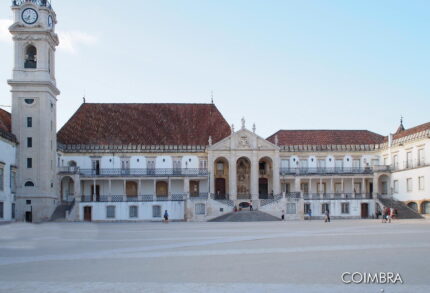
Coimbra, Portugal
University of Coimbra – Alta and Sofia
Santa Cruz Monastery
Old Cathedral of Coimbra
Santa Clara-a-Velha Monastery
Portugal dos Pequenitos
History of Coimbra
Visiting Coimbra