Cascais, Portugal

Cascais, Portugal

Cascais is a town on the Lisbon Riviera, 30 kilometres west of the capital, with a coastline of sandy beaches, a historic centre and a well-established international community.

Cascais

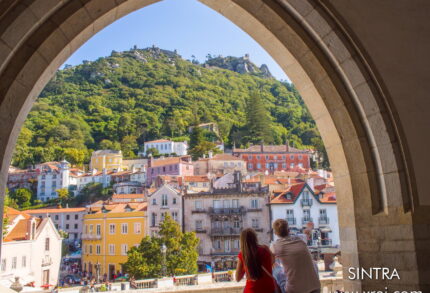
Cascais is a charming Portuguese village known for its quality of life, ranked in 2016 as the second best city in Portugal to live in, visit and do business, according to the City Brand Ranking. Cascais is part of the Greater Lisbon district and offers a perfect blend of unspoilt nature and glamour — an ideal destination for an adventure or family holiday. Cascais enjoys more than 300 days of sunshine per year. It is a locality known for the exoticism, Romanticism, glamour and charm it conveys to those who live and visit there. It is a village rich in history and stories passed down through generations, known for sporting competitions across a wide range of disciplines — particularly Golf, Tennis, Sailing and Regatta, Equestrian Sports, Surfing, Motorsport — Classic Cars, Sports Cars and Motorcycling. Cascais offers excellent conditions for outdoor sport through its cycle paths, walking trails and marinas. Cultural activity and cosmopolitanism are hallmarks of this Portuguese village, evident in the various festivals held throughout the year as well as international events and conferences on a wide range of themes, including the Festas do Mar, the Procissão de Nossa Senhora dos Navegantes and the Estoril Film Festival. Cascais is considered the Riviera of Portugal, together with Estoril and Sintra.
Cascais is synonymous with a high-quality healthy lifestyle.

Location of Cascais and distances

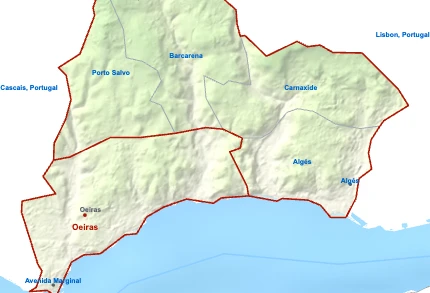
The village of Cascais is separated from Lisbon by one motorway and a coastal seafront road, approximately 20 minutes from Lisbon by car and 45 minutes by train. It is 20 minutes from Sintra and two and a half hours by air from the main European capitals, including London, Paris, Madrid and Rome, eight hours and thirty minutes from New York and five hours and thirty minutes from Moscow. Cascais borders Sintra to the north, the Atlantic Ocean to the south and west, and Oeiras to the east. Cascais is located approximately half an hour from Lisbon and from Lisbon Humberto Delgado International Airport.

Attractions to visit in Cascais (top 10)

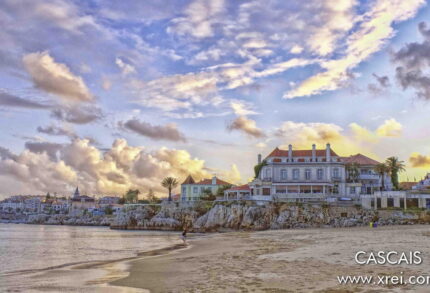
1. Baía de Cascais ![(38.696908, -9.420042)]: the Baía de Cascais has served as a shelter for ships since the time of the Phoenicians and is one of the most beautiful locations in the village of Cascais, featuring several elements along the bay including the marina, beach, palaces and squares. Bathed by the Atlantic Ocean, the bay is surrounded by restaurants, shops, hotels and outdoor terraces. The buildings that stand out most in the setting of the Baía de Cascais are the Cascais Town Hall, the Palácio de Seixas (current Capitania de Cascais), the Lota de Cascais, the Hotel Baía and the Praia dos Pescadores. Throughout the year it is possible to observe traditional fishing boats anchored along the bay. The Baía de Cascais was once the first port of call before entering Lisbon.

Cascais is situated facing the Atlantic Ocean, at the mouth of the Tagus River, sheltered by a natural bay ideal for sailing

2. Marina de Cascais ![(38.692156, -9.419183)]: located in the Baía de Cascais, the marina is a shelter harbour with capacity for 650 vessels, making it the third largest marina in Portugal. The Marina de Cascais was inaugurated in 1995 and its main nautical services include a 70-tonne travel hoist, a 3-tonne crane, a slipway, hull cleaning, towing and dry storage. The Marina de Cascais has hosted international events of the stature of the ISAF Sailing World Championships 2007 and the America’s Cup World Series Cascais 2011.
The Cascais Sailing Club is located next to the marina, hosting regular national and international regattas across a wide range of classes, with the strongest attendance in the Optimist, Laser, Dragon and SB20 classes, among others.

3. Parque Marechal Carmona ![(38.692996, -9.422857)]: the Parque Marechal Carmona was inaugurated during the 1940s, although it had already been used as a leisure area since the 16th century. The park formed part of the estate of the Palácio Condes Castro Guimarães. It was opened to the public in 1944 and received the official name of Parque do Gandarinha. The Parque Marechal Carmona features extensive green spaces, large trees, birds, the Ribeira dos Mochos, lakes, a picnic area, a traditional games court, a children’s and youth library, a restaurant, a playground and the Cascais Organic Market, which takes place every Saturday.

4. Casa da Guia ![(38.695611, -9.442950)]: Casa da Guia is an open-air commercial space surrounded by green areas, with seafront terraces, located halfway between Boca do Inferno and Guincho. It is a popular destination for leisure, dining, relaxation and walking. From here it is possible to observe the greenhouses, the Atlantic Ocean and the Farol de Santa Marta, with a panoramic view extending as far as Lisbon. Casa da Guia has several restaurant spaces, shops and a Roman amphitheatre.

Casa da Guia in Cascais is an open-air commercial space facing the ocean. Here you will find a unique atmosphere created by pine trees growing on a cliff above the sea, with a sheltered seafront path, restaurants and terraces from which a panoramic view of the ocean can be enjoyed, and small shops.

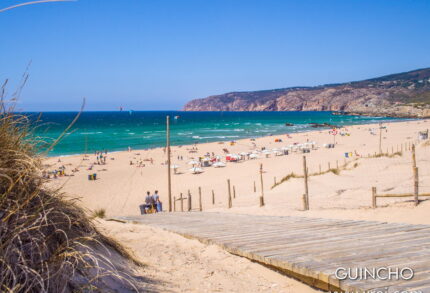
5. Guincho ![(38.732042, -9.472418)]: Guincho is a beach and natural park located to the north of the village of Cascais. The name Guincho refers to a species of gull (larus ridibundus) common on the Portuguese coast — white and grey with a brown head in summer. The name of this area most likely derives from the abundance of this species of gull. Praia do Guincho is the ideal setting for Surfing, Kitesurfing and Windsurfing owing to the strong winds that prevail there throughout the year. Guincho is located between the Serra de Sintra and the village of Cascais and is the venue for important sporting events including the National Surf and Bodyboard Championship and the World Surf Championship. The area is also known for its excellent restaurants, in particular Porto de Santa Maria, Os Prazeres da Carne and Furnas do Guincho.

Guincho is a beach and natural park located to the north of the village of Cascais — an ideal setting for Surfing, Kitesurfing and Windsurfing owing to the strong winds that prevail there throughout the year
The surroundings of Praia do Guincho feature a landscape of dunes and low-lying vegetation blending into the pine trees on the hillside and serra

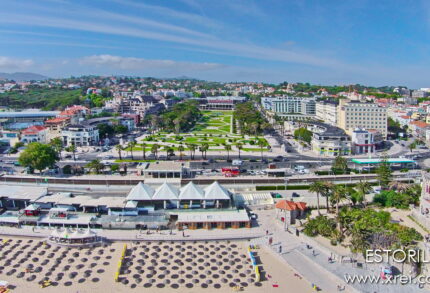
6. Casino do Estoril and Gardens ![(38.708095, -9.397044)]: the Casino do Estoril is the glamorous casino on the Avenida Marginal, located halfway between Lisbon and Cascais, and is one of the oldest casinos in the country. The Casino do Estoril stands apart from others by being a major driver of culture, art and entertainment in Portugal. Its main highlights include the Salão Preto e Prata with capacity for approximately one thousand people, a large auditorium for 350 spectators, one of the most prestigious art galleries in the country, a panoramic foyer, a gaming room with roulette, blackjack, Caribbean stud poker, French bank, more than 700 slot machines and outdoor gardens.
The Gardens of the Casino do Estoril deserve special mention as a place of great beauty and the venue for numerous cultural and leisure activities throughout the year, including the European Street Food Festival, the Meo Music Kids Festival and the Estoril Classic Week. The Gardens of the Casino do Estoril feature several lawned areas, fountains, trees and lakes.

7. Boca do Inferno ![(38° 41′ 16.79″, -9° 25′ 31.19″)]: Boca do Inferno is a coastal area of natural cliff located near Cascais, notable for the presence of sea caves. The Boca do Inferno is a rocky area beside the Atlantic Ocean formed by the erosion of the sea on the rocks. It is called Boca do Inferno (Mouth of Hell) owing to the force of the sea and the intensity of the wind on winter days. Beyond its natural beauty, it is possible to sample Cascais cuisine at the local restaurant or at one of the snack kiosks. On the site where a small chapel once used by fishermen for prayer before putting to sea now stands a small souvenir shop featuring maritime items, particularly shells and conches.

8. Borboletário ![(38.696277, -9.345895)]: located in the Parque Urbano da Quinta de Rana, this is a unique space where visitors can learn about the life cycle and evolution of butterflies and discover the various species found in Cascais.

9. Espaço Memória dos Exílios: ![(38.703583, -9.396261)]: the Espaço Memória dos Exílios is a space that documents the history of the Jewish presence in Estoril and Cascais between 1936 and 1962, located in the post office building in São João do Estoril. The main collections relate to the Spanish Civil War (1936–1939), the Second World War (1939–1945) and the Holocaust, Exile, Jewish communities and the Estado Novo.

10. Bairro dos Museus:

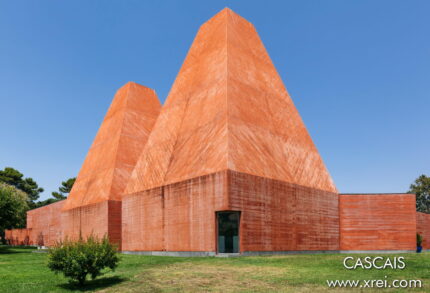
Casa das Histórias Paula Rego ![(38.694689, -9.423544)]: the Casa das Histórias Paula Rego is a contemporary architecture building designed by architect Eduardo Souto Moura with the purpose of promoting and showcasing the work of artist Paula Rego, inaugurated in September 2009. The displayed collection comprises more than 620 works. The museum offers a shop, an auditorium, an educational service and a cafeteria.

Casa das Histórias Paula Rego is a contemporary architecture building in Cascais designed by architect Eduardo Souto Moura to promote and showcase the work of artist Paula Rego, with an exhibition of more than 620 works by the artist

Museu do Mar Rei Dom Carlos ![(38.695250, -9.423163)]: the Museu do Mar Rei Dom Carlos aims to promote marine biodiversity and raise awareness of ocean environmental issues. It was inaugurated on 7 June 1992 in the building of the former Sporting Club de Cascais. The museum is divided into seven collections:

  • Open Ocean (Lives in Motion, People of the Sea of Cascais)
  • Fisheries,
  • Navy and Navigation,
  • The Shipwreck Route,
  • The Sea and the Origin of Life,
  • The World of Molluscs,
  • Dom Carlos and Oceanographic Science — the services offered by the Museu do Mar Rei Dom Carlos are a shop, an educational service, a documentation centre and an exhibition and conference space.

Teatro Gil Vicente ![(38.696344, -9.421547)]: the Teatro Gil Vicente was inaugurated in 1869 and has a capacity of 273 spectators.

Centro Cultural de Cascais ![(38.693975, -9.421255)]: the Centro Cultural de Cascais is a visual arts promotion space and conference centre in Cascais, inaugurated on 15 May 2000. The Centro Cultural de Cascais is housed in the former building of the Convento de Nossa Senhora da Piedade, which served as a monastery throughout its history and was the first Portuguese College of Philosophy in the 18th century.

Casa Sommer ![(38.694965, -9.421740)]: this is the home of the Municipal Historical Archive and the Municipal Library of Cascais since 7 December 2016. Casa Sommer was built by Henrique de Araújo de Sommer (1886–1944) in the late 19th century. It is currently the most important example of Neoclassical residential architecture in Cascais. Casa Sommer was rehabilitated by architect Paula Santos. The main highlight is the existence of more than 100 archives and collections dating from 1387 to 2016.

Museu da Vila: the Museu da Vila was built with the aim of documenting the history of Cascais from its foundation to the present day. The museum is divided into five thematic areas. The most important pieces are the sandals from the Grutas de Alapraia — the oldest known representation of the village of Cascais — and the Manueline charter of 1514.

Forte de São Jorge de Oitavos ![(38.699777, -9.468225)]: the Forte de São Jorge de Oitavos was built between 1642 and 1648 to defend Lisbon and Cascais from Spanish attacks. The museum space is organised into two sections:

  • the first section tells the history of the maritime fortifications of Cascais and the history of the Forte de São Jorge;
  • the second section covers the French Invasions and the history of the military equipment that existed on this site from 1760.

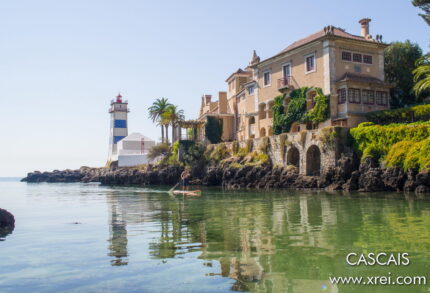
Casa de Santa Maria ![(38.691278, -9.421444)]: Casa de Santa Maria was designed by architect Raúl Lino (1879–1974) in 1902. Casa de Santa Maria is located in the enseada de Santa Maria, near the Farol de Santa Maria. This residence was commissioned by banker Jorge O’Neil and was the private residence of Maria Teresa O’Neil, Dom António Avillez, José Lino, Raúl Lino and Manuel Ribeiro Espírito Santo Silva. Casa de Santa Maria provides an educational service.

Casa de Santa Maria is a building dating from 1902, a symbol of Cascais owing to its architecture and location in the enseada de Santa Maria, near the Farol de Santa Maria

Farol Museu de Santa Marta ![(38º 41′ 25.91”, 9º 25′ 18.27′)]: this is the only museologised lighthouse in Portugal. The Farol Museu de Santa Marta opened to the public in 2007 with a project by Francisco and Manuel Aires de Mateus. The museological model is innovative in that it combines thematic exhibitions with an active coastal signalling function. The permanent exhibition is divided into two sections: one named Portuguese Lighthouses: Technology and History and another named Santa Marta, from Fort to Lighthouse and the Lighthouse Keeper’s Craft. The services available at the Farol Museu de Santa Marta are a shop, an auditorium and an educational service.

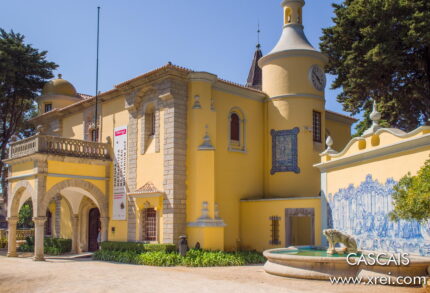
Museu Condes Castro Guimarães, situated in Parque Marechal Carmona, is the oldest museum space in Cascais, housed in the former palace of the Counts of Castro Guimarães.

Museu dos Condes de Castro Guimarães ![(38º 41′ 32.24”, 9º 25′ 18.27′)]: the museum was inaugurated on 12 July 1931. The main highlights are the cloister, the Sala dos Trevos, Sala da Música, Sala Neogótica, Sala de Leitura and the Sala Doutor José de Figueiredo, as well as the panoramic view over the Baía de Cascais, the Baía de Santa Marta, the Parque Marechal Carmona, Casa de Santa Maria and the Farol de Santa Marta.

Palácio Cidadela de Cascais ![(38.693982, -9.419194)]: the Palácio Cidadela de Cascais opened to the public on 23 November 2011 following rehabilitation by architect Pedro Vaz. The Palácio da Cidadela de Cascais served as the residence of the village governor until the arrival of King Dom Luís in 1870. After that date it functioned as a holiday residence of the Portuguese Royal Family, who stayed here during the months of September and October. Following the proclamation of the Republic on 5 October 1910, it was used as the official residence of the Presidency of the Republic, notably by Marshal António Óscar de Fragoso Carmona and Marshal Francisco Higino Craveiro Lopes. Since 2004 it has been used by the President of the Republic to receive diplomats and heads of state.

Cidadela de Cascais was built to defend Lisbon alongside the Torre de Belém, Torre da Caparica and Torre de Santo António by order of Dom João II (1455–1495). Today the Cidadela de Cascais operates as a hotel, restaurant and public art exhibition space open to visitors.

Other attractions to visit in Cascais

Museu da Música Portuguesa — Casa Verdades Faria ![(38.710046, -9.405377)]: the Museu da Música Portuguesa was established in 1987 under the name Museu da Música Regional Portuguesa. The museum grew in several phases, notably in 1994 with the donation of the archive of composer Fernando Lopes Graça and with works by Giacometti. The museum is housed in a building commissioned by Jorge O’Neil in 1918 on Monte do Estoril, which he named Torre de São Patrício. This building was subsequently purchased by Enrique Mantero Belard and Gertrudes Verdades de Faria in 1942. Gertrudes Verdades de Faria was passionate about art and regularly hosted social and cultural gatherings with the aim of promoting artists and works of art.

Piscina Oceânica do Estoril ![(N 38º 42′ 6,77” ,W 9º 23′ 52,76”)]: this pool was inaugurated in 1953 with the aim of being supplied with water directly from the Atlantic Ocean. The Piscina Oceânica do Estoril is located near Tamariz.

Núcleo de Interpretação da Duna da Cresmina ![(38.726517, -9.468898)]: the Núcleo de Interpretação da Duna da Cresmina was created to promote the fauna and flora of this location. The centre offers various activities including Dune System Interpretation, a guided route or virtual guide, birdwatching and flora identification.

Parque das Gerações ![(38.698313, -9.381186)]: the Parque das Gerações is a skatepark located in São Domingos de Rana offering a range of facilities for sport. The park also features community allotments.

Forte de Santo António da Barra ![(38.698330, -9.384043)]: the Forte de Santo António da Barra is a fort ordered by Filipe I of Portugal for the defence of Lisbon in 1589, located in São João do Estoril. It is also known as Forte de Salazar or Forte Velho. The Forte de Santo António da Barra underwent several renovations and changes of function over time, particularly in 1681 following the War of Restoration, between 1762 and 1763 during the Seven Years’ War, in 1889 when it became a Fiscal Guard post, in 1915 when it served as a holiday camp for the Instituto Feminino de Educação e Trabalho de Odivelas, and as a seasonal residence of Salazar from 1950. It was here that the Portuguese dictator suffered a cerebral haemorrhage in 1968, later dying on 27 July 1970. On 29 September 1977 it was classified as a national monument and rehabilitation by Cascais Municipal Council began on 13 March 2018.

Museu da Pólvora Negra

Parque Palmela ![(38.703655, -9.412891)]: the Parque Palmela was built on the orders of the Dukes of Palmela in 1870 for the festivals promoted by the dukes. The park has large trees, extensive lawns and the Ribeira dos Boqueiros. Today the Parque Palmela provides two main leisure spaces: the Auditório Fernando Lopes Graça and an outdoor sports area.

Grutas Artificiais de Alapraia: located approximately 1 km from the Cascais Line towards the interior. The caves form part of a Roman necropolis — the name given to cemeteries during the period of Roman occupation. The Grutas Artificiais de Alapraia were the first cultural space in Cascais to be classified as a site of public interest, in 1942. Four funerary caves were discovered along with several important objects, including limestone votive sandals, ceramic vessels, decorated slate plaques and polished bone artefacts. These objects can be viewed at the Museu da Vila de Cascais.

Centro de Interpretação Ambiental da Pedra do Sal ![(38.694284, -9.371872)]: the interpretation centre was created to promote the natural heritage of this region through various activities, including the Interpretive Trail at Pedra do Sal, passing by the Grutas I & II de São Pedro do Estoril, the Second World War Casamatas Casa do Holofote and Casa do Gerador, the Ponte Filipina, the Aldeia de Cal Água and the Ribeira de Caparide / Manique. Located in São Pedro do Estoril, it is notable for the views over the Atlantic Ocean.

Cabo da Roca is the westernmost point of Europe, also known as Cabo da Ofiussa, Cabo da Serpente or Promontório da Lua. It is a place of great energy, with a stunning view over the ocean and the force of the sea crashing against the cliffs.

Cabo da Roca: one of the landmarks associated with Cascais is Cabo da Roca, the westernmost point of Europe. Cabo da Roca is popular with nature lovers owing to its wild landscape, sheer cliffs, panoramic views over the Atlantic Ocean and the unique experience of watching the Atlantic waves break against the rocks. From here it is possible to take in a panoramic view to the ocean horizon, and it attracts those who appreciate the area’s still-primitive natural character.

Administrative Organisation

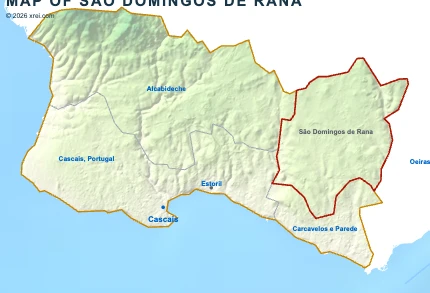
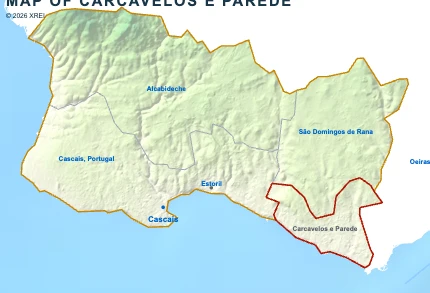
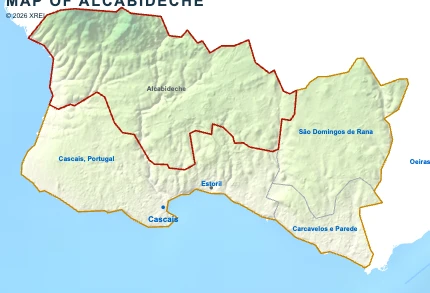
Cascais Municipal Council, with approximately 211,000 inhabitants of whom 21,000 are foreign residents, is administratively organised into four civil parishes:

  • Alcabideche
  • Carcavelos e Parede
  • Cascais e Estoril
  • São Domingos de Rana

Reasons to live in Cascais and Estoril

Cascais exerts great appeal for those wishing to live in Portugal owing to:

  • Mild climate: the climate in Cascais is temperate and humid (Csb in the Köppen-Geiger climate classification), with dry and temperate summers and mild winters owing to the proximity to the sea, southerly exposure and the protection afforded by the Serra de Sintra to the north. Cascais has 265 rain-free days per year, supporting a constant outdoor lifestyle in the village and surroundings.
  • Natural beauty: there is a unique natural beauty arising from great natural diversity, encompassing forest, sea and countryside. The landscape of Cascais is extremely varied, with every kind of natural beauty — from the white sand dunes of Guincho, to the rocks shaped by erosion from the force of the sea (as at the Boca do Inferno), to boundless cliffs such as those at Cabo da Roca, to dense forest such as the Parque Natural de Sintra-Cascais.
  • Tranquillity: Cascais is a calm, peaceful and safe location.
  • Warmth of the local people: this is a characteristic that sets the people of Cascais apart. The hospitality of the village’s residents means that almost all who visit experience a sense of calm and wellbeing.
  • Gastronomy: Cascais cuisine is highly regarded for its variety, freshness and quality. The highlights are fresh fish, Vinho de Carcavelos, broad bean soup, chicken broth, mussel stew, carne de alguidar, areias and Cascais walnuts.
  • Health: Cascais has some of the best health indicators in the country across several areas, particularly through programmes such as a family doctor for every resident and the Smart Health initiative. The area has strong healthcare infrastructure, including Hospital Sant’Ana in Parede — considered the largest orthopaedic surgery hospital on the Iberian Peninsula — and the Centro de Medicina de Reabilitação de Alcoitão, one of the best rehabilitation centres in the world.
  • Education: education is a strength, with university facilities including the Nova School of Business & Economics in Carcavelos — with 29 lecture theatres and 33 classrooms and capacity for 4,000 staff and students — and the Catholic University School of Medicine. The municipality of Cascais is served by highly rated private schools offering both Portuguese and international curricula.
  • Mobility and transport: Cascais Municipal Council has programmes to improve the mobility of residents. Notable initiatives include MobiCascais and MobiBuscas, with more than 60 bus routes and the installation of dozens of electric vehicle charging points throughout the municipality, and bicycle access for more than 38,000 people. Tires Aerodrome is home to eight aviation schools that train approximately 200 pilots per year. Tires Aerodrome is part of the Bragança–Lisbon air route.
  • Leisure and outdoor sports facilities: Cascais has several projects related to healthy living and sustainability, including the creation of small organic allotments throughout the municipality.
  • Proximity to all daily essentials: it is possible to live in Cascais without the need for private transport. Distances are short and services are concentrated and easily accessible. Cascais offers a wide variety of retail — from seafront restaurants and traditional street commerce to covered shopping centres and large supermarkets.
  • Economy and Innovation: projects such as DNA Cascais have enabled the creation of more than 300 companies, alongside the Centro de Mar de Cascais, the European Innovation Academy, Get in the Ring and Horasis.
  • Political, cultural and environmental activity: Cascais Municipal Council develops projects including:
    • The Projeto Carta Arqueológica Subaquática Cascais, which led to the discovery of a 16th-century India fleet vessel;
    • The Festival Muraliza urban art festival: a campaign to end the use of plastic bottles within the municipality;
    • Cascais Smart City, the Estoril Conferences;
    • Cascais Gastronómica, featuring Michelin-starred chefs.

Surfing

Cascais is where surfing was born in Portugal. This sport emerged in the mid-1960s. At that time there were almost no surfers in the country, which drew considerable curiosity from those driving past Guincho who watched the country’s first surfers in action. The Cascais Line has produced between 30 and 40% of Portugal’s national surf champions, including Ruben Gonzalez (four-time champion), José Gregório, Vasco Ribeiro, Maria Abecassis, Patrícia Lopes and Rodrigo Herédia — all leading figures in Portuguese surfing.
The most popular surf spots in Cascais are Praia da Poça, Guincho, São Pedro do Estoril, São João do Estoril and Praia de Carcavelos.

The Cascais coastline offers excellent natural conditions for surfing, with a surfable season of six months per year, predominantly north-westerly winds, 20 to 25 different types of wave, and surf schools including Surf Technique, Cascais Surf School, Guincho Surf School and Moana Surf School. Cascais has several surfboard shaping workshops and manufacturers, including Polen Surfboards, Surfactory and Malta Factory, among many others.
The Cascais Line has played a significant role in the history of surfing in Portugal through the creation of Portugal’s first surf club — the Surf Clube de Portugal — the election of the first president of the Portuguese Surfing Federation, Antero Santos, who was born in this region, and the launch of Rádio Marginal with the first surf conditions weather report for beaches in the 1980s.

Golf

Cascais offers seven golf courses, with particular prominence given to the Oitavos Dunes golf course, ranked the top golf course in Portugal and 55th in the world rankings according to Golf Magazine’s Top 100 Courses in the World. The Oitavos Dunes golf course stands out for the beauty of its natural landscape, located between the Serra de Sintra and Praia do Guincho. It is one of the few courses in Europe designed by Arthur Hills, an American golf course designer, and is complemented by a hotel. The course offers 18 holes and par 71, capacity for 60 players simultaneously, and a practice facility of approximately 5,600 m².
Other golf courses in Cascais:

  • Praia d’el Rey golf course: inaugurated on 14 June 1997, the Praia d’el Rey golf course has 18 holes and par 73. It was designed by Cabell Robinson. The facilities of the Praia d’el Rey golf course include a clubhouse, a golf shop and a training programme for younger players.
  • Penha Longa golf course: integrated within the Penha Longa Hotel & Resort, the Penha Longa golf course is considered one of the thirty best courses in Europe. It was inaugurated in 1992 and designed by Robert Trent Jones Jr. The course is divided into two smaller layouts — the Atlantic Course and the Mosteiro Course. The main highlight of the Penha Longa golf course is the landscape setting, with the Serra de Sintra, the Mosteiro da Penha Longa and a Roman bridge providing unique and unforgettable scenery. The support facilities of the Penha Longa golf course include a golf shop, driving range, putting green, chipping green, bar and restaurant.
  • Pestana Beloura Golf course: the Pestana Beloura Golf course was inaugurated in 1993, has 18 holes and par 72. It was designed by Rocky Roquemore. The Pestana Beloura Golf course includes a clubhouse, changing rooms, golf shop, restaurant, bar, golf school, putting green, driving range and chipping area.
  • Lisbon Sports Club: located in the Serra da Carregueira, the Lisbon Sports Club golf course has 18 holes with par 69. The golf course was inaugurated in 1992 and the club was founded in 1922 under the name Lisbon Cricket, later renamed Lisbon Sports Club in 1922. The Lisbon Sports Club offers a clubhouse, changing rooms, golf shop, restaurant, bar, golf school, putting green, driving range and chipping area. The main highlights are the Scottish-style layout, the constant presence of small wildlife such as rabbits and the numerous streams throughout the course.
  • Golf do Estoril: an 18-hole course integrated within the Palácio Estoril Hotel, Resort & Wellness. The Golf do Estoril course was designed by Mackenzie Ross. The facilities consist of a golf academy, chipping area, golf club, driving range, putting green, golf shop, restaurant, bar, outdoor terrace and a swimming pool.
  • Quinta da Marinha golf course: a golf course integrated within the Hotel da Quinta da Marinha, the Quinta da Marinha golf course has 18 holes with par 71. The course was designed by Robert Trent Jones and inaugurated in 1984. The Quinta da Marinha golf course offers a golf shop, driving range, putting green, practice bunker, chipping green, bar and restaurant.

The Beaches of Cascais

The municipality of Cascais has 17 beaches along approximately 25 km of coastline, visited for family walks and relaxation, surfing, bodyboarding, windsurfing, diving, swimming and sailing, among many other activities. Cascais is home to Praia do Guincho, one of the most popular beaches for surfing and a venue for stages of World Championships, as well as one of the most unspoilt and wild beaches in the country, featuring a landscape of dunes and verdant serra. A coastal cycle path and pedestrian route runs from Cascais to Guincho — a popular route for sport and outdoor enthusiasts.

  • Praia Grande do Guincho
  • Praia da Rainha — Praia da Rainha is a small beach to the left of the Baía de Cascais. It was the beach chosen by Queen Dona Amélia for swimming during the Royal Family’s stays in Cascais.
  • Praia da Conceição
  • Praia de Santa Marta
  • Praia da Ribeira de Cascais
  • Praia do Abano (38.741699, -9.472525): a beach located near Guincho, popular for surfing, bodyboarding, kitesurfing and windsurfing owing to the strong winds and large swell.
  • Praia das Avencas (38.688305, -9.360591): located in Parede, notable for its natural beauty due to the cliff formations. Praia das Avencas was designated a Biophysical Interest Zone in 1998 and classified as the Avencas Marine Protected Area in 2016.
  • Praia da Azarujinha (38.700663, -9.389342): located in São João do Estoril, notable for its amphitheatre shape created by sea erosion on the rocks over time. Access to the beach is on foot only.
  • Praia da Bafureira (38.692446, -9.366296): located in São Pedro do Estoril, notable for its cliffs and the large staircase providing access.
  • Praia de Carcavelos (38.679876, -9.336034): located in Carcavelos, offering an extensive beach of more than one kilometre. The main highlights are the Forte de São Julião da Barra, the various surf and bodyboard schools on site, and a bar/restaurant.
  • Praia da Cresmina (38.725647, -9.476682): a beach located in Guincho, notable for its natural beauty and popular for surfing.
  • Praia da Duquesa (38.700817, -9.414955): located in the village of Cascais, surrounded by restaurants, cafés and outdoor terraces.
  • Praia das Moitas (38.702041, -9.409215): located in Monte do Estoril, also known as Praia da Rata. The main highlights are the Atlantic pool and the terraces along the beach.
  • Praia da Parede (38.685940, -9.354694): located in Parede, popular for sunbathing rather than swimming owing to the large number of rocks near the sand. During the second half of the 19th century and the first half of the 20th century it was widely sought out for the therapeutic qualities of its waters, particularly for bone-related conditions.
  • Praia da Poça (38.702053, -9.391991): located in São João do Estoril between the Forte Velho and the Forte da Cadaveira. A popular beach for surfing.
  • Praia da Rainha (38.699140, -9.418169): located in the centre of Cascais, its main highlights are the proximity to the village centre and its natural beauty.
  • Praia de São Pedro do Estoril (38.693706, -9.369494): located in São Pedro do Estoril, near Ponta do Sal. Notable for its natural beauty and excellent support facilities.
  • Praia do Tamariz (38.702911, -9.399909): located in Estoril, with excellent access and surrounding amenities. The main support facilities are changing rooms, restaurants, bars and outdoor terraces. Praia do Tamariz also has an Atlantic pool.

Transport to and from Cascais

  • Cascais Municipal Aerodrome: aerodrome located in Tires, approximately 20 km from Lisbon. It has a terminal with capacity for 300 people and a runway 1,700 metres long and 30 metres wide. The aerodrome is also used as an aviation school, as a parking facility for private jets, for aircraft maintenance and for aeronautical festivals.
  • Marina de Cascais: marina located at 38º 42′ N – 09º 25′ W in Cascais, with mooring capacity for 650 vessels, including the Mega Yacht Pontoon, which can accommodate vessels over 36 metres in length.
  • MobiCascais: this project of Cascais Municipal Council includes approximately 23 km of cycle paths and provides residents with the following:
    • 1,200 bicycles
    • 5 bus lines
    • 21,000 parking spaces
  • Trains: Cascais is served by the Cais do Sodré Line, which begins in Lisbon and covers approximately 30 km. The Cais do Sodré–Cascais journey takes approximately thirty minutes, with services running from six in the morning until one in the morning. The railway stations in the municipality of Cascais are:
    • Carcavelos railway station
    • Parede railway station
    • São Pedro do Estoril railway station
    • São João do Estoril railway station
    • Estoril railway station
    • Monte do Estoril railway station
    • Cascais railway station
  • Buses: the municipality of Cascais has 38 Scotturb bus routes. The most notable are:
    • Bus 403: linking Sintra and Cabo da Roca, departing from the Centro Comercial Cascais Villa station.
    • Bus 417: linking Sintra, departing from the Centro Comercial Cascais Villa station.
    • Bus 418: linking Sintra, departing from Estoril railway station.

Educational Institutions in Cascais

  • Colégio Amor de Deus
  • Colégio Senhora da Boa Nova
  • Colégio da Bafureira
  • Colégio Dona Luísa Sígea
  • Colégio Quinta do Lago
  • Escola Salesiana de Manique
  • Escola Profissional de Teatro de Cascais
  • Externato Nossa Senhora do Rosário
  • International Christian School of Cascais
  • International Preparatory School – EPPI
  • Jardim de Infância Vila Bicuda
  • Saint Dominic’s International School
  • Saint John’s School
  • Saint James Primary School

Healthcare Services, Clinics and Hospitals in Cascais

  • CADIn: Centro de Apoio ao Desenvolvimento Infantil
  • Clínica Baía de Cascais
  • Clínica Lev Cascais
  • Clínica Medicinas: Clínica Holística Integrativa
  • Clínicas Pedro Choi: Medicina Tradicional Chinesa
  • Chris FisioDerm Clinic Spa
  • Health Club Visconde
  • Holmes Place Cascais
  • IMI: Imagens Médicas Integradas
  • Instituto de Ciência e Saúde: Clínica Poço Novo
  • Kangaroo Health Clubs de Cascais
  • Santa Casa da Misericórdia de Cascais
  • Saúde Integral – Centro de Tratamento e de Recuperação Física Unipessoal lda
  • SPA Dramático & Clínica Estética Médica

Restaurants

  • Gelataria Santini
  • Pastelaria Sacolinha
  • Restaurante Capricciosa
  • Restaurante Cascas
  • Restaurante Confraria
  • Restaurante O Cantinho da Belinha
  • Restaurante Fortaleza do Guincho
  • Restaurante Mar do Inferno
  • Restaurante Porto de Santa Maria
  • Restaurante Redes do Mar
  • Restaurante Visconde da Luz

Shopping

  • Cascais Shopping
  • Cascais Villa
  • Dejá Lu
  • Loja das Meias
  • Rua Direita

Hotels

  • Estalagem Muchaxo Hotel
  • Grande Real Villa Itália Hotel & Spa
  • Farol Design Hotel
  • Hotel Albatroz
  • Hotel Cidadela
  • Hotel Pestana Cascais
  • Hotel Quinta da Marinha & Villas Resort
  • Hotel the Oitavos
  • Pousada de Cascais, Fortaleza da Cidadela
  • Vila Bicuda Hotel

Fairs, Festivals and Celebrations in Cascais

  • CSI Longines Global Champions Tour: world-level showjumping competition held annually in July
  • Procissão de Nossa Senhora dos Navegantes: procession held annually in August
  • Festival Internacional de Cultura: festival held annually in September
  • Lumina — Festival of Light: festival held annually in September
  • Marginal A Passo de Corrida: sporting event held annually in September
  • Swim Challenge Cascais: the largest open-water swimming events in Portugal, held annually in September
  • Billabong Pro Cascais — World Surf League: stage of the World Surf Championship held annually in Cascais
  • Cascais Classic Motorshow: held annually in September

Cascais and Estoril Curiosities

  • Cascais was elevated to the status of a village 650 years ago, in 1364
  • António Martins, from Cascais, was one of the master stonemasons who participated in the construction of the Convento de Mafra
  • The first Portuguese college of philosophy was established in Cascais in the 18th century
  • Portugal’s first electrical connection was made in Cascais in 1878
  • The first public football match in Portugal was held in Cascais in 1888
  • The first live jazz concert in Portugal took place in the summer of 1941 at the Casino do Estoril, featuring the Willie Lewis Orchestra
  • Canadian singer Bryan Adams lived in Cascais between the ages of 9 and 12
  • Cascais has the only bridge over the Atlantic Ocean — the Ponte de Santa Marta
  • A person born in Cascais is called a cascalense
  • The majority of surf champions in Portugal were born and raised in Cascais, including Ruben Gonzalez
  • A unique surf event takes place in Cascais — Surf à Noite (Night Surf)
  • The best surfing beaches are São Pedro do Estoril, Monte Estoril, Tamariz and Guincho
  • Figures such as Vinicius de Moraes, Thomas Mann, Calouste Gulbenkian, Indira Nehru, Robert Rothschild and Ian Fleming lived in Cascais or Estoril
  • Ian Fleming is said to have drawn inspiration for James Bond from his time in Cascais and Estoril
  • It was in Cascais, at the Forte de Santo António da Barra, that António de Oliveira Salazar suffered the fall from his chair that led to his death
  • The Cascais Line was the birthplace of urban art in Portugal

In the village of Cascais it is possible to enjoy a tranquil and safe life while simultaneously leading a cosmopolitan and varied one. Cascais is the third largest municipality in the Lisbon district in terms of foreign residents, with notable communities including:

  • more than five thousand Brazilians,
  • more than one thousand citizens from the United Kingdom,
  • more than seven hundred Germans,
  • more than eight hundred Spanish nationals, and
  • more than eight hundred French nationals.
    Cascais is undoubtedly a multicultural village with a vibrant outdoor life throughout the year. Cascais has one of the most expensive property markets in the world, with strong investment return potential comparable to Saint-Tropez. Quality of life, gastronomy, simplicity and the welcoming nature of its residents are the main assets of this locality. The village of Cascais lends itself to being experienced on foot, given the proximity of all its amenities.

Cascais and Estoril Quick Facts

  • Cascais Municipal Council is organised into four civil parishes:
    • Alcabideche,
    • Carcavelos e Parede,
    • Cascais e Estoril,
    • São Domingos de Rana
  • Cascais has a land area of 97.4 km² and a maritime area of 119 km²
  • Cascais has approximately 211,000 inhabitants
  • Cascais receives more than 500,000 tourists per year, the majority from the United Kingdom, Spain and France
  • Cascais has three municipal libraries, 24 school libraries, a mobile library and a digital library
  • Two in every ten inhabitants of Cascais were born in other countries
  • Cascais was ranked the third best municipal brand in the areas of Tourism, Business and Social
  • Cascais offers excellent conditions for sport, including two cycle paths, three mountain bike trails, 67 tennis courts, 14 swimming pools, 4 athletics tracks, 7 fitness circuits, 6 golf courses, 26 padel courts, 4 equestrian centres, 4 nautical centres, a canoeing space, 6 surf spots and 2 windsurfing and kitesurfing locations
  • São Domingos de Rana has approximately 57,000 inhabitants and has a larger population than 85% of Portugal’s municipalities
  • Tires Aerodrome is the eighth busiest airport facility on the Iberian Peninsula
  • More than one hundred nationalities live in the municipality of Cascais, totalling approximately 23,000 immigrants. The majority of immigrants living in Cascais are from Brazil (7,000), Romania (2,000), Cape Verde (1,500), Ukraine (1,400), Guinea-Bissau (1,300) and the United Kingdom (1,100).

History of Cascais

Cascais is a village founded approximately 650 years ago. The most important events are:

  • Elevation of Cascais to the status of a village by the charter of 1364 issued by King Dom Pedro
  • The Spanish invasion of 1580 began in Cascais with the landing of the troops of the Duke of Alba
  • Most of the fortifications were built in the 17th century, during the reign of Dom João IV
  • Cascais was almost entirely destroyed during the earthquake of 1 November 1755
  • Cascais was invaded by the troops of Napoleon
  • Cascais was used as a prison for supporters of Dom Pedro IV during the Liberal Wars in the 19th century
  • Cascais served as a holiday destination for the Portuguese Royal Family and the Monarchical Court during the second half of the 19th century
  • Cascais was the location of the first electric lighting experiment in Portugal
  • Cascais was the location where the first marine biology laboratory was built
  • Cascais was the location where the first electrically operated railway lines were constructed
  • Cascais was the pioneer in sport, hosting the first competitions in:
    • sailing,
    • canoe rowing,
    • swimming,
    • tennis,
    • rugby,
    • cricket,
    • cycling,
    • football
  • Cascais served as a refuge for influential families and European celebrities during the Second World War

Cascais from Prehistory to the 19th century

  • Cascais has been inhabited since Prehistory and the Neolithic period, particularly in the areas of Guincho, Talaíde and Estoril, owing to the mild climate and the safety of the bay for fishing. Evidence includes Roman remains in São Domingos de Rana and in the village of Cascais itself, where a fish-salting industrial complex was discovered. Examples of prehistoric occupation include the Grutas do Poço Velho, Grutas de Alapraia, Grutas de São Pedro and the Grutas de Porto Covo. Cascais was settled by various peoples in antiquity, including Phoenicians, Romans, Visigoths and Arabs. It was also occupied by the Moors, who founded localities such as Alcabideche and Alcoitão.
  • Cascais is the birthplace of Ibn Muqãna, born in the early 11th century, one of the most celebrated Arabic poets. The village of Cascais was conquered from the Moors by Dom Afonso Henriques in 1147. During the second half of the 12th century, Cascais was home to fishermen and farmers.
  • Cascais was the target of hundreds of pirate attacks throughout its history, which led King Dom Pedro I (1320–1367) to provide the settlement near the port with a defensive wall and subsequently elevate the village of Cascais to town status in 1364. Today only a small stretch of this wall remains.
  • Owing to the growth of Cascais during the Age of Discoveries, Dom João II ordered the construction of a defensive tower in 1488.
  • King Dom Manuel I (1469–1521) granted Cascais its first municipal charter in 1514. The village of Cascais was invaded by the Duke of Alba (1507–1582) on 25 June 1580, with the principal aim of occupying Portugal. As a result of Spain’s occupation of Portugal, Cascais became the target of a series of raids carried out by Francis Drake in 1587.
  • It was at Cascais that the Spanish fleet of 61 galleys carrying an army of 23,000 men under the Duke of Alba landed in 1580, subsequently advancing on Lisbon. The fortress of Cascais was partially razed and was rebuilt after the Spanish occupation by Dom João IV. The village of Cascais was almost entirely destroyed by the earthquake of 1755.
  • Following Portuguese independence in 1640, Dom João IV rebuilt the country’s defences, including several in Cascais: the Forte do Guincho, the Bateria da Galé, Bateria Alta (now Hotel do Guincho), Bateria da Cresmina, Forte de São Jorge de Oitavos, Forte e Farol de Santa Marta, Cidadela de Cascais, and others that no longer exist.
  • Cascais experienced a period of development following the destruction caused by the earthquake of 1 November 1755, through the construction of the Real Fábrica de Lanifícios in Cascais in 1774, the intensification of wheat cultivation and the production of Vinho de Carcavelos. This economic development was briefly interrupted by the French Invasions of 1807 under General Junot and of 1810 under General Massena. During this period the 19th Regiment quartered at the Cidadela de Cascais became notable for — according to local legend — having been protected by a statue of Santo António and suffering not a single defeat in the struggle against the French invader. The statue of Santo António can still be visited at the Cidadela de Cascais today.
  • In 1859 Cascais began to grow in importance following the construction of the road linking it to Oeiras, reducing the distance to Lisbon. From 1871 Cascais became the preferred summer holiday destination of the Royal Family, owing to improved transport links and the village’s mild temperatures.

Cascais grew again in the 19th century owing to three principal factors:

  1. The growing importance of stone quarrying in the 19th century, which led to the establishment of 26 quarries in 1873. Roads linking Cascais to Sintra and Oeiras were built during the 19th century. The Teatro Gil Vicente was inaugurated in 1869, steam-powered passenger services to Lisbon began, and tourism was formalised with the official promotion of Costa do Sol in 1935.
  2. The arrival of the Portuguese Royal Family in Cascais, which transformed the village into a seaside resort: Cascais was granted the status of a royal beach resort in 1867 by Dona Maria Pia and renewed by King Dom Luís. Dom Carlos, passionate about the study of the sea, transformed Cascais into a major scientific research centre in this field, launching twelve campaigns between 1896 and 1907 and establishing Portugal’s first marine biology laboratory here. With the establishment of the Portuguese Royal Family in Cascais, the village developed what became known as summer architecture — a blend of architectural styles still visible today through various examples, including the palace of the Dukes of Palmela in English style, the palace of the Duke of Loulé in French style (now Hotel Albatroz), the Herédias residence, which was built in the style of Swiss chalets, and the palace of banker George O’Neil, constructed in a blend of Manueline and Gothic styles (now the Museu dos Condes de Castro Guimarães).
  3. Construction of the railway line linking Lisbon to Cascais: the Cascais railway line began construction in September 1889 with the inauguration of the section between Pedrouços and Cascais. The railway subsequently expanded with the opening of the section between Pedrouços and Alcântara-Mar in 1891 and the Cais do Sodré extension in 1895.

Cascais and Estoril have served as refuges for noble exiles fleeing persecution since the Second World War (1939–1945). Among the most notable were several European royal families, including Humberto II of Italy, the Count of Barcelona, son of Alfonso XIII of Spain, King Carol of Romania, Regent Miklós Horthy of Hungary and the Duke of Windsor of England.

The Movimento das Forças Armadas was established in Cascais at a meeting held on 5 March 1974. At this meeting the manifesto “O Movimento das Forças Armadas e a Nação” was approved, which served as the basis for the revolt of 25 April 1974.

Origin of the Name Cascais

The name Cascais has two possible origins: one version holds that it is the singular form of the word “cascal”, meaning a cluster of houses; the second version is linked to the presence of an Almoravid admiral named Kax Kax who used the Baía de Cascais as an advanced post.

Olemme lähellä sinua

XREI toimii toimistoista ympäri Portugalia — Portosta Algarveen.

Pohjoinen

Porto — Edifício ICON

Rua Direita de Francos, 165 Piso 1 · 4100-211 Porto

Suur-Lissabon

Lissabon — Rua Castilho

Rua Castilho, 39 · 1250-068 Lisboa

Suur-Lissabon

Estoril

Avenida Aida, 353A · 2765-187 Estoril

Alentejo-rannikko

Comporta

Av. 18 Dezembro, 37 · 7570-779 Carvalhal

Algarve

Vilamoura — Marina Plaza

Av. da Marina, 3 · Marina Plaza Loja 14/15 · 8125-401 Quarteira