
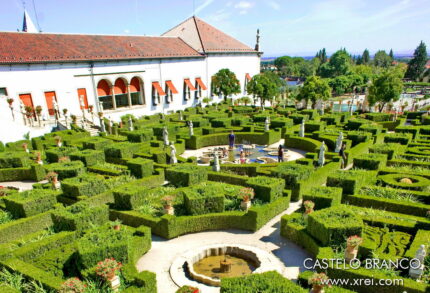
The Episcopal Palace Garden is a Baroque garden beside the former bishops' palace of Castelo Branco, built in the first quarter of the 18th century for D. João de Mendonça, Bishop of Guarda from 1711 to 1736. It is dedicated to Saint John the Baptist, whose statue carries the date 1725, and it is known for its granite statues of saints, apostles, virtues and kings.
The garden, the palace and the walkway between them are classified as a National Monument since 2018.

What to see at the Episcopal Palace Garden
- Statues: granite figures among the box hedges, including the apostles, the cardinal and theological virtues, and the signs of the zodiac.
- Stairway of the Kings: a stairway lined with statues of the kings of Portugal, where the kings of the sixty years of Spanish rule are carved smaller than the rest.
- Lakes: five lakes with worked edges and water games, fed by a hydraulic system built in 1725 and found intact during the restoration.
- Moses cascade: the cascade above the large tank, with the statue of Moses dated 1726.
- Tile panels: blue and white tiles on the garden walls, with views of Castelo Branco, the old estate and the chapel of São João.
History of the Episcopal Palace Garden
- 16th century: D. Nuno de Noronha, Bishop of Guarda, builds the palace as a winter residence.
- 1725 and 1726: the dates carved on the statues of Saint John the Baptist and of Moses mark the works ordered by D. João de Mendonça.
- Late 18th century: D. Vicente Ferrer da Rocha, the second bishop of the Diocese of Castelo Branco, carries out further works.
- 1911 and 1919: the municipality first rents the garden and then buys it.
- 2018: the garden, the palace and the walkway are classified as a National Monument.
Visiting the Episcopal Palace Garden
- Location: the garden is beside the Tavares Proença Museum, in the former palace.
- Tickets: the municipality publishes current opening times and prices.
Places to visit in Castelo Branco
Castelo Branco, Portugal
Episcopal Palace Garden
Castelo Branco Castle
Tavares Proença Museum
Cargaleiro Museum
History of Castelo Branco
Visiting Castelo Branco