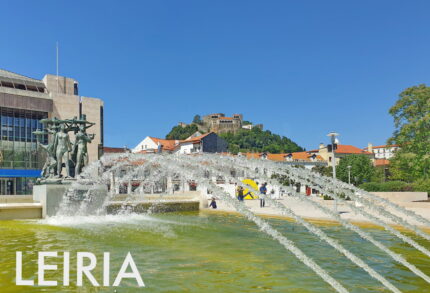
The history of Leiria runs from Palaeolithic settlement in the Lapedo Valley to a castle founded by the first King of Portugal in 1135, a medieval royal residence, the first paper mill in Portugal, and a city and bishopric from 1545.
This page lists the main dates in the history of Leiria and the people linked to the city.
Timeline of Leiria
- Upper Palaeolithic: people use the Abrigo do Lagar Velho in the Lapedo Valley, where the burial of the Lapedo Child is found in 1998.
- 1135: Afonso Henriques founds Leiria Castle on the southern frontier of his territory.
- 1142: Afonso Henriques grants Leiria its first charter to encourage settlement.
- 1195: King Sancho I orders the walls of the castle.
- 1254: King Afonso III holds the Cortes of Leiria, an assembly of the kingdom.
- 1324: King Dinis rebuilds and enlarges the keep of the castle.
- 1401: King João I holds the wedding of his son Afonso at the castle, and the royal palace called Paços Novos is built.
- 1411: King João I authorises paper making at the Moinho do Papel, the first known paper mill in Portugal.
- 1496: the Almanach Perpetuum of the astronomer Abraão Zacuto is printed in Leiria.
- 1510: King Manuel I grants Leiria a new charter.
- 22 May 1545: Pope Paul III creates the Diocese of Leiria, and Leiria becomes a city.
- 1559: construction of Leiria Cathedral begins in earnest.
- 1755: the Lisbon earthquake damages the cathedral and the castle.
- Early 19th century: French troops damage the city and its monuments during the Peninsular War.
- Early 20th century: Ernesto Korrodi leads the restoration of the castle.
- 28 November 1998: the skeleton of the Lapedo Child is discovered.
People linked to Leiria
- King Dinis and Queen Isabel: the king and queen who spent time at Leiria Castle, where King Dinis rebuilt the keep.
- Francisco Rodrigues Lobo (1580 to 1621): a poet born in Leiria, author of O Pastor Peregrino and Corte na Aldeia, after whom the main square of the historic centre is named.
- Eça de Queirós (1845 to 1900): the novelist who served as an administrator of the municipality of Leiria in 1870 and set his novel O Crime do Padre Amaro in the city.
- Ernesto Korrodi (1870 to 1944): a Swiss-born architect who settled in Leiria, taught at its industrial school and led the restoration of the castle.
Places to visit in Leiria