
Alfama
Alfama ist das älteste Viertel Lissabons und eines der ältesten Europas. Es ist ein Ort, an dem man in das mittelalterliche Lissabon zurückversetzt wird und gleichzeitig die Modernität der portugiesischen Hauptstadt spürt. Auf einem Hügel mit Blick auf den Tejo gelegen, bietet Alfama einen Blick über die Amphitheater-ähnlich angeordneten Dächer Lissabons, über den Tejo bis zum Südufer. Alfama liegt im historischen Zentrum Lissabons und grenzt an die Viertel Graça, Mouraria, Castelo und Baixa. Es liegt in der Nähe der Luxus-Avenida da Liberdade, des kosmopolitischen Chiado und des Bohème-Viertels Bairro Alto.

Alfama behält seine engen, gewundenen, labyrinthartigen Straßen mit Gassen und Pfaden. Hier kann man Wäsche von den Fenstern hängen sehen, Menschen, die laut von einem Fenster zum anderen rufen, als wären sie in einem kleinen Dorf, tagsüber offene Haustüren und Fado, der auf die Straße dringt.

Alfama ist einer der Ursprungsorte des Fado und wegen seiner zahlreichen Fado-Lokale sehr gefragt. Es ist Tradition, dass sich Fadistas im Sommer auf der Straße versammeln, um zu singen, was den Besuchern des Viertels eine einzigartige Atmosphäre verleiht. Alfama ist tagsüber ruhig, friedlich und sicher, mit Touristengruppen, die sich zwischen Fado-Lokalen und Restaurants bewegen, in denen die gefeierte traditionelle portugiesische Küche genossen werden kann. Einer der Höhepunkte von Alfama findet im Juni während der Festas da Cidade statt, wenn das Viertel mit Tausenden von Menschen aus aller Welt gefüllt ist, die die Straßen säumen und bis in die frühen Morgenstunden gesellig beisammen sind. Nachts wird Alfama zu einem beliebten Ziel wegen seiner großen Anzahl an Restaurants.
Der Fado wurde bekannt, als der Graf von Vimioso ihn am portugiesischen Hof durch Auftritte von Maria Severa Onofriana (1820–1846), der ersten Fado-Sängerin, einführte. Mit dem Aufkommen von Amália Rodrigues erlangte der Fado größere Bekanntheit und wurde international anerkannt, als Amália Rodrigues eine internationale Karriere aufbaute – die erste portugiesische Künstlerin, die dies tat. Einige der heute bekanntesten Fadistas stammen aus Alfama, darunter Ricardo Ribeiro, Raquel Tavares und Artur Batalha. Fado ist seit 2011 von der UNESCO als immaterielles Kulturerbe der Menschheit anerkannt.
Erkundung von Alfama
Der beste Weg, Alfama zu besuchen, ist zu Fuß, obwohl die Straßenbahn 28 eine ausgezeichnete Alternative ist, um hierher zu gelangen. Die Route der Straßenbahn 28 beginnt an der Praça do Martim Moniz und endet in Campo de Ourique und führt durch mehrere der wichtigsten Sehenswürdigkeiten der Stadt, darunter das Viertel Alfama, Miradouro de Nossa Senhora do Monte, Miradouro da Graça, die Kathedrale von Lissabon, Praça do Comércio, Rua Garrett, Praça Luís de Camões, Miradouro de Santa Catarina, Basílica da Estrela, Jardim da Estrela, Mercado de Campo de Ourique, Cemitério dos Prazeres und die Igreja do Santo Condestável in Campo de Ourique. Die erste Fahrt findet täglich von 6 Uhr morgens bis nach 23 Uhr abends statt. Die Linie 28 hat 50 Straßenbahnen zur Verfügung, jede mit einer Kapazität von 20 Sitz- und 38 Stehplätzen. Die Linie wurde 1914 geschaffen und ist heute eines der Symbole und wichtigsten Touristenattraktionen Lissabons.
Top 10 Sehenswürdigkeiten in Alfama
- Panteão Nacional: Das Panteão Nacional befindet sich in der Igreja de Santa Engrácia am Campo de Santa Clara. Es ist ein Gebäude, das der Erinnerung an herausragende Persönlichkeiten gewidmet ist, wo deren sterbliche Überreste ruhen. Der Bau der heutigen Kirche begann 1682 während der Herrschaft von Dom Pedro II unter der Leitung des Architekten Mateus Couto und dauerte etwa 284 Jahre. Die Igreja de Santa Engrácia diente nach der Auflösung der Ordensgemeinschaften im Jahr 1834 verschiedenen Zwecken, darunter als Kaserne für das Zweite Bataillon der Lissabonner Nationalgarde, als Waffenfabrik und als Schuhwerkstatt. Die Igreja de Santa Engrácia wurde 1916 zum Panteão Nacional erklärt und in den 1950er Jahren umfassend umgebaut, an dem mehrere Architekten beteiligt waren, darunter António Lino, Joaquim Areal e Silva, Raúl Lino und Luís Amoroso Lopes. Das Panteão Nacional wurde 1966 eingeweiht – anlässlich des vierzigsten Jahrestages des Estado Novo-Regimes – mit dem endgültigen Bau der Stahlbetonkuppel unter der Leitung des Architekten António Lino. Die herausragenden portugiesischen Persönlichkeiten, die im Panteão Nacional begraben sind, sind:
- Manuel de Arriaga;
- Teófilo Braga;
- Sidónio Pais;
- Óscar Carmona;
- Almeida Garrett;
- Aquilino Ribeiro;
- Guerra Junqueiro;
- João de Deus;
- Amália Rodrigues;
- Humberto Delgado;
- Sophia de Mello Breyner Andresen;
- Eusébio da Silva Ferreira.
Das Panteão Nacional ehrt auch die folgenden portugiesischen Persönlichkeiten mit Kenotaphien: - Luís Vaz de Camões;
- Pedro Álvares Cabral;
- Infante Dom Henrique;
- Vasco da Gama;
- Afonso de Albuquerque;
- Dom Nuno Álvares Pereira.
Andere Denkmäler in Portugal, die als Nationalpantheons anerkannt sind, sind: - Mosteiro de Santa Cruz de Coimbra: Hier sind Dom Afonso Henriques und Dom Sancho I begraben;
- Mosteiro de Alcobaça: Hier sind Dom Afonso II, Dom Afonso III und Dom Pedro I begraben;
- Mosteiro da Batalha: Hier sind Dom João I und Dona Filipa de Lencastre, Dom Duarte und Dona Leonor de Aragão, Dom Afonso V und Dom João II begraben;
- Mosteiro dos Jerónimos: Hier sind Dom Manuel I, Dom João III, Dom Sebastião und Kardinal Dom Henrique begraben;
- Mosteiro de São Vicente de Fora: Hier sind die Monarchen von Dom João IV bis Dom Manuel II begraben, mit Ausnahme von Dom Pedro IV – dessen Gebeine mit Lissabon und Porto verbunden sind – und Dona Maria I, die in der Basílica da Estrela begraben ist.
Andere Denkmäler, in denen Könige und Königinnen von Portugal begraben sind, die aber nicht als Nationalpantheons anerkannt sind, umfassen: - Convento de Odivelas: Grab von Dom Dinis;
- Sé Catedral de Lisboa: Grab von Dom Afonso IV;
- Museu do Carmo: Grab von Dom Fernando I;
- Kathedrale von Toledo, Spanien: Hier ist Dom Sancho II begraben.
Das Wort „Pantheon“ leitet sich vom lateinischen „pantheon“ ab, was „Tempel, der den Göttern geweiht ist“ bedeutet. Die erste Igreja de Santa Engrácia in Portugal wurde 1570 auf Befehl von Dona Maria, einer Tochter von König Dom Manuel I und einer Anhängerin von Santa Engrácia, erbaut.

- Sé Catedral de Lisboa: Die Sé Catedral de Lisboa ist die wichtigste Kirche Lissabons und befindet sich am Largo da Sé. Sie wurde 1150 im romanischen Stil unter der Leitung von Meister Roberto eingeweiht, offiziell von Dom Afonso Henriques zur Igreja de Santa Maria Maior ernannt und im Laufe der Jahrhunderte verschiedenen Umbauten unterzogen, darunter der Bau des Kreuzgangs zwischen 1281 und 1319 während der Herrschaft von Dom Dinis, der Bau der Kapelle São Bartolomeu im Jahr 1324, die Kapelle-Mor während der Herrschaft von Dom Afonso IV, die Apsis und die Kreuzgangmalereien von Meister Manuel André im Jahr 1569, die Sakristei und die Schatzkammer während der Herrschaft von Dom João V, der Bau der Uhr im Jahr 1743 und der Wiederaufbau nach dem Erdbeben von 1755. Die wichtigsten Highlights der Sé Catedral de Lisboa sind:
- Sakristei;
- Kapelle-Mor;
- Grab von Dom Afonso IV;
- Taufbecken, in dem Santo António 1195 getauft wurde;
- Kreuzgang;
- Archäologische Ausgrabungen von über dreitausend Jahren im gotischen Kreuzgang;
- Krippe von Machado de Castro, 1766;
- Königliche Schatzkammer mit Stücken wie der Monstranz von Dom José I;
- Panoramablick über den Tejo vom Turm aus.

- Mosteiro de São Vicente de Fora: Das Mosteiro de São Vicente de Fora ist eines der ältesten Klöster Lissabons und wurde aus Dankbarkeit für die Eroberung Lissabons im Jahr 1147 erbaut. Der Bau der ursprünglichen Kirche begann am 21. November 1147 und wurde Nossa Senhora da Conceição-a-Enfermaria und São Vicente Mártir geweiht und dem Orden des Heiligen Augustinus anvertraut. Das heutige Kloster wurde während der Herrschaft von Philipp I. von Portugal (1527–1598) erbaut, mit den Hauptarchitekten Juan de Herrera (1530–1597) – auch verantwortlich für das Mosteiro de San Lorenzo de El Escorial (1563–1584) –, Filippo Terzi (1520–1597), Baltazar Álvares (1560–1630) und João Frederico Ludovice (1673–1752). Die wichtigsten Sehenswürdigkeiten des Mosteiro de São Vicente de Fora sind:
- Pantheon des Hauses Braganza: Das Pantheon des Hauses Braganza wurde erstmals von Dom João V geplant und 1932 fertiggestellt. Das Projekt von 1932 wurde vom Architekten Raul Lino durchgeführt, mit dem Ziel, ein würdigeres Grab für König Dom Carlos zu schaffen.
- Fassade mit zwei Türmen: Dies war ein innovatives Merkmal, da der Bau von zwei Türmen an einer Kirche ausschließlich Kathedralkirchen vorbehalten war. Das Zwillings-Turm-Design beeinflusste den Bau anderer christlicher Kirchen im ganzen Land, darunter die Sé Nova in Coimbra (1598), die Igreja de São Lourenço (1690) in Porto und die Basílica da Estrela (1779) in Lissabon.
- Zisterne: das einzige erhaltene Bauwerk aus dem Kloster, das von Dom Afonso Henriques in Auftrag gegeben wurde. Die Zisterne funktioniert weiterhin.
- Größte Sammlung von barocken Azulejo-Kacheln der Welt: Die einzige vergleichbare Sammlung befindet sich im Kreuzgang des Convento de São Francisco in Salvador da Bahia, Brasilien.
- Portaria des Mosteiro de São Vicente de Fora: bemerkenswert für Azulejo-Paneele, die Episoden aus der portugiesischen Geschichte und die verschiedenen Könige Portugals darstellen, die zum Bau des Klosters beigetragen haben, sowie für die Deckenmalerei des Italieners Vicenzo Baccarelli.
- Klosterkreuzgang: erbaut im 17. Jahrhundert, mit 81 Azulejo-Paneelen und etwa fünfzehntausend Kacheln aus der Herrschaft von Dom João V.
- Kapelle Santo António: die Kapelle, in der Teresa Teixeira, die Mutter von Santo António, begraben wurde.
- Sakristei: in Auftrag gegeben von Dom João V und bemerkenswert für ihre Opulenz.
- Kapelle der Meninos de Palhavã: benannt nach der Verlegung aus dem Palácio da Palhavã in Lissabon – heute die spanische Botschaft. Die Kapelle enthält die Gräber der unehelichen Söhne von Dom João V.
- Azulejo-Paneele mit den Fabeln von La Fontaine: dargestellt auf insgesamt 38 Azulejo-Paneelen aus dem 18. Jahrhundert.
- Kirchturm: ein privilegierter Punkt, von dem aus man Lissabon, den Tejo und die Serra da Arrábida beobachten kann.
- Orgel: erbaut 1765 von João Fontanes de Maqueira, mit mehr als dreitausend Pfeifen auf zwei Manualen und sechzig Registern – eine der größten Orgeln Portugals.
São Vicente war ein Diakon in Saragossa und einer der hispanischen Märtyrer, der der Legende nach außergewöhnliche Folter erlitt, bevor er am 22. Januar 304 starb. Er wurde auf einem Friedhof in Valencia begraben und später nach Cabo de São Vicente an der Algarve gebracht, nachdem die Mauren die Iberische Halbinsel erobert hatten. Dom Afonso Henriques schickte eine Flotte nach Cabo de São Vicente, um den Körper und die Reliquien zu bergen, die dann per Schiff nach Lissabon transportiert wurden – und zu einem großen Symbol der christlichen Einheit gegen den muslimischen Feind wurden.
- Miradouro de Santa Luzia: Einer der begehrtesten Aussichtspunkte Lissabons mit einem herrlichen Blick über Alfama, den Tejo und die Serra da Arrábida, gelegen am Largo de Santa Luzia. Die wichtigsten Highlights sind der Blick über das Viertel Alfama, Azulejo-Paneele, die die Eroberung Lissabons im Jahr 1147 und die Praça do Comércio vor dem Erdbeben von 1755 darstellen, sowie eine Büste zu Ehren des Lissabonner Historikers Norberto de Araújo. Der Miradouro de Santa Luzia wird von Touristen aus aller Welt stark besucht und trägt zu einer sehr angenehmen Atmosphäre in der Stadt bei.


- Miradouro das Portas do Sol: Einer der begehrtesten Aussichtspunkte Lissabons, gelegen am Largo das Portas do Sol, auch bekannt als Varanda do Tejo, in der Nähe des Castelo de São Jorge. Vom Aussichtspunkt aus kann man das Panteão Nacional, das Mosteiro de São Vicente de Fora, das Viertel Alfama, das Museu do Fado, die Igreja de São Miguel, die Igreja de Santo Estêvão, den Tejo und die Serra da Arrábida sehen. Die Highlights des Aussichtspunkts sind:
- Statue von São Vicente von Raul Xavier;
- Palácio Azurara, Sitz der Fundação Ricardo Espírito Santo Silva;
- Maurische Mauer aus dem 10. Jahrhundert.
Am Largo das Portas do Sol befinden sich bemerkenswerte Sehenswürdigkeiten: - Museu de Artes Decorativas;
- Igreja de Santiago.

- Museu do Fado e da Guitarra Portuguesa: Das Museu do Fado ist ein Museum, in dem die historische Entwicklung des Fado erforscht, Live-Aufführungen dieses portugiesischen Musikgenres besucht und die portugiesische Gitarre erlernt werden kann. Das Museum befindet sich am Largo do Chafariz de Dentro, das mit der Rua de São Pedro, der Rua dos Remédios und dem Tejo verbunden ist, und wurde am 25. September 1998 eingeweiht. Zu den Highlights gehören:
- O Fado von José Malhoa, 1910;
- Triptychon O Marinheiro von Constantino Fernandes, 1913;
- O Mais Português dos Quadros a Óleo von João Vieira, 2005;
- Ausstellung von Musikinstrumenten und Kostümen;
- Dokumentationszentrum, in dem Fado studiert werden kann;
- Museumsschule, in der Fado-Gesang und portugiesische Gitarre erlernt werden können.

- Miradouro de Santo Estêvão: Einer der weniger bekannten Aussichtspunkte von Alfama, gelegen im Innenhof vor der Igreja de Santo Estêvão. Es ist ein ruhiger Ort abseits des Trubels der bekannteren Aussichtspunkte der Stadt und bietet Blick auf das Viertel Alfama, die Serra da Arrábida und den Tejo.
- Igreja de Nossa Senhora da Conceição-a-Velha: Die Igreja de Nossa Senhora da Conceição-a-Velha markiert die Grenze zwischen der Baixa Pombalina und Alfama. Die erste Kirche wurde 1496 unter dem Namen Igreja da Conceição dos Frades erbaut und ersetzte die Synagoge, die im 15. Jahrhundert an diesem Ort stand, und wurde beim Erdbeben von 1755 zerstört. Die heutige Kirche wurde nach dem Erdbeben nach einem Entwurf von Francisco António Ferreira wieder aufgebaut. Die wichtigsten Sehenswürdigkeiten sind:
- Hauptfassade: Es wird angenommen, dass sie von der ursprünglichen Kirche vor 1755 erhalten ist. Die Fassade ist ein manuelinisches Portal, in dem die Figur der Nossa Senhora da Misericórdia und die Jungfrau Maria, deren Mantel die gesamte portugiesische Gesellschaft schützt, die zentralen Highlights sind.
- Kirchenschiff: die Decke, bemalt in Stuck, die den Triumph der Nossa Senhora da Conceição von Félix da Rocha darstellt.
- Statuen von Heiliger Petrus und Heiliger Paulus von José de Almeida.
- Kapelle-Mor: Die heutige Kapelle-Mor war ursprünglich eine Seitenkapelle, die von Simoa Godinha (1530–1594) in Auftrag gegeben wurde, einer wohlhabenden schwarzen Adligen aus São Tomé und Príncipe und einer bedeutenden Zuckerproduzentin. Das Herzstück der Kapelle-Mor ist die Statue der Nossa Senhora da Conceição-a-Velha, die zwischen 1730 und 1740 von José de Almeida geschaffen wurde.
- Bild der Nossa Senhora de Belém: in Auftrag gegeben von Infante Dom Henrique (1394–1460) für eine kleine Kirche des Christusordens, die abgerissen wurde, um Platz für das Mosteiro dos Jerónimos zu schaffen. Das Bild ist bedeutsam, da laut mündlicher Überlieferung Vasco da Gama vor diesem Bild betete, bevor er 1498 nach Indien aufbrach.
- Pfeifenorgel: Diese kleine Orgel stammt aus dem Palácio das Necessidades in Lissabon.
- Teatro Romano: Das Teatro Romano ist ein archäologischer Fund aus dem 1. Jahrhundert n. Chr. mit einer geschätzten Kapazität von 4.000 Zuschauern. Es ist einer der fünf Zweige des Museu de Lisboa, neben dem Palácio Pimenta, dem Museu de Santo António, der Casa dos Bicos und dem Westturm der Praça do Comércio. Die Ruinen des Teatro Romano liegen zwischen der Rua de São Mamede und der Rua da Saudade – verbunden mit dem Largo do Caldas und der Rua da Madalena – und wurden 1798 entdeckt und erstmals vom italienischen Architekten Francisco Xavier Fabri dokumentiert. Die Stätte wurde mehreren archäologischen Interventionen unterzogen, darunter zwischen 1964 und 1967 unter Fernando de Almeida und Irisalva Moita sowie zwischen 1989 und 1993 unter dem Museu de Lisboa und der Stadtverwaltung von Lissabon. Es wurde 2001 als Museum eingeweiht und ist in zwei Gebäude integriert – einen Palast aus dem 18. Jahrhundert und eine ehemalige Fabrik aus dem 19. Jahrhundert.

- Casa dos Bicos: Die Casa dos Bicos ist einer der Zweige des Museu de Lisboa und Sitz der José Saramago Foundation – des Nobelpreisträgers für Literatur – am Campo das Cebolas. Sie wurde von Brás de Albuquerque, Sohn von Afonso de Albuquerque, Gouverneur von Portugiesisch-Indien, in Auftrag gegeben und zwischen 1521 und 1523 unter der Leitung von Francisco de Arruda erbaut. Die Hauptfassade des Palastes war vom Palazzo dei Diamanti in Ferrara, Italien, inspiriert, wurde aber mit spitzen Steinbossen anstelle von Diamantformen gebaut – daher der heutige Name. Die Casa dos Bicos wurde beim Erdbeben von 1755 teilweise zerstört und 1981 unter den Architekten Manuel Vicente und Daniel Santa Rita restauriert, um die Europäische Ausstellung für Kunst, Wissenschaft und Kultur auszurichten und den Kern Os Descobrimentos Portugueses und A Europa do Renascimento einzuweihen. Im Laufe der Zeit diente das Gebäude als Lagerhaus für Kabeljau, Hauptsitz der Comissão Nacional para a Comemoração dos Descobrimentos Portugueses zwischen 1987 und 2002, Kulturabteilung der Stadtverwaltung von Lissabon zwischen 2003 und 2008 und die José Saramago Foundation von 2008 bis heute. Die Highlights der Casa dos Bicos sind:
- Ruinen des römischen Lissabons: bemerkenswert für die Entdeckung von Fabriken für Fischgewürze aus dem 1. Jahrhundert n. Chr., Teile der römischen Stadtmauer Lissabons und einen halbkreisförmigen Turm aus dem 3. Jahrhundert.
- José Saramago Foundation: untergebracht in den beiden oberen Etagen der Casa dos Bicos, wo das Werk des Schriftstellers besichtigt und studiert werden kann.
- Mittelalterliche Mauer: Ein Teil der mittelalterlichen Mauer wurde hier entdeckt.
- Cetariae: rechteckige Becken, die in Fabriken während der römischen Besatzung verwendet wurden.

Weitere Orte in Alfama zu erkunden
- Igreja de Santo António: Die Igreja de Santo António ist ein symbolisches Wahrzeichen Lissabons, erbaut an der Stelle, an der Santo António 1195 geboren wurde, am heutigen Largo de Santo António da Sé. Der Bau begann 1495 während der Herrschaft von Dom João II und wurde während der Herrschaft von Dom Manuel I. abgeschlossen. Die heutige Kirche wurde zwischen 1767 und 1812 unter der Leitung des Architekten Mateus Vicente de Oliveira (1706–1786) vollständig wieder aufgebaut. Die wichtigsten Sehenswürdigkeiten sind:
- Statue von Santo António, eingeweiht von Papst Johannes Paul II. während seines Besuchs in Portugal im Jahr 1982, von Soares Branco;
- Neoklassizistische Fassade;
- Inschrifttafel mit der Bulle von Papst Pius VI., die denjenigen einen vollkommenen Ablass gewährt, die den Geburtsort von Santo António besuchen;
- Wappen von Portugal und der Familie Bulhões – dem Familiennamen von Santo António – gemalt im Narthex der Kirche;
- Orgel, erbaut 1872;
- Raum, in dem Santo António geboren wurde.
- Igreja de São Miguel: Die wichtigste Kirche im Viertel Alfama, gelegen am Largo de São Miguel. Die Igreja de São Miguel wurde 1295 gegründet, die heutige Version wurde zwischen 1673 und 1720 unter der Leitung des Architekten João Nunes Tinoco erbaut – sie stellt eines der größten Ensembles von vergoldeten Holzschnitzereien in Lissabon dar. Die Highlights sind:
- Statue von São Miguel an der Hauptfassade;
- Holzdecke, bemalt in fünfzehn Aquarellen, die Engel darstellen;
- Kapelle Santo António, vollständig mit vergoldeten Holzschnitzereien verkleidet;
- Sechzehn Gemälde in vergoldeten Holzschnitzrahmen, die Szenen aus dem Neuen Testament von Bento Coelho da Silveira (1617–1706) darstellen;
- Kapelle-Mor in vergoldeten Holzschnitzereien mit einer Darstellung von São Miguel in der Mitte, flankiert von einer Statue des Heiligen Josef und einer der Nossa Senhora da Boa Viagem.
- Museu Militar de Lisboa: Lissabons ältestes Museum, eingeweiht am 10. Dezember 1851 als Museu de Artilharia, gelegen am Largo do Museu de Artilharia in Alfama, nahe dem Bahnhof Santa Apolónia und dem Kreuzfahrtterminal. Die Mission des Museums ist es, die Militärgeschichte Portugals zu vermitteln und es beherbergt eine Sammlung von mehr als 26.000 Objekten. Das Gebäude des Museu Militar de Lisboa wurde zweimal beschädigt – durch eine Explosion und durch das Erdbeben von 1755. Zu den Highlights gehören:
- Hauptfassade mit einer weiblichen Skulptur, die das Vaterland symbolisiert;
- Zentraler Innenhof mit Kanonen und sechsundzwanzig Azulejo-Paneelen, die die Geschichte Portugals von der Reconquista im 12. Jahrhundert bis zum Ersten Weltkrieg (1914–1918) erzählen;
- Bronzene Artilleriesammlung – eine der größten der Welt;
- Fahrzeug, das zum Transport der Säulen des Arco da Rua Augusta verwendet wurde;
- Sala Vasco da Gama: mit Gemälden von Columbano Bordalo Pinheiro, darunter "O Velho do Restelo", das die Entdeckung des Seewegs nach Indien darstellt, "O Mural" von Carlos Reis und die Decke des Gebäudes von Luigi Manini;
- Sala América: bemerkenswert für die von Columbano Bordalo Pinheiro bemalte Decke;
- Raum, der João Maria Ferreira do Amaral gewidmet ist, Kommandeur des 15. Infanteriebataillons – der am besten dekorierte Infanterieeinheit der portugiesischen Armee für ihre Aktionen in der Schlacht am Lys am 9. April 1918. Nach dem Ersten Weltkrieg schrieb Ferreira do Amaral "A Mentira da Flandres" und "O Medo", in denen er die Politik der damaligen Zeit kritisierte;
- Salas da Grande Guerra: bemerkenswert für Gemälde von Sousa Lopes, die den Ersten Weltkrieg und das Denkmal des Unbekannten Soldaten darstellen.
- Kopfsteinpflaster-Porträt zu Ehren von Amália Rodrigues: Eine Hommage an die berühmteste Fadista Portugals, gelegen zwischen der Rua de São Tomé und der Calçada do Menino de Deus in Alfama. Es wurde am 2. Juli 2015 eingeweiht und vom urbanen Künstler Vhils und der Escola de Calceteiros der Stadtverwaltung von Lissabon geschaffen.
- Museu do Aljube: Resistência e Liberdade: Ein Museum, das sich der Geschichte des Kampfes gegen das diktatorische Regime widmet, das Portugal zwischen 1926 und 1974 regierte. Es befindet sich am Pátio do Aljube zwischen der Kathedrale von Lissabon und dem Miradouro de Santa Luzia in Alfama. Das Museum ist im Aljube-Gebäude untergebracht – ein Wort, das vom arabischen "al-jubb" abgeleitet ist und einen trockenen Brunnen, Kerker oder Gefängnis bedeutet. Das Gebäude diente seit seiner Gründung in der römischen Zeit als Gefängnis, darunter für Geistliche, Frauen im 19. Jahrhundert und politische Widerstandskämpfer zwischen 1928 und 1965. Das Museum ist wie folgt strukturiert:
- Etage -1: Archäologische Überreste aus der römischen und islamischen Zeit;
- Erdgeschoss: Ehemaliges Hauptgefängnistor, heutiger Museumseingang;
- Etage 1: Teil der Dauerausstellung mit Abschnitten über: Der Aufstieg und Fall des Faschismus, Portugal 1890–1976, Unbestreitbare Gewissheiten, Untergrundpresse, Untergrundaktivitäten, Politische Polizei und Gerichte;
- Etage 2: Teil der Dauerausstellung mit Abschnitten über: Widerstand, Der Gefängniskreislauf, Identifizierung, Verhöre und Folter, Gefängnisse und Konzentrationslager, Widerstand hinter Gittern und Isolation in den „Pens“;
- Etage 3: Teil der Dauerausstellung mit Abschnitten über: Kolonialismus und antikolonialer Kampf, Diejenigen, die auf dem Weg fielen, Freiheit – 25. April 1974, Erinnerung und Bürgerschaft, Dokumentationszentrum;
- Etage 4: Auditorium und Cafeteria.
- Igreja de Santo Estêvão: Eine Kirche, die zu einer der ältesten Pfarreien Lissabons gehört, gegründet 1183, gelegen am Largo de Santo Estêvão. Die erste Kirche wurde zwischen 1316 und 1543 erbaut und wurde stark vom Erdbeben von 1755 beeinträchtigt. Die heutige Kirche wurde 1775 eingeweiht und verfügt über:
- Kapelle Nossa Senhora do Monte do Carmo mit einer kleinen Holzstatuette;
- Kapelle Nossa Senhora da Conceição mit einem Marmormedaillon, das Sant'Ana darstellt;
- Kapelle-Mor mit Darstellungen der Evangelisten und rosa Marmordekoration aus der Serra da Arrábida;
- Gekreuzigter Christus, flankiert von zwei Seraphim von José de Almeida und Jerónimo da Costa;
- Bild von Santo Estêvão von Nicolau Pinto;
- Azulejo-Paneele aus dem 17. Jahrhundert mit biblischen Szenen.
- Chafariz d'El-Rei: Einer der ältesten Brunnen Lissabons aus der islamischen Zeit. Er befindet sich in der Travessa do Chafariz d'El-Rei in Alfama, wurde im 13. Jahrhundert während der Herrschaft von Dom Dinis (1279–1325) erbaut und bis zu seinem heutigen Aussehen aus dem 19. Jahrhundert wiederholt verändert. Er ist in den Palácio do Marquês de Angeja integriert und verfügt über:
- Obergeschoss mit Terrasse;
- Untergeschoss mit Wasserhähnen;
- Paneele, die zwei Karavellen und das Wappen von Lissabon darstellen.
- Chafariz de Dentro: Einer der Wasserversorgungspunkte für die Bevölkerung von Alfama, gelegen am Largo do Chafariz de Dentro. Erbaut im 13. Jahrhundert, hat er seinen Namen von seiner Lage innerhalb der Fernandine-Mauern, die während der Herrschaft von Dom Fernando I. (1345–1383) erbaut wurden. Er war als Chafariz dos Cavalos bekannt, wegen der Bronzepferde, die die Fassade schmückten und angeblich von spanischen Truppen während der Belagerung Lissabons im Jahr 1384 gestohlen wurden. Das Haupt-Highlight des Chafariz de Dentro ist seine barocke und romantische Fassade, die heutige Version stammt aus dem Jahr 1872.
- Museu-Escola de Artes Decorativas: Ein Museum und eine Schule, die sich der Präsentation der verschiedenen Dekorationsstile portugiesischer Adelshäuser zwischen dem 17. und 19. Jahrhundert widmet und sich im Palácio Azurara am Largo das Portas do Sol befindet. Der Palácio Azurara diente im 20. Jahrhundert verschiedenen Zwecken – als Generalstab der Armee von 1902 bis 1907, als religiöses Kolleg von 1907 bis 1912 und als Hospiz für Tollwut (Angst vor Wasser oder Flüssigkeiten) von 1913 bis 1933. Er wurde 1947 von Ricardo Espírito Santo Silva gekauft und nach einem Entwurf des Architekten Raul Lino (1879–1974) restauriert. Die wichtigsten Highlights sind:
- Große Treppe: mit Azulejo-Paneelen von Bartolomeu Antunes (1688–1753), einem Spiegel mit vergoldetem Holzrahmen, zwei flämischen Wandteppichen aus dem 16. oder 17. Jahrhundert und zwei chinesischen Porzellanvasen der Qing-Dynastie;
- Großer Salon: mit Themen des orientalischen Exotismus und der portugiesischen Expansion, darunter ein Wandteppich mit orientalischen Tieren und Figuren, ein indo-portugiesischer Schreibtisch aus dem heutigen Mongolei und ein Arraiolos-Teppich aus dem 18. Jahrhundert;
- Portugiesische Stuhlkollektion: umfasst mehr als 300 Stühle und 30 Sofas aus dem 17. bis 19. Jahrhundert aus der Privatsammlung von Ricardo do Espírito Santo Silva;
- Vitrinensaal: beherbergt Fayence-Sammlungen vom 18. bis 20. Jahrhundert aus Werkstätten in ganz Portugal, darunter die ehemalige Real Fábrica do Rato in Lissabon, Viana do Castelo, Miragaia und Massarelos;
- Schlafzimmer von Dom José I. (1750–1777) und Dona Maria I. (1777–1816): bemerkenswert für Rokoko-Möbel und ein Gemälde der „Madonna mit Kind“ von Gregório Lopes;
- Sala Cadaval: bemerkenswert für ein Triptychon aus dem 16. Jahrhundert, das den Heiligen Bartholomäus, die Klage über den toten Christus und den Heiligen Franziskus von Gregório Lopes (1490–1550) darstellt;
- Sala dos Presépios: bemerkenswert für die Krippe mit Terrakottafiguren von Silvestre Faria Lobo;
- Sala Dom João V.: mit einem Porträt von Dom João V. von Pierre Antoine Quillard (1701–1753).
- Igreja do Menino de Deus: Bekannt für die Extravaganz und den Reichtum seines Barockstils, der als Inspiration für andere Kirchen der Stadt diente, gelegen an der Calçada do Menino de Deus. Die heutige Kirche wurde zwischen 1711 und 1730 unter mehreren Architekten erbaut, hauptsächlich João Antunes (1643–1712) – der die Anfangsphase vor seinem Tod 1712 beaufsichtigte – und João Frederico Ludovice (1673–1752). Sie wurde von Dom João V. (1689–1750) in Auftrag gegeben, um ein Bild des Jesuskindes zu beherbergen, dem wundersame Kräfte zugeschrieben wurden und das von der Äbtissin von Madre de Deus, Cecília de Jesus (1694–1766), gestiftet wurde. Die Highlights sind die vergoldeten Holzschnitzaltäre von Malern wie Vieira Lusitano, André Rubira und André Gonçalves.
- Wohnhaus aus dem 16. Jahrhundert: Eines der wenigen Wohngebäude in Lissabon, das vor dem Erdbeben von 1755 existierte, gelegen in der Rua dos Cegos nahe der Rua de São Tomé. Das Haupt-Highlight ist ein Azulejo-Paneel aus den 1940er Jahren.
- Igreja de Santa Luzia e São Brás: Eine Kirche des Malteserordens, gelegen am Largo de Santa Luzia. Santa Luzia ist die Schutzpatronin des Sehens und São Brás der Schutzpatron der Medizin für den Malteserorden. Die Kirche wurde während der Herrschaft von Dom Afonso Henriques erbaut und dem Malteserorden zum Dank für seine Hilfe bei der Eroberung Lissabons von den Mauren im Jahr 1147 geschenkt und später in eine Kirchenburg umgewandelt. Die heutige Kirche wurde nach dem Erdbeben von 1755 unter der Leitung des Architekten Mateus Vicente Oliveira wieder aufgebaut. Die wichtigsten Sehenswürdigkeiten sind:
- Azulejo-Paneel, das Lissabon vor dem Erdbeben von 1755 darstellt;
- Azulejo-Paneel, das die Eroberung Lissabons von den Mauren im Jahr 1147 darstellt;
- Zehn Gräber mit lateinischen Inschriften;
- Statue von Dom Nuno Álvares Pereira;
- Statue von Rainha Santa Isabel.
Historisch klassifizierte Betriebe
- Restaurante Estrela da Sé: Das Restaurante Estrela da Sé trägt seinen Namen als Hommage an den Geburtsort seines Gründers – Santiago de Compostela, was „Sternenfeld“ bedeutet. Agapito Fernandes gründete das Restaurant im Jahr 1857. Zu den gastronomischen Spezialitäten gehören Morcela, gegrillte Chorizo, gebratene Alheira, geschmorte Saubohnen, Bife à Estrela und Iscas à Portuguesa.
Hauptstraßen und Plätze von Alfama
- Rua dos Remédios: Die Hauptstraße von Alfama und ihr wichtigstes Zentrum für Handel und Restaurants. Sie hat ihren Namen von der Ermida de Nossa Senhora dos Remédios und hieß bis 1859 Rua das Portas do Sol. Ihre Hauptattraktion ist die Capela de Nossa Senhora dos Remédios.
- Rua de São Pedro: Auch bekannt als Rua Direita de São Pedro, beherbergt diese Straße zahlreiche Restaurants, Geschäfte und Fado-Lokale. Sie verbindet den Largo do Chafariz de Dentro mit der Rua de São Miguel. Die Rua de São Pedro wurde erstmals 1191 vom Bischof von Lissabon Dom Soeiro Annes erwähnt, der für die Igreja de São Pedro de Alfama verantwortlich war – diese wurde später 1770 an die Pfarrei São Pedro de Alcântara unter dem Namen Igreja de São Pedro de Alcântara verlegt.
- Largo de São Miguel: Das Herz des Viertels Alfama, das die Rua de São Miguel mit der Travessa do Terreiro do Trigo verbindet. Es hat seinen Namen von der Igreja de São Miguel.
- Rua de São Miguel: Die mittelalterliche Hauptstraße von Alfama, die Largo de São Miguel mit der Rua dos Remédios verbindet. Die Rua de São Miguel wurde zwischen 1150 und 1180 erbaut.
- Largo do Chafariz de Dentro: Gilt als das Rossio von Alfama – ein geräumiger offener Platz, auf dem sich Besucher entspannen, spazieren gehen und den Handwerksmarkt besuchen können, der jeden Donnerstag das ganze Jahr über stattfindet, außer im Juli, wenn die Festas de Santo António stattfinden. Largo do Chafariz de Dentro verbindet Rua do Terreiro do Trigo, Rua do Jardim do Tabaco, Rua dos Remédios und Rua de São Pedro. Er hat seinen Namen von dem Brunnen, der sich innerhalb der Fernandine-Mauern befindet, die zwischen 1373 und 1375 von König Dom Fernando I. erbaut wurden. Die Haupt-Highlights sind der Brunnen Chafariz de Dentro und das Museu do Fado.
Fado-Lokale
- Clube de Fado: gelegen in der Rua de São João da Praça, nahe der Kathedrale von Lissabon, ist das Clube de Fado für seine einladende und romantische Atmosphäre bekannt. Es befindet sich in einem über dreihundert Jahre alten Gebäude, das sich durch sein Inneres mit Bögen, sehr dicken Mauern, der Decke und dem Poço Moiro auszeichnet. Zu den hier auftretenden Künstlern gehören Mário Pacheco, Cuca Roseta und Carlos Leitão.
- Casa de Linhares: auf halbem Weg zwischen der Kathedrale von Lissabon und dem Tejo gelegen, heißt das Casa de Linhares offiziell Bacalhau do Molho. Es war früher die Residenz der Grafen von Linhares und zeichnet sich durch seine Gewölbedecken, den großen Kamin, den Steinboden, rustikale Holztische und rote beleuchtete Sofas an den Wänden aus. Das Programm bietet Qualitätskünstler wie Jorge Fernando und Fábia Rebordão.
- Taverna del Rey: gelegen am Largo do Chafariz de Dentro, eines der gefeiertsten Fado-Lokale Alfamas, bekannt für seine mit Holz verzierte Decke, die an die Karavellen der portugiesischen Entdeckungen erinnert, und seinen portugiesischen Kopfsteinpflasterboden mit Fado-Motiven. Im Laufe der Jahre haben im Taverna del Rey gefeierte Fadistas wie Tony de Matos und Fernando Maurício aufgetreten.
- Mesa de Frades: gelegen in der Rua dos Remédios, diente dieser Ort früher als Kapelle, Lebensmittelgeschäft und Taverne. Die blaue Azulejo-Dekoration, die einladende Atmosphäre und die Qualität des Essens machen es zu einem der begehrtesten Fado-Lokale Lissabons. Zu den vorgestellten Künstlern gehören Ricardo Ribeiro und Pedro Moutinho.
- A Parreirinha de Alfama: gelegen nahe der Rua dos Remédios, gegründet von Argentina Santos, einer Legende des Fado. Zu den hier aufgetretenen Künstlern gehören Amália Rodrigues, Alfredo Marceneiro und Maria da Fé. Das Restaurant zeichnet sich durch seine Dekoration mit Fado- und portugiesischen Küchenmotiven aus.
- Tasca do Jaime d'Alfama;
- Senhor Fado;
- Adega dos Fadistas;
- A Baiúca;
- Dragão de Alfama;
- A Travessa do Fado — Bij Alfama;
- Esquina de Alfama;
- Páteo de Alfama;

- Pastel do Fado;
- Guitarras de Lisboa;
- Fado na Morgadinha;
- Coração de Alfama;
- São Miguel de Alfama;
- Boteco da Fá;
- Tasca Bela;
- Tasca do Chico;
- Duetos da Sé.
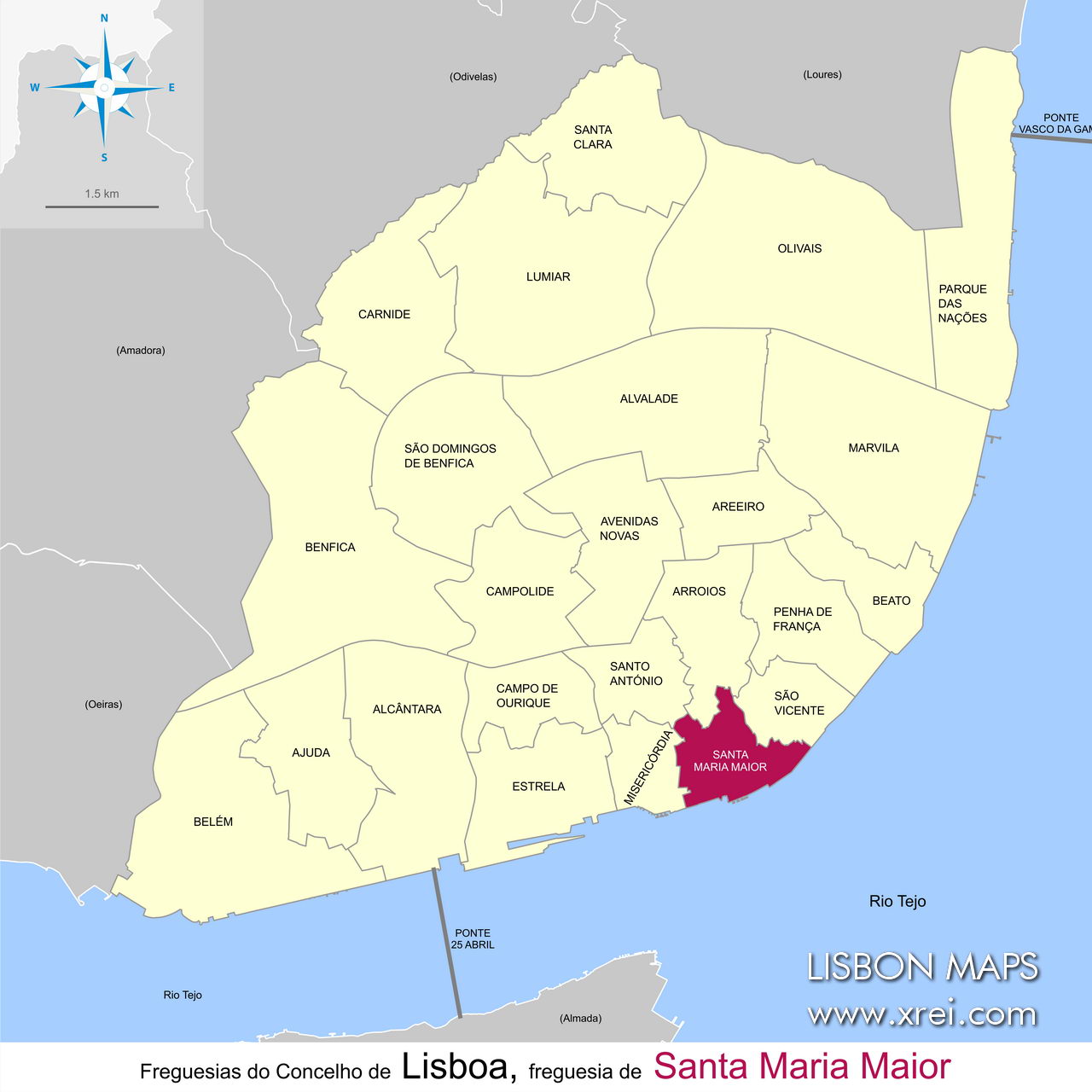
Die zivile Pfarrverwaltung für Alfama ist die Junta de Freguesia de Santa Maria Maior.
Bildungseinrichtungen in Alfama
- Escola Superior de Educação Almeida Garrett;
- Instituto Universitário de Ciências Psicológicas, Sociais e da Vida.
Touristische Unterkünfte in Alfama
- Alfama Patio
- Hotel Convento do Salvador
- Memmo Alfama
- Palacete Chafariz d'el Rei
- Santiago de Alfama: Boutique Hotel
Märkte, Festivals und Wallfahrten
- Feira da Ladra: findet wöchentlich dienstags und samstags vormittags in der Nähe des Panteão Nacional statt;
- Santos Populares de Lisboa: findet jährlich im Juni statt, mit dem Höhepunkt am 12.;
- CaixaAlfama: findet jährlich im September statt.
Transport und Zugang in Alfama
Alfama wird von folgenden öffentlichen Verkehrsmitteln bedient:
- Lissabonner U-Bahn: Bahnhof Santa Apolónia (Blaue Linie)
- Züge: Bahnhof Santa Apolónia
- Parkhäuser: Miradouro das Portas do Sol
Geschichte von Alfama

Alfama war eines der jüdischen Viertel Lissabons. Der Name Alfama leitet sich vom arabischen „Al-Hamma“ ab, was heiße Quellen oder Thermalbäder bedeutet. Bis ins frühe 20. Jahrhundert war Alfama für seine unterirdischen Wasserquellen mit heilenden Eigenschaften bekannt, die Temperaturen von 40 °C erreichten. Die Muslime teilten Alfama in zwei Zonen auf:
- Alfama do Alto, wo der Adel lebte; und
- Alfama do Mar, näher am Fluss, wo das einfache Volk lebte.
Alfama wurde zuerst von den Muslimen und anschließend von den Juden nach der christlichen Reconquista besiedelt. Vom Mittelalter an geriet Alfama in einen Niedergang, der bis zur zweiten Hälfte des 20. Jahrhunderts andauerte. Das Viertel wies bis in die 1990er Jahre hohe Kriminalitätsraten auf, als die Sanierung begann. Heute ist es eines der begehrtesten Viertel sowohl zum Leben als auch zum Besuchen, dank der Sicherheitsverbesserungen und Sanierungen, die im Laufe der Jahre durchgeführt wurden. Es ist immer noch möglich, die gleichen engen, gewundenen Straßen, durch die unzähligen Gassen und Pfade, über die Treppen, die seit der Gründung des Viertels existieren, zu gehen – die entweder zum Castelo de São Jorge und Graça führen oder hinunter zum Tejo und zur Baixa. Die bemerkenswertesten Straßen sind Rua dos Remédios, Rua de São Tomé und Rua de São Pedro. Die wichtigsten Plätze sind Campo das Cebolas, Largo de São Miguel und Largo do Chafariz de Dentro. Alfama ist einer der Orte in der Stadt – neben Mouraria und Bairro Alto –, an denen Fado zu hören ist: ein portugiesischer Musikstil, der als der Blues Portugals bezeichnet wurde. Alfama beherbergt auch die Kathedrale von Lissabon und einige der schönsten Aussichtspunkte der portugiesischen Hauptstadt: den Miradouro das Portas do Sol, den Miradouro de Santa Luzia und den Miradouro de Santo Estêvão.
Eine ausgezeichnete Alternative für den Besuch von Alfama ist die Straßenbahn 28, die durch das historische Lissabon fährt.
Städtebauliche Gestaltung von Alfama
Alfama entwickelte sich organisch nach den Bedürfnissen seiner Bevölkerung, ohne städtebaulichen Plan. Es ist ein labyrinthartiges Viertel mit gewundenen, engen Straßen, unzähligen Gassen und Treppen, die entweder in Richtung des Viertels Graça und des Castelo de São Jorge führen oder nach unten zum Tejo und zur Baixa de Lisboa. Die Haupt-Highlights von Alfama sind: Rua de São Tomé, Heimat des ältesten Verkehrsschilds Lissabons; Rua dos Remédios, die Geschäftsstraße des Viertels; Rua de São Pedro, bekannt als die Bohème-Straße von Alfama und Heimat der größten Konzentration von Fado-Lokalen; Campo das Cebolas, wo sich die Casa dos Bicos – Sitz der José Saramago Foundation (Nobelpreis für portugiesische Literatur) – befindet; Largo de São Miguel, Heimat der Igreja de São Miguel, der wichtigsten Kirche des Viertels, und zukünftiger Standort des Museu Judaico de Lisboa; und Largo do Chafariz de Dentro – das Tor zu Alfama – mit Zugang zur Rua dos Remédios und Rua de São Pedro, wo sich das Museu do Fado befindet.
Kuriositäten über Alfama
- Im Jahr 2002 wurde ein Projekt zur Sanierung aller natürlichen Quellen von Alfama vorgeschlagen, aber nie umgesetzt;
- Es gibt eine Ortschaft in Israel namens al-Alhaman, die für ihre Thermalquellen bekannt ist;
- In Alfama, in der Rua de São Tomé, steht das älteste Verkehrsschild Portugals aus dem Jahr 1686;
- Alfama hatte im 19. Jahrhundert vier Thermalbäder: Alcaçarias do Duque, Alcaçarias de Dona Clara, Alcaçarias do Baptista und Banhos do Doutor;
- Königin Dona Maria I. war eine regelmäßige Besucherin der Thermalbäder von Alfama;
- Alfama beherbergt einen der größten Freiluftmärkte Lissabons: die Feira da Ladra;
- In Alfama verkaufen Straßenhändler Ginjinha vor Privathäusern.
Schnelle Fakten über Alfama
- Alfama hat ungefähr zehntausend Einwohner;
- Hauptwirtschaftszweige: Tourismus, Restaurants und Fischerei.
Lage der Pfarrei Santa Maria Maior (Alfama) auf der Karte von Lissabon